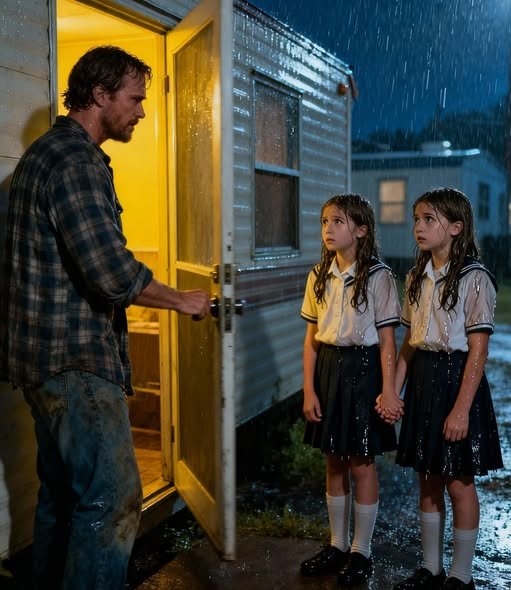
The rain in Portland didn’t just fall; it punished. Daniel felt each drop as he walked, his son Ethan’s small hand clasped tightly in his own. The diner apron beneath his coat was a damp reminder of the life he could barely afford, a life of rent weeks and silent worries. The world was reduced to the drumming on his umbrella and the chill in his bones—until he saw them. Two small figures, silhouetted by a dying streetlight, were fused together under the deluge. They weren’t just wet; they were marinated in fear, their postures screaming a silent plea that, for once, someone would hear.
Ethan’s whisper, “Dad, they seem scared,” was all it took. Daniel’s own life had taught him to be cautious, to protect the little he had. But the sight of the girls broke through the fortress of his practicality. He knelt, his own worn knees sinking into the cold pavement, and spoke to them not as a stranger, but as a father. Their story tumbled out in shivers: a broken-down car, a father who left for help and vanished, and door after door that remained shut. Daniel looked at his own small, struggling world and then back at them. “Come on,” he said, his voice a sudden anchor in their storm. “We invite you to stay with us tonight.”
His apartment was a sanctuary of shabbiness, but it was dry. The ancient space heater coughed to life, and towels became robes for shivering princesses. Ethan, with the solemnity of a royal steward, used the last of the cocoa powder. In that cramped living room, with toy cars scattered on the floor, a different kind of economy took hold—one measured in shared warmth and gentle voices. The girls, Claire and Lily, finally slept, wrapped in blankets on the couch, their nightmares held at bay by the simple, solid presence of a man who asked for nothing.
The morning brought the smell of burning eggs and the sound of giggles. The chaos of a failed breakfast was a beautiful, normal mess. But reality, in the form of a billionaire’s name, soon arrived. Richard Bennett. The name was a skyscraper, a headline, a world away. The subsequent police lights and the frantic father at his door were a whirlwind from which Daniel emerged with quiet dignity. He didn’t defend himself; he simply stated the truth. He had opened a door. That was all.
What grew from that night was not a transaction, but a transformation. Richard Bennett, a man who commanded boardrooms, learned to listen in a diner booth. He saw his daughters not as heirs to a fortune, but as children who needed his time. Daniel, who had refused a check, accepted a friendship. And from that unlikely bond grew The Open Door Initiative, a testament to the idea that the richest sanctuary isn’t made of marble, but of the courage to offer shelter, no matter how humble, to a soul in the storm. The real fortune, they discovered, was in the offering itself.