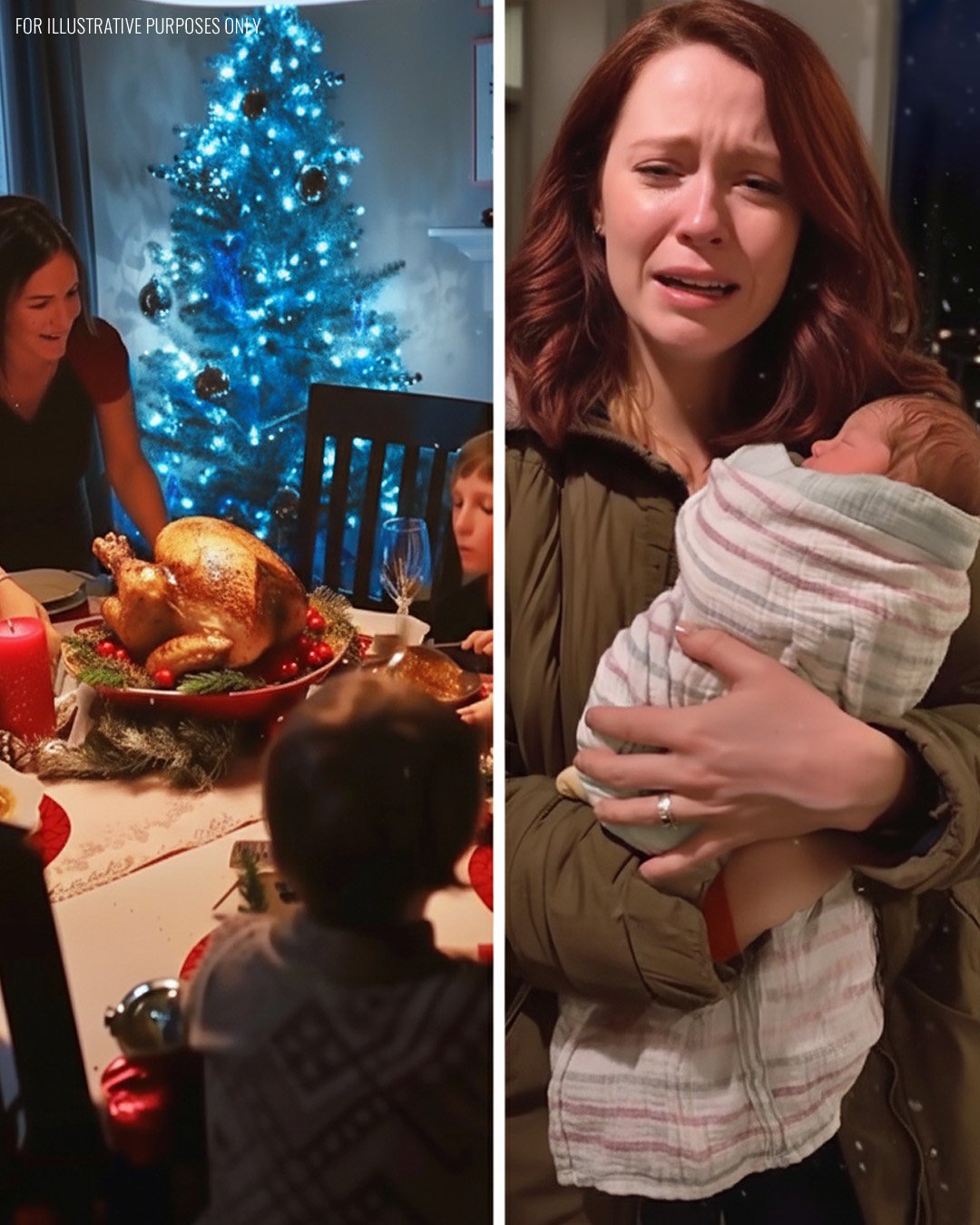
The perfect Christmas is a beautiful illusion. Jacob’s family had learned that the hard way twelve years prior when his brother vanished. This year, they embraced a simpler, quieter truth: contentment. The missing brother’s chair was gone, the candle unlit. They were simply a family of three sharing a meal. The knocking that interrupted them was so violent it seemed to reject their hard-won peace. On the other side of the door was a truth too big for the cold: a young mother, Crystal, and her infant son, Sam, searching for the man who had left them both—Jacob’s brother, Noah. In an instant, Christmas became a courtroom, and a baby the evidence in a case no one knew was still open.
Laura’s world tilted. The ghost of her brother-in-law had always been a source of tension, a shadow over her marriage. Now, that ghost had a child. Her reaction was a fortress of defense—accusations flew, old insecurities about Jacob’s loyalty resurfaced. She saw not a baby in need, but a grenade rolled into the center of her living room. She demanded Jacob remove it, to protect the life they had built from the chaos that seemed to follow his bloodline. For a moment, it seemed the family would fracture along the fault line of this old pain.
Jacob, however, was transfixed by the living link to his lost brother. This was no longer a mystery of where Noah went, but a question of who he had been. The baby was a person, a nephew, a legacy of choices that were not his own. When Laura asked him to leave with Crystal and the child, Jacob did so not to obey an order, but to follow a duty he hadn’t known he had. He sought out Crystal’s story and found not a schemer, but a shattered young woman who believed surrendering her son was her last act of love, her only chance to give him a better story than her own.
In a cold duplex, holding the sleeping Sam, Jacob saw the cycle clearly: abandonment begets abandonment. He had a chance to stop it. He returned to his own home not to disrupt it further, but to offer it a purpose larger than its own peace. Standing on the porch with his nephew, he presented Laura with a raw, real choice. They could cling to the safe family unit of three, or they could become a different kind of family—one brave enough to mend a broken circle by welcoming the piece that had been cast out.
Laura’s decision to open the door and say “Please stay” was the true Christmas miracle. It was the moment a family chose expansion over contraction, compassion over comfort. It acknowledged that healing isn’t about erasing the past, but about integrating its most vulnerable lessons into a stronger, more generous future. The baby on the porch didn’t just expose a secret; he offered them a chance to build a new one, together.