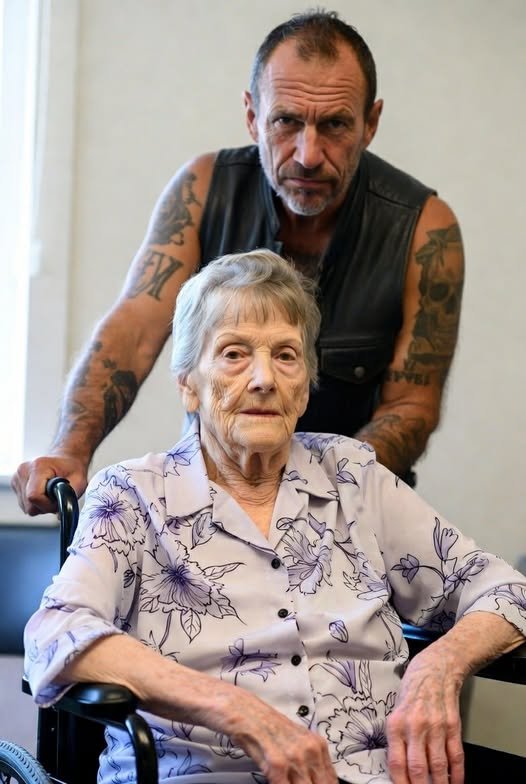
We often hear that angels walk among us, but we rarely imagine them wearing leather vests. For 87-year-old Dorothy, that is exactly what her angel looked like. Her name was Dorothy Mitchell, and her story is a powerful reminder that judgment based on appearance can blind us to the most profound acts of human kindness. When she let her home care nurse go and entrusted her well-being to a biker named Michael, her relatives were outraged. They saw a threatening stranger, but I, her neighbor across the hall, witnessed a miracle of companionship.
Life had been a slow and lonely journey for Dorothy, whose days were shaped by Parkinson’s disease and the lingering grief of losing her husband. The spark of life had faded from her eyes until a chance encounter reignited it. Michael, a man whose stature and tattoos could be intimidating, proved to be the most gentle soul. He didn’t just help her up the stairs when the elevator broke; he helped her rediscover a world she had lost. He returned not out of obligation, but out of a growing love that saw her as family.
Their daily routine became a testament to this beautiful, unconventional bond. I would see Michael, this formidable figure, carefully preparing Dorothy’s meals or sitting with her for hours, simply listening. He pushed her wheelchair around the neighborhood, and locals would watch in awe as this giant tenderly attended to the petite woman who beamed up at him. She was no longer just an old woman with an illness; she was someone’s cherished grandmother, someone’s center of attention, and her joy was palpable.
This newfound happiness was threatened when Dorothy’s children intervened, launching a legal challenge against Michael. They saw exploitation where there was only devotion. In court, Dorothy found a fierce and eloquent voice. She confronted her children, demanding to know where they had been during her loneliest hours while the man they called a predator had been faithfully by her side. The judge saw the truth in her unwavering defense and in the documented improvement of her health, ruling in favor of her right to define her own family.
The ruling allowed their unique family to flourish. Even as Dorothy’s body grew weaker, Michael’s care never did. He was her constant, and he extended his circle to include his biker friends, who became her honorary grandsons, filling her home with laughter and protection. Dorothy’s final chapter was not one of loneliness but of being deeply and truly loved. She told me that Michael gave her back her life, and in doing so, he taught us all a vital lesson: to never judge the person God sends, especially when they arrive on a motorcycle.