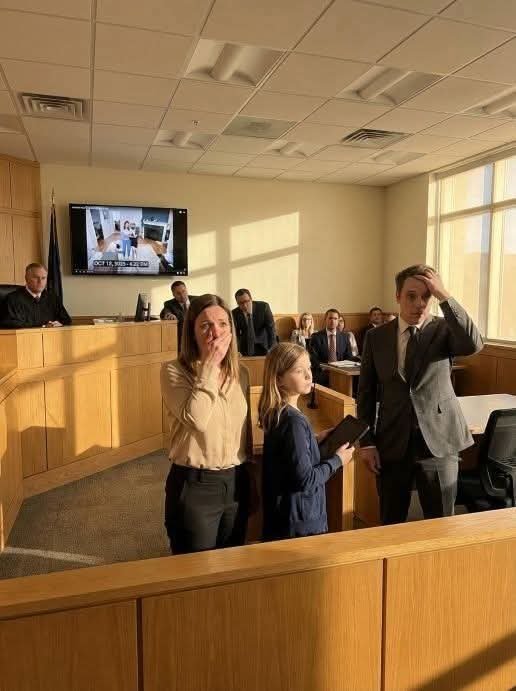
The final divorce hearing felt like a formality, the last box to check in a process that had drained me. Caleb, my soon-to-be-ex, had skillfully framed our separation as a necessity due to my emotional nature, positioning himself as the stable, logical choice for our daughter Harper’s future. I listened, numb, as my motherhood was put on trial. Harper, a miniature of composure in her best dress, sat quietly beside me. Just when I thought the legal machinery would grind to its inevitable conclusion, she raised her hand. With a solemnity that belied her years, she addressed the judge and requested to present new evidence—evidence even I, her mother, had not seen.
The evidence was a video, shaky and dark, time-stamped in the lonely middle of the night. It captured a side of Caleb I had glimpsed in arguments with me, but never imagined he would turn on our child. There he was, in our own kitchen, his voice a weapon of frustration as he chastised Harper for crying. He loaded his own stress onto her small shoulders and ended with a threat designed to isolate her: keeping it from me. The sound of shattering glass at the end was a period on a sentence of fear. In the courtroom, you could feel the collective intake of breath, the sudden recalibration of every assumption in the room.
The judge, a seasoned arbiter of conflict, was visibly moved. He first sought my confirmation that I was unaware, and my shattered expression was answer enough. Then he looked to Caleb, whose confident facade had completely evaporated. No legal argument could explain away the raw, digital proof of a child’s intimidation. The case that had been built over months disintegrated in two minutes. The law requires the “best interests of the child,” and Harper had just defined those interests in the most vivid, undeniable terms possible. The truth, it turned out, had been in her pocket all along.
The official judgment followed, prioritizing Harper’s emotional safety and granting me primary custody. But the true resolution happened the moment the video ended. As we exited the cavernous building into the daylight, Harper’s brave composure finally cracked. She whispered that she was sorry for not coming to me. I stopped and crouched down, holding her by her shoulders. I told her that her instinct to preserve the truth—afraid her own mind might try to soften it—was not just smart, it was heroic. She had protected herself when she felt no one else could, and that was a strength I would always honor.
This journey through the legal system ended with a lesson no lawyer could have taught. It showed me that a child’s perception is not just a feeling; it can be the most critical evidence of all. Harper’s quiet defiance in that courtroom underscored that safety is the non-negotiable foundation of love. She didn’t need a perfect family; she needed a safe haven. By finding the courage to play that video, she didn’t just change a custody agreement. She reclaimed her own story and taught everyone present that the most powerful voice is sometimes the one we have not yet learned to hear.