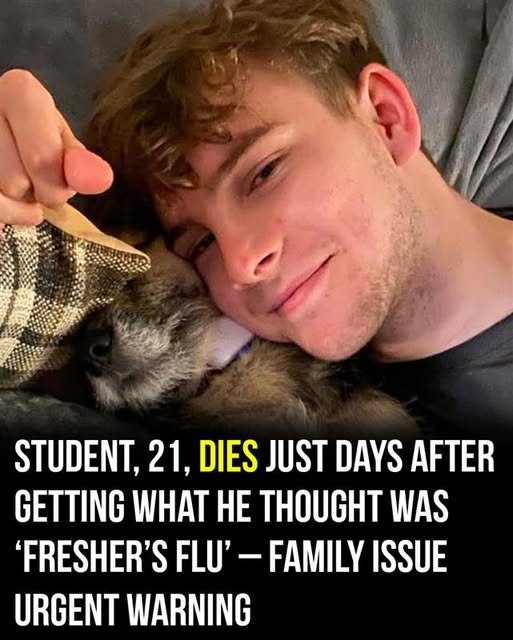
The Martin family’s world was turned upside down in the span of a few days. Their 21-year-old son, Lucas, a recent university graduate, came home feeling unwell. He had a pounding headache, a fever, and was unusually tired. Like many families would, they assumed it was a simple case of “fresher’s flu,” a mild virus that countless students experience. There was no reason to suspect anything more serious, as Lucas showed none of the classic signs often associated with meningitis. It seemed like just a bad bug that needed time to run its course.
This assumption proved to be fatal. Lucas’s health declined at a pace that was both terrifying and incomprehensible. The initial fatigue and fever soon gave way to significant confusion. The crisis point came when his father found him struggling to speak, a symptom that finally revealed the grave reality of the situation. The family rushed him to the hospital on September 10th, where doctors immediately placed him in an induced coma. Despite this intervention, Lucas lost his fight for life on September 12th. A future filled with promise was extinguished by a disease that had flown under the radar.
His brother, Connor, now speaks out to honor Lucas’s memory and to prevent other families from suffering a similar nightmare. He describes Lucas as an ambitious and kind-hearted young man whose life was “taken too soon.” The family’s painful reflection led them to a crucial realization: awareness and immediate action are the only defenses against such a swift-acting illness. Meningitis does not always present with a textbook rash; sometimes, its only warnings are a severe headache, fever, and mental confusion.
Driven by their loss, Lucas’s loved ones founded Looky’s Aid. The charity aims to support young people through education and to spread lifesaving information about the signs of meningitis. Lucas’s story is a powerful and tragic reminder that common symptoms can sometimes hide an uncommon danger. His legacy is one of love and vigilance, urging everyone not to dismiss a severe illness as “just the flu,” but to listen to their instincts and seek help when something feels wrong.