There is a special kind of loneliness that follows the loss of a parent, a hollow space that nothing seems to fill. For me, my mother’s scarves were a tactile comfort in that emptiness. When my father remarried, I tried to welcome Valerie, but it soon became clear that she saw my memories as a threat. She never said a harsh word directly, but her actions spoke volumes. Photos of my mom were relegated to my room, her favorite coffee mug disappeared, and the home she had created slowly transformed into a place that felt unfamiliar and cold. I learned to keep my grief and my memories to myself, a secret garden I tended alone.
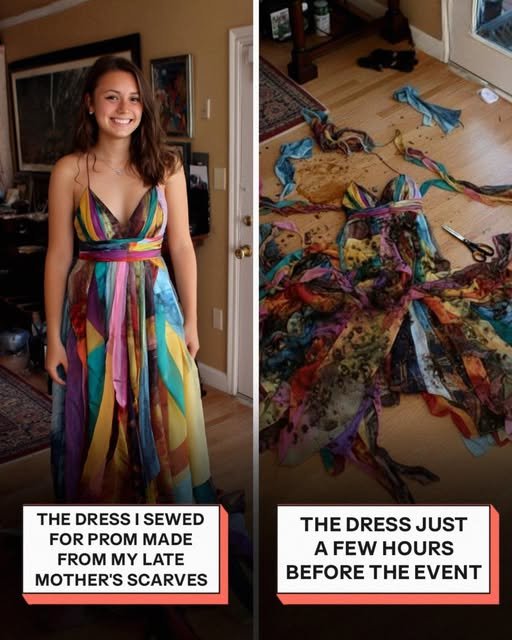
The prom dress was the most important thing I had ever made. It was my way of bringing my mother into a celebration she would never physically see. I spent countless hours sewing, the rustle of the fabric and the hum of the sewing machine a soothing ritual. I incorporated a green scarf from a picnic, a purple one from a birthday, and a delicate lace one she cherished. The finished dress was a mosaic of our life together. It was my secret triumph, a beautiful rebellion against the slow fading of my mother’s memory in our own home. I felt proud and protected, as if I had woven a piece of her soul into the very fabric I would wear.
On prom day, that feeling of safety was violently ripped away. I found the dress destroyed in my closet, a pile of colorful scraps. Valerie was there, watching me with an unnerving calm. She told me she had done me a favor, sparing me the shame of looking poor and pathetic. Her words were like ice, but the destruction of the dress was a fire that burned away any pretense of civility between us. It was an act of war on my most cherished possession, a deliberate attempt to sever my final, creative link to my mother.
But karma often works with perfect timing. My father witnessed the aftermath. He saw the shredded dress and the raw pain on my face, and for the first time, he could not ignore the truth about the woman he had married. The confrontation was the end of everything—the end of his denial, the end of Valerie’s place in our home, and the end of the silent suffering I had endured. She was gone by nightfall, her cruelty having finally exposed her true nature. The home felt lighter the moment she left, as if a heavy, cold fog had lifted.
I refused to let her destruction be the end of the story. With help, I repaired the dress, the new stitches standing as a testament to resilience. Wearing it to prom was an act of victory. Later, my father looked at me and saw my mother, and in that moment, I knew we were going to be okay. Valerie’s jealousy and cruelty had not broken me; they had broken her own standing. The dress, and the love it represented, proved to be unbreakable. The universe has a way of balancing the scales, and in this case, it did so with swift and decisive justice.