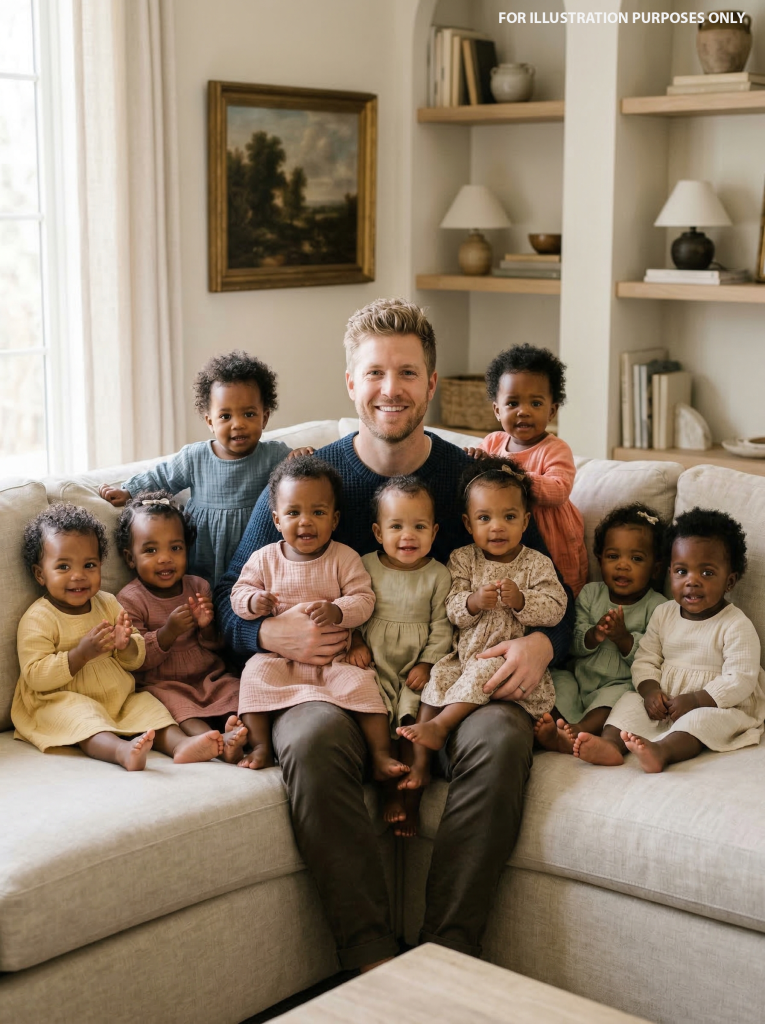
In 1979, Richard Miller lived in a kind of silence that did not come from the absence of sound, but from the absence of meaning. Two years had passed since Anne was gone, yet the house they had once imagined filling with children remained unchanged, as if time itself had refused to move forward. Every room carried her memory, and every quiet moment seemed to echo with what should have been there but never came to be.
People around him spoke in the language of recovery. They suggested he remarry, rebuild, begin again as if life could be reset like a broken clock. But Richard did not want a new beginning. He wanted to honor something that had never truly ended—a promise whispered in a hospital room, fragile yet unwavering, when Anne had asked him not to let love disappear with her, but to give it somewhere else to live.
That promise followed him on a rain-soaked evening when his truck stalled near the edge of the city. He had no intention of going anywhere unfamiliar, yet necessity led him to St. Mary’s Orphanage, a place that seemed forgotten even by those who passed it every day. He stepped inside only to find a phone, but something else found him first.
The building carried the faint smell of disinfectant layered over years of wear, and as he waited, a sound reached him from down the hallway—uneven, fragile crying that did not blend together but rose in scattered, desperate notes. Without realizing it, he followed it until he reached a small room lined with cribs placed too closely together.
Inside were nine baby girls.
They were impossibly small, their dark skin contrasting softly against pale blankets, their tiny hands reaching outward as if searching for something they had already lost. They did not cry in unison; instead, each voice broke through at different moments, creating something that felt less like noise and more like a quiet plea that had nowhere to land.
A nurse approached him gently, explaining that they had been left together during the night, wrapped in the same blanket, without names, without explanation, without anyone waiting for them.
“No one wants all of them,” she said softly. “Families ask about one… maybe two. They’ll have to be separated.”
The word settled heavily in his chest.
Separated.
It was not just a logistical reality; it was a fracture waiting to happen, a future already decided for them. In that moment, Richard did not think about practicality, or cost, or how impossible it sounded. He thought about Anne, about her belief that family was something chosen, not assigned, and about the promise he had carried without knowing where it would lead.
When he stepped closer, one of the babies fixed her gaze on him with a quiet intensity that felt almost knowing. Another reached for his sleeve, her tiny fingers curling instinctively. A third smiled in that unformed, unconscious way that belongs only to the very young.
Something inside him shifted—not suddenly, but completely.
“I’ll take them,” he said, his voice softer than he expected, yet firm enough that the room seemed to hold its breath.
What followed was not simple. The process was long, filled with warnings and resistance. Social workers questioned his capacity, relatives doubted his judgment, and strangers did not hesitate to voice their opinions about a white man choosing to raise nine Black girls alone. Some called it impossible. Others called it irresponsible. A few called it something worse.
Richard listened to none of it.
He sold what he had—his truck, his tools, even pieces of the life he had once built with Anne. He worked wherever he could, taking on extra shifts at the factory, fixing roofs on weekends, washing dishes late into the night. He learned things no one had ever taught him, from braiding hair with clumsy patience to recognizing the subtle differences in nine separate cries. He built cribs with his own hands, boiled bottles on a stove that rarely cooled, and lay awake counting breaths in the dark when fear whispered that he might not be enough.
The world did not make it easy.
There were stares in grocery stores, whispers at school gates, moments when judgment took on a sharper edge. Once, a man told him outright that he would regret everything.
He never did.

Instead, his life filled with moments that could not be measured by hardship. The first time all nine girls laughed together, the sound was so pure it seemed to push back against every doubt. They crawled through the house like a living chain, their small hands reaching for one another, turning even the narrow hallway into something alive. On stormy nights, when the power failed and darkness settled in, he held them close, feeling the quiet weight of nine sleeping bodies as something steadier than any certainty he had ever known.
Over time, they became known beyond their home as the Miller Nine, a story people repeated with curiosity or disbelief. But to Richard, they were never a spectacle. They were simply his daughters, each one carrying her own personality, her own presence, her own way of filling the space Anne had once feared would remain empty.
As they grew, so did the complexity of their lives. School brought new challenges, new forms of scrutiny, and questions that could not always be answered easily. Richard did not try to shield them from everything. Instead, he showed up—again and again—with lunches prepared, hair carefully braided, shoes purchased through sacrifice they never fully saw. There were nights when he went without so they would not have to feel the cost of what he was building.
And slowly, quietly, they flourished.
They became themselves in ways no one had predicted—loud and gentle, thoughtful and bold, each carrying something unique while still remaining deeply connected to one another. The world that had once doubted them began to shift, not because it had changed entirely, but because they had grown strong enough to move through it on their own terms.
Eventually, they began to leave.
One by one, the house that had once overflowed with movement and noise grew quieter. College, careers, relationships—each departure carried both pride and a familiar ache. When the last daughter stepped out into her own life, Richard found himself sitting alone once more, holding a photograph of nine small girls lined up together, their faces bright with a future that had once seemed uncertain.
“I kept my promise,” he said softly into the stillness.
But time, as it always does, continued forward.
Years later, in 2025, the house was no longer quiet in the same way. Though his body had grown fragile, and his movements slower, Richard sat surrounded by nine women whose lives had expanded far beyond anything he had imagined that night in the orphanage. They stood close to him, their presence warm and undeniable, their hands resting on his shoulders as if grounding him in the very thing he had spent his life building.
There were cameras, attention, stories being told about what he had done.
But none of that held his focus.
One of his daughters leaned closer, her voice steady but filled with emotion.
“Dad, you kept us together.”
Richard smiled, and this time he did not hold back the tears.
“No,” he replied quietly. “We did. Love did.”
And in that moment, the promise he had carried for so many years was no longer something he had to remember.
It had become something he could finally see.