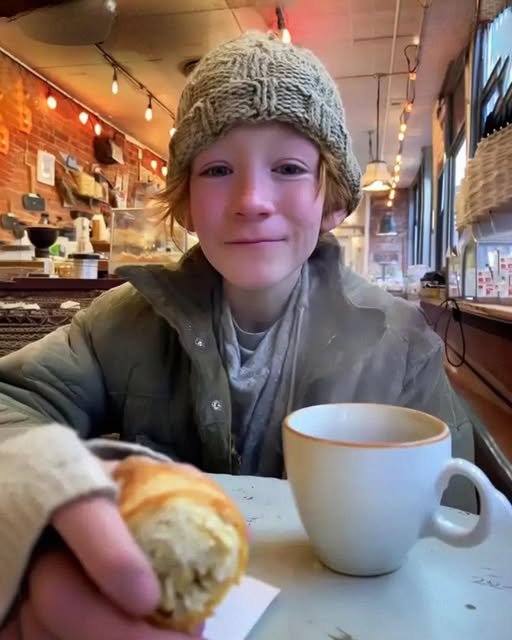
The bell on my bakery door jingled long after the last customer had left. I looked up and saw a boy, no more than twelve, standing in a pool of melted snow. His jacket was too thin, and his shoes were soaked. “Miss,” he said, his voice barely a whisper, “do you have any old bread?” I didn’t see a beggar; I saw a child who was scared and hungry. I told him to come sit by the heater and pushed a cup of hot chocolate across the counter. When I said he could have anything from the display case, he looked at me as if I’d spoken a language he’d forgotten. He pointed to an apple turnover with a trembling finger.
He came back the next night, clutching the paper bag I’d given him. “Please don’t call anyone,” he pleaded. And that’s how I learned about Marco and his mother, Miranda. She was sick, and he was her sole provider, a secret they kept from the world for fear it would tear them apart. So, I became their secret, too. Every evening, after I’d flipped the sign to ‘Closed,’ I’d pack a bag with the day’s best rolls, a container of soup, or a slice of quiche. We didn’t talk much, but a deep understanding passed between us in those quiet moments.
Then one evening, Marco didn’t come alone. He brought his mother, a woman whose body was frail but whose eyes held a fierce love for her son. She took my hand and said, “If I don’t make it, will you watch over him?” I promised I would. That promise led to Marco staying with me when Miranda was hospitalized, and it saw us through the long, uncertain months of her recovery. The day she walked out of the hospital, holding onto Marco’s arm, was the day I understood that family isn’t always born—it’s sometimes built, one act of kindness at a time. The bakery is still my business, but Marco and Miranda, they are my heart.