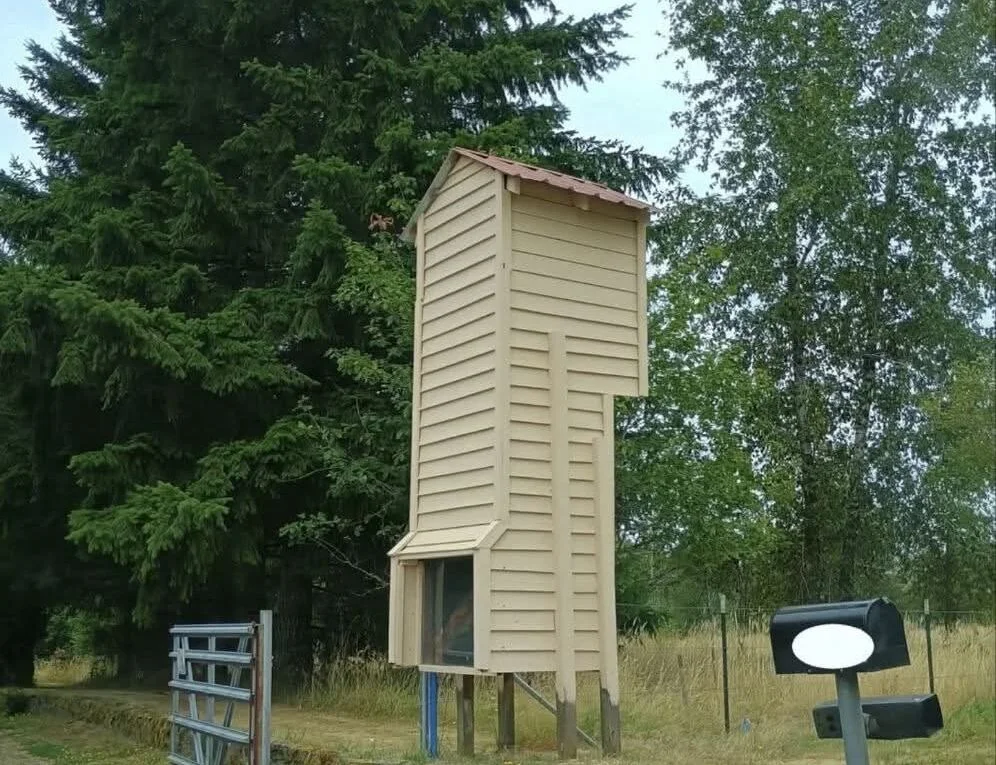
There’s a strange and wonderful sight to see on a certain Oregon backroad: a skinny, house-like tower standing guard beside a driveway. With its domestic siding and roof, it looks almost like a tiny, abandoned cottage mounted on a pole. It captures the attention of every passerby, prompting questions and slow drive-bys. For the homeowner, however, it’s not a mystery but a masterpiece of practical engineering—a custom-built optical device that brings safety to a hazardous spot.
The challenge was visibility. From the end of their driveway, the view of the road was completely obstructed, making a simple departure a risky maneuver. Commercial options felt inadequate or overly complex. So, the resident became an inventor. The solution was inspired by one of the most straightforward optical tools in existence. By constructing a tall wooden shaft and installing two ordinary mirrors inside, angled toward each other, they created a functional periscope that elevates the driver’s line of sight above the obstacles.

This homespun invention requires no instruction manual. Its operation is instinctive: look into the viewing window and see what’s coming. It’s a tactile, analog solution in a digital world, and it works flawlessly in rain or shine. The periscope empowers the driver with information, transforming a moment of vulnerability into one of control. It’s a powerful demonstration of how a little creativity can dramatically improve everyday safety.
Pictures of the tower have spread across social media, where its unique appearance sparks delight and detective work. Yet, the fascination ultimately settles on its purpose. In an era where we are encouraged to buy solutions, this story is about building one. The tower’s handmade nature is key to its appeal; it feels personal and thoughtful, a direct expression of one person’s need and capability.
More than a traffic aid, this Oregon periscope is a symbol. It symbolizes the enduring power of hands-on problem-solving and the beauty of functional design. It asks us to look closer at the world around us and consider what we might build to make it better. In its reflective glass, we don’t just see cars; we see a reflection of human cleverness at its most pure and effective.