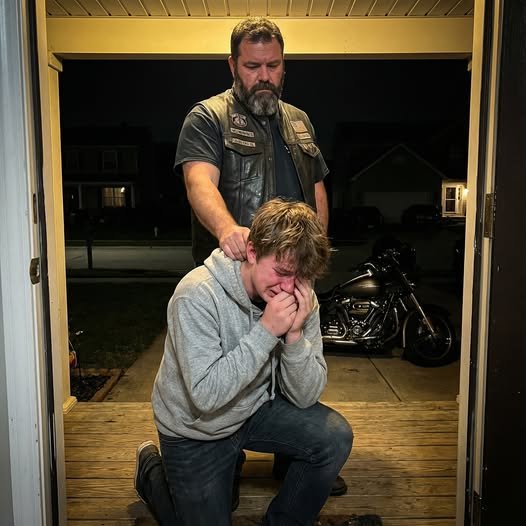
For Marcus, school was a prison built by one boy: Tyler. The bullying was a sophisticated torture, blending physical intimidation with a devastating online campaign. Marcus’s spirit was crumbling in silence until a late-night knock changed everything. The man at the door wasn’t a principal or a counselor; it was Tyler’s father, Dean, a biker whose demeanor spoke of a life far removed from parent-teacher conferences. He had brought Tyler, not to defend him, but to surrender him to the consequences of his actions. In that moment, a journey of punishment was reframed as a journey of redemption.
Dean forced a full, unvarnished confession in Marcus’s living room. As Tyler sobbed out the details of his cruelty, the scope of the damage became horrifyingly clear. The psychological warfare had pushed Marcus to dark thoughts. Dean listened, and then he leveled the playing field in the most humbling way possible. He got down on his knees, not to beg for leniency, but to accept his portion of the blame. “I taught him the wrong kind of strength,” he admitted, showing his son that real men own their mistakes—both the immediate and the foundational.
The amends were concrete and demanding. Dean designed a process that would rewrite Tyler’s understanding of responsibility. Weekend yard work served as both restitution and a lesson in diligence. Public apologies addressed the social harm. Therapy provided tools for emotional growth. Dean’s presence through it all was the constant—a firm, loving guide ensuring his son didn’t just serve time, but underwent a change of heart.
The magic happened in the mundane repetition of those Saturday mornings. As Tyler pushed a lawnmower and painted a fence, the performative shame faded into genuine effort. Marcus, from his window and then from the porch, watched the transformation. He began to offer a glass of water, then conversation. The dynamic shifted from victim and aggressor to two boys navigating an awkward, honest reconciliation. Marcus extended a conditional grace, not as weakness, but as immense strength.
The story’s epilogue reads like a hopeful novel. The boys became inseparable friends. The fathers, bridging a vast social gap, found brotherhood in their shared commitment to raising good men. The school assembly where Tyler praised Marcus as his best friend closed a painful circle with a message of hope. This tale reminds us that justice and mercy are not opposites. Sometimes, they meet on a front porch at night, guided by a father who knows that saving his son meant first making him see the wreckage he’d caused, and then handing him a shovel to help rebuild.