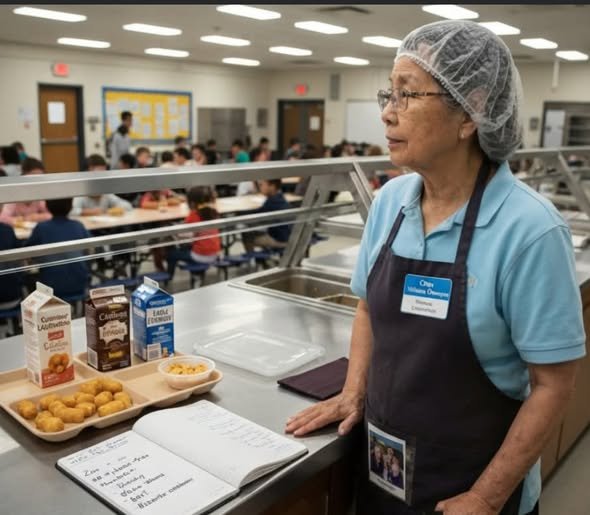
In the hierarchy of a school, the lunch lady is rarely at the top. But for the students who needed her most, Mrs. Chen was the most important adult in the building. Over two decades, she cultivated a deep, intuitive understanding of the children who passed through her line. She remembered names, but she also memorized patterns: who was always last, who avoided certain foods, who looked tired on Mondays, who brightened on pizza day. She saw the hidden curriculum of pain and need that plays out in social spaces, and she chose to engage with it personally, quietly, and effectively.
Her assistance was never condescending or obvious. It was coded into the everyday. A knowing nod, an intentionally heaping portion, a strategically placed carton of “new” milk. She fought battles against hunger, shame, and mental anguish with the tools she had: compassion and a serving spoon. For a child counting calories, she was a source of gentle misinformation that provided a moment of peace. For a child hiding their culture, she was an accomplice in a lunchbox disguise operation. She provided not just sustenance, but also sanctuary, in the middle of a crowded, often judgmental, cafeteria.
Mrs. Chen’s role was that of a silent sentinel. Earning a humble wage, she performed emotional labor of incalculable worth. She was the one constant who noticed when a child’s demeanor shifted, when a lunch habit changed, when a smile didn’t reach the eyes. She held this knowledge without exploiting it, using it only to extend kindness. In doing so, she became a critical piece of the school’s social-emotional infrastructure, a non-threatening adult who offered unconditional, low-stakes care.
Her absence, following a stroke, created a silent epidemic of unmet need. The new lunch employee performed the mechanical duties of the job, but the crucial layer of human observation was missing. The consequences were swift and severe, manifesting in a wave of emotional crises that overwhelmed the formal support staff. The school had lost its keystone, the person whose daily, subtle interventions had kept countless small problems from becoming big ones. The students felt it acutely: they were no longer being watched over.
The school’s decision to reinstate Mrs. Chen as a Wellness Observer was a rare institutional admission of a truth children already knew: her presence was therapeutic. Though her body was frailer, her capacity for connection was intact. Her story reached its apex at a graduation, where a former student declared that Mrs. Chen’s greatest gift was teaching them that to be seen is to be saved. This narrative forces a reevaluation of what we value in educational settings, arguing that the person who notices the bruised apples and the bruised hearts may be delivering the most important education of all.