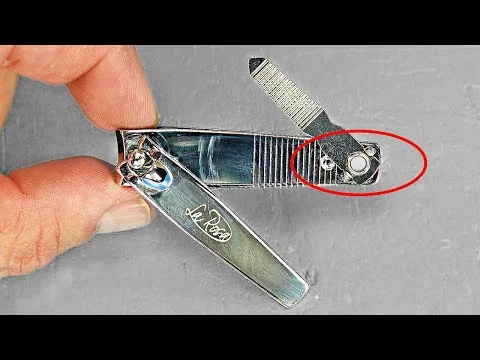
Open any manicure kit or junk drawer, and you’ll find the ubiquitous nail clipper. It’s a study in minimalism: a few pieces of steel assembled to perform one task perfectly. But if you examine the tool, you’ll discover a small, intriguing detail—a perfect little hole at the tip of the lever. For the majority of users, this hole’s purpose is a mystery, often mistaken for a vestigial part of the stamping process. The truth, however, reveals a layer of practical ingenuity baked into this everyday item.
That hole is far from decorative. It’s the functional core of a removable lever system. The design allows you to swing the lever around and detach it completely from the clipper’s body with minimal effort. This isn’t a secret meant for manufacturers alone; it’s a user-facing feature, a deliberate choice to make the tool modular. Recognizing this transforms your perception of the clipper from a sealed unit to an accessible, maintainable device.
The most immediate advantage of this design is unparalleled access for sanitation. Clippers operate by shearing off bits of keratin, and those bits have a tendency to stick and accumulate in the mechanism. Combined with the humid environment of a bathroom, this can create an unclean situation. By removing the lever, you can blast out debris with water, use a small brush, or soak the parts in disinfectant, ensuring the tool you use on your nails is genuinely clean.
Additionally, this feature serves as a simple troubleshooting step. If your clipper starts to feel loose, wobbly, or requires excessive force, the fix might be as easy as taking it apart and putting it back together. This action can reseat the components properly, correcting minor alignment issues. For people with different hand sizes or strength, occasionally flipping the lever can also offer a more comfortable or controllable cutting angle, showcasing the tool’s inherent flexibility.
It’s a beautiful paradox: in a tool defined by its simplicity lies a clever, hidden functionality. That small hole is a legacy of thoughtful industrial design, a nod to durability and user care that has persisted for over a hundred years. It reminds us that good design doesn’t need to shout; it can be a quiet, round hole waiting to be understood, offering both practicality and a small moment of discovery in the midst of our daily routines.