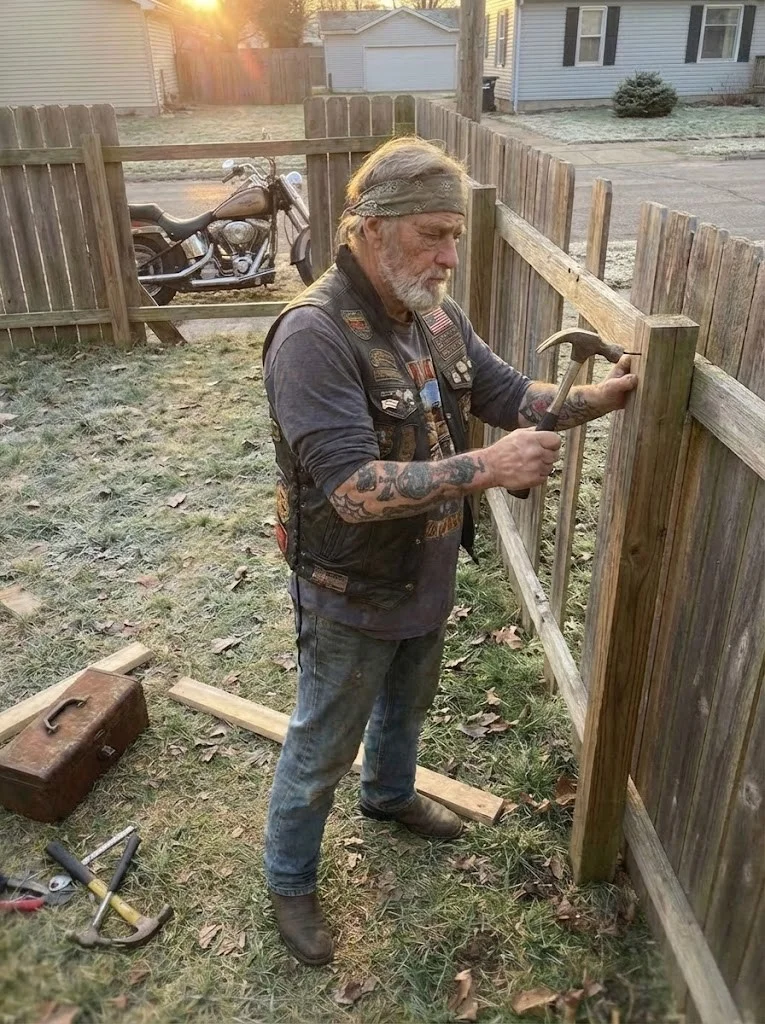
Single parenthood is a masterclass in juggling, and my most persistent, dropped ball was the sorry fence around my yard. It was a collection of splinters and sighs, a visual reminder of limits. So when a stranger on a motorcycle pulled up and started working on it, my reaction wasn’t gratitude—it was visceral fear. I saw a large man in a vest, wielding tools on my property without permission. From behind the safety of my front door, I called the police, convinced this was a prelude to something worse. I watched, heart pounding, as he measured, sawed, and hammered with an unsettling focus, building something new where I had only seen decay.
This scene repeated itself like a strange dream throughout the turning seasons. He’d appear, work in utter silence, and leave the fence a little stronger. Each time, I’d call the authorities, and each time, I’d receive the same gentle, baffling reassurance that he was not a threat. My fear, met with consistent calm from both the biker and the police, began to feel foolish. Yet, I couldn’t shake it. His silent charity was a paradox I couldn’t understand. In my world, nothing was free. His actions forced me to confront my own cynicism, the wall I’d built that was in even worse shape than the fence.
Clarity came on a morning sharp with cold. I finally walked out to him, my footsteps crunching on the frost. “Can you tell me what you’re doing?” I asked, my voice steadier than I felt. He put down his hammer and stood. His eyes were pale and clear. “I knew your dad,” he said simply. The words hung in the air. He explained that they’d been neighbors, two men who’d helped each other with projects just like this. Seeing the house and the familiar disrepair was a call he felt compelled to answer. It was a tribute, and for him, a peaceful way to spend his days.
In an instant, the stranger became a sacred link. The fear melted, replaced by a surge of emotion so strong it buckled my knees. This wasn’t random kindness; it was a message from the past, delivered by a man with grease under his nails. I stopped being afraid and started being thankful. Our interactions became silent exchanges of coffee and a nod. My children, who had witnessed the whole strange saga, now saw him as a quiet hero. The fence he built was impeccably strong, but its greater purpose was to enclose a new feeling of safety and belonging for my little family.
That fence is now my favorite thing about the property. It stands against the weather, a daily, tactile reminder that goodness is persistent and often wears a disguise. The biker asked for no thanks, but he gave me an invaluable gift: the proof that we are woven into a web of quiet care, often by people we’ve never met, for reasons we might never know. He didn’t just fix a fence; he repaired my belief in unexpected grace, one solid board at a time.