The Pink Dress
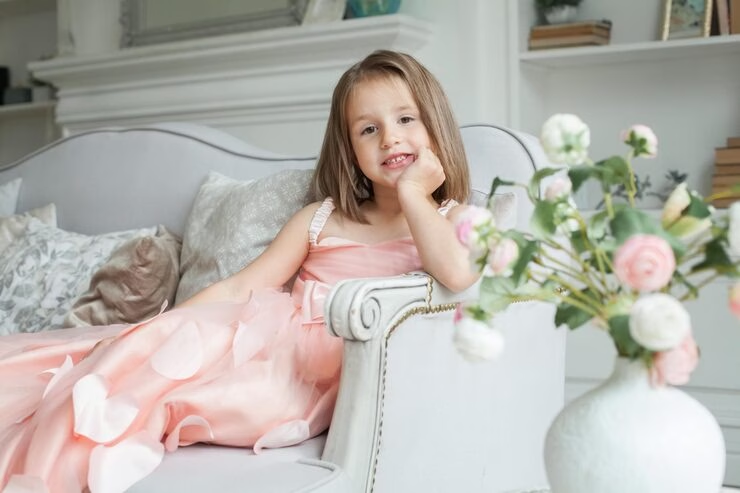
For my daughter’s 8th birthday, my parents sent her a pink dress as a gift. She seemed happy at first, but then froze. “What is this, mommy?” I looked closer and my hands started shaking. I didn’t cry. I acted. The next morning, my parents were calling non-stop… The steady sound of a neighbor’s lawnmower filled the air, but inside my kitchen, everything felt still. The package arrived on an ordinary Thursday, bearing my mother’s unmistakable, elegant, yet carefully deliberate cursive. My eight-year-old, Maya, was full of excitement as she opened the tissue paper, revealing a blush pink dress that seemed to glow in the afternoon light. “Wow,” David remarked from his laptop. “That looks expensive. Quite an effort for a late birthday gift.” I was about to offer a motherly smile when Maya froze. Her twirl didn’t slow; she simply stopped. “Mommy? What is this?”
I crossed the room, the linoleum cool beneath my bare feet. Maya turned the dress, pointing to the bodice. Stitched in neat, white cursive thread, right above the heart, were two words that immediately caught my attention: “Little Emily.” My hands began to shake before my thoughts could fully catch up. A quiet ringing filled my ears. “Is it a mistake?” Maya asked, her voice small and uncertain. “Who is Emily, Mommy?” I didn’t answer. I couldn’t. We don’t talk about Emily in this house, I thought, but the words stayed held inside. Not because we can’t, but because we understand what her name brings with it. “I don’t mind,” Maya said, trying to stay positive. “It’s still pretty. I can wear it even if the name is wrong.” “No,” I said. My voice was firm, like a door closing. “You are not putting that on.” “But Mom—” “You are not wearing it, Maya.” I took the dress from Maya’s hands, noticing her hurt expression. I walked to my bedroom and closed the door. As I sat on the edge of the bed, holding that pink fabric tightly, I realized this wasn’t just a dress. It was a message. Something I had spent twenty years trying to leave behind had finally returned.
Let me tell you who Emily was—and what I did the next morning when my parents started calling.
My name is Sarah Mitchell. I’m thirty-eight years old, a mother, a wife, and the surviving daughter of parents who never recovered from losing my twin sister.
Emily died when we were eight. Twenty years ago. The same age Maya is now.
My parents sent Maya a dress with Emily’s name embroidered on it. On purpose. As a message.
I didn’t cry. I didn’t call them immediately. I waited until the next morning.
And when they started calling non-stop, I answered. Once. And told them exactly what would happen next.
Let me back up. To Emily. To the twin sister I lost when we were eight years old.
We were identical. Same face. Same voice. Same everything. Except personality.
Emily was outgoing. Confident. The star of every room. The daughter my parents adored openly.
I was quieter. Thoughtful. The daughter they loved but didn’t quite understand.
We were a unit. Emily and Sarah. Always together. Always compared.
Then came the accident. A car running a red light. Emily and I were crossing the street after school.
She was hit. I wasn’t. Pure chance. Pure timing. Pure devastation.
Emily died instantly. I survived without a scratch.
And my parents never forgave me for it. Not explicitly. Not openly. But in a thousand small ways over the next ten years.
They kept Emily’s room exactly as she’d left it. Shrine-like. Untouchable.
They talked about her constantly. “Emily would have loved this.” “Emily would have done it differently.” “Emily was so talented.”
Every achievement I had was measured against what Emily might have done. Every milestone shadowed by her absence.
I graduated high school with honors. “Emily would have been valedictorian.”
I got into a good college. “Emily had such potential. She would have gone Ivy League.”
I got engaged. “Emily would have had such a beautiful wedding.”
By the time I was eighteen, I understood: I would never be enough. Because I wasn’t Emily.
I moved away for college. Put distance between us. Built a life separate from their grief.
Met David. Got married. Had Maya. Created a family that didn’t revolve around a ghost.
My parents attended the wedding. Met their granddaughter. But always with that distance. That disappointment.
Maya wasn’t Emily. And I wasn’t the daughter they’d wanted to keep.
We maintained minimal contact. Holidays. Birthday cards. Occasional phone calls.
They sent gifts for Maya. Always pink. Always dresses. Always feminine. Like Emily had been.
I never commented. Just accepted the gifts. Let Maya wear them or not. Tried to keep peace.
Until this dress. With Emily’s name embroidered on it.
That wasn’t a mistake. That was deliberate. A message.
“Your daughter is named wrong. She should have been Emily.”
I sat on my bed holding that dress. Shaking. Angry. Devastated.
David found me. “Sarah, what’s wrong?”
I showed him the embroidery. “Little Emily.”
His face changed. “That’s… that can’t be intentional—”
“It’s intentional. My mother’s handwriting on the package. Custom embroidery. On my daughter’s birthday gift. It’s a message.”
“What message?”
“That Maya should have been named Emily. That I should have died instead of my sister. That they’ll never accept that I’m the one who survived.”
David was quiet. Then: “What do you want to do?”
“I want to cut them off. Completely. Permanently.”
“Are you sure?”
“They just sent my eight-year-old daughter—the same age Emily was when she died—a dress with my dead sister’s name on it. Yes, I’m sure.”
“Then I support you. Whatever you need.”
That night, I didn’t call them. Didn’t text. Didn’t acknowledge the gift.
Just took the dress. Put it in a box. Sealed it. Set it aside.
Maya asked about it once. “Mommy, can I wear the pink dress?”
“No, sweetie. It’s not the right dress for you.”
“Because of the name?”
“Because it wasn’t meant for you. It was meant for someone else.”
She accepted that. Eight-year-olds are resilient that way.
The next morning, my phone started ringing. 7 AM. My mother.
I didn’t answer. She called again. And again. Five times before 8 AM.
Then my father. Three calls. Then my mother again.
Text messages started. “Sarah, please call.” “We need to talk about the dress.” “There’s been a misunderstanding.”
No misunderstanding. Just a message they regretted after I didn’t respond with gratitude.
At 9 AM, I called back. Once. Final conversation.
“Sarah! Finally. We’ve been trying to reach you—”
“I know, Mom. I got the dress. The one with Emily’s name on it.”
Silence. Then: “It’s a beautiful dress—”
“It has my dead sister’s name embroidered on it. For my daughter’s eighth birthday. The same age Emily was when she died.”
“It’s a tribute—”
“It’s inappropriate. Cruel. And unacceptable.”
“Sarah, you’re overreacting—”
“No. I’m reacting appropriately. You sent my daughter a gift with another child’s name on it. A dead child. My twin sister. As what—a reminder? A message? A wish that Maya was Emily instead?”
“We would never—”
“You did. Whether you admit it or not. You did.”
My father’s voice in the background: “Let me talk to her.”
The phone changed hands. “Sarah, your mother made a mistake. The embroidery was supposed to be a memorial—”
“A memorial on my daughter’s birthday gift? Dad, listen to yourself.”
“Emily is still part of this family—”
“Emily died twenty years ago. She’s not part of this family anymore. She’s a memory. And you’ve used that memory to punish me for surviving ever since.”
“That’s not true—”
“It is true. Every achievement compared to what Emily might have done. Every milestone shadowed by her absence. Every moment measured against a ghost I could never compete with.”
“We loved you both equally—”
“You loved Emily more. And you’ve never forgiven me for being the one who lived.”
Silence. Long. Heavy. Telling.
“I’m done, Dad. With the comparisons. With the grief. With the subtle and not-so-subtle messages that I’m not enough because I’m not Emily.”
“Sarah, please—”
“I’m done. Don’t call. Don’t visit. Don’t send gifts. Maya deserves grandparents who see her as herself. Not as a replacement for someone who died before she was born.”
“You’re cutting us off over a dress?”
“I’m cutting you off for twenty years of emotional manipulation. The dress was just the final message I needed to see clearly.”
I hung up. Blocked their numbers. Blocked their emails. Blocked them on social media.
Sent a certified letter: “Do not contact me or my family. Any communication will be considered harassment.”
David supported me. “You did the right thing.”
Maya asked once: “Why don’t Grandma and Grandpa visit anymore?”
“Because they’re not healthy for our family right now.”
She accepted that too. Children understand more than we think.
My parents tried to reach out through relatives. “She’s overreacting.” “It’s just grief.” “She’s punishing us for mourning Emily.”
I responded through my aunt: “They sent my daughter a dress with my dead sister’s name on it for her birthday. That’s not mourning. That’s cruelty. I’m protecting my child.”
Most relatives understood. Some didn’t. Those who didn’t, I distanced from too.
Six months later, my mother sent a letter. Handwritten. Delivered by courier to avoid my block.
Sarah,
I’m sorry. The dress was wrong. I was wrong. I’ve been wrong for twenty years.
I never processed Emily’s death properly. I held onto her memory instead of embracing the daughter I still had. I compared you to a ghost and made you feel inadequate.
I understand if you can’t forgive me. But I want you to know: you were always enough. You are enough. Maya is perfect as herself.
I’m in therapy now. Learning to grieve properly. To let go of Emily while honoring her memory. To separate past from present.
If you’re ever ready to talk, I’m here. If not, I understand.
— Mom
I read the letter. Cried. Put it away. Didn’t respond.
Three months later, I responded. Short note:
Mom,
Thank you for the letter. I’m glad you’re in therapy. Keep going.
I’m not ready for contact yet. Maybe someday. But not now.
The dress hurt more than you know. It confirmed every fear I’ve had since Emily died—that I wasn’t the daughter you wanted to keep.
I need time. Possibly years. Possibly forever. I hope you can respect that.
— Sarah
A year passed. Then two. My mother sent occasional letters. Always respectful. Never pushy. Updating me on her therapy. Her progress. Her understanding of what she’d done wrong.
I read them. Didn’t respond to most. Occasionally sent a brief acknowledgment.
David asked, “Will you ever forgive them?”
“Maybe. But forgiveness doesn’t mean restored relationship. They damaged something fundamental. That doesn’t heal quickly.”
It’s been three years since the pink dress. Since Maya’s eighth birthday. Since I cut off my parents.
Maya is eleven now. Thriving. Happy. No longer asking about grandparents who couldn’t see her as herself.
My mother is still in therapy. Still sending respectful letters. Still giving me space.
My father sent one letter. Short. Direct: “I’m sorry. You deserved better. Emily’s death broke something in us. We broke you in response. Unforgivable.”
That letter meant more than my mother’s repeated apologies. Because it acknowledged the fundamental truth.
People ask if I’ll reconcile. If family is worth fighting for. If I’m punishing them too harshly.
I tell them the truth:
My parents sent my eight-year-old daughter a dress with my dead twin sister’s name embroidered on it.
On her birthday. At the same age Emily died. With deliberate, custom embroidery.
That wasn’t a mistake. That was a message: You should have been Emily. Your daughter should have been named Emily. We wish the other daughter had survived.
I didn’t cry when I saw that dress. I acted.
Took it from Maya’s hands. Told her she wasn’t wearing it. Went to my room. Made a decision.
The next morning, when they called non-stop trying to explain or excuse, I answered once.
Told them I was done. With the comparisons. With the grief. With the punishment for surviving.
And I hung up. Cut them off. Protected my daughter from becoming another shadow of Emily.
“Who is Emily, Mommy?”
That’s what Maya asked when she saw the name on the dress.
I should have had to explain that Emily was my twin sister who died. That her grandparents still grieve her. That memories complicate relationships.
Instead, I just had to explain: “Someone who isn’t you. And you should never have to wear someone else’s name.”
For my daughter’s eighth birthday, my parents sent a pink dress.
Beautiful. Expensive. With my dead sister’s name embroidered over the heart.
“Little Emily.”
My hands shook. But I didn’t cry. I acted.
The next morning, they called non-stop. Trying to explain. Trying to excuse. Trying to minimize.
I answered once. Told them: You’ve spent twenty years punishing me for surviving. I’m done. Don’t contact us again.
They tried anyway. Through letters. Through relatives. Through every channel they could find.
I held firm. Protected my daughter. Chose present over past.
My parents lost Emily twenty years ago in an accident.
They lost me three years ago by refusing to let Emily go.
They’ve never met the granddaughter who could have been theirs—because they insisted she should have been someone else.
That dress proved it. “Little Emily.” Not “Little Maya.” Not even a mistake.
A message. A wish. A rejection.
And I rejected them right back. Completely. Permanently.
Fair trade, I think.
THE END