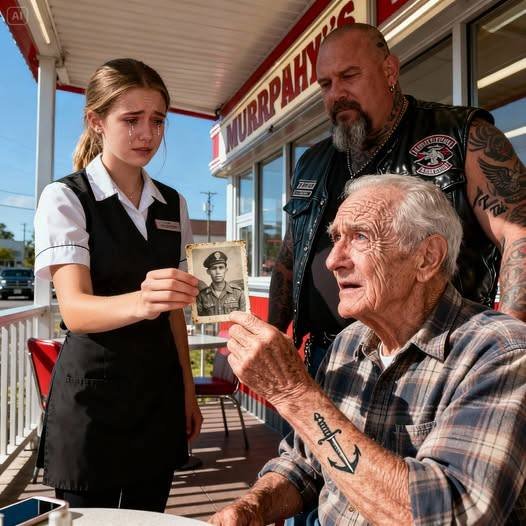
I watched them make the old man leave the diner that morning. Not with their hands, but with their words. They called him a faker, said the tattoo on his arm was a grocery-store job, a prop for sympathy. His name was Walter, and he just took it, hunched over his eggs like the words were a rain he was used to. He couldn’t tell them the truth—that the tattoo was real, that his silence was an oath, not an admission. Then the door jingled, and a biker walked in. He was dust and leather, and his eyes scanned the room like he was reading a map. They landed on Walter, and he went still.
“Commander Reed?” he said, and the name landed in the quiet diner like a stone in a pond. Walter looked up, and I saw a lifetime of memory flood his eyes. The biker, Dean, saluted. Right there, between the coffee station and the syrup bottles, he held a salute so sharp it could cut glass. And Walter, with a hand that shook with age and emotion, slowly returned it. Dean told us then that Walter had pulled him out of a hellhole sixty years ago, a mission that didn’t officially exist. He was the reason Dean was alive.
The men who had been mocking Walter couldn’t look at him anymore. The biker paid for Walter’s meal, left a hundred dollars on the counter, and walked out with him. As they stepped into the sunlight, Walter looked back just once, and I heard him say, “Maybe now I can go home.” I don’t know if he meant his house or some peace in his own mind. But I do know that sometimes heroes don’t wear uniforms; sometimes they wear faded flannel, and sometimes their justice arrives on a Harley.