The Architecture of Salvation
Chapter 1: The Monument to Violence
This is the chronicle of a war I was never supposed to fight, and a surrender that ultimately saved my life.
I am Gabriel Mercer. For a decade, my identity was defined not by who I was, but by what I had survived. I was a walking casualty of a roadside bomb outside of Fallujah that had taken my squad, my purpose, and the steady control of my own nervous system.
They tell you that time heals all wounds, but that is a civilian lie. Time merely lets the scar tissue harden into armor. At six-foot-five, I was a massive, lumbering ghost in my own life. My body was a topography of trauma; extensive, pale burn scars trailed up my forearms, wrapped around my biceps, and crept up the left side of my neck—the permanent signature of burning diesel and twisted metal. But the most debilitating casualty of the war wasn’t visible on my skin. It lived in my central nervous system. I suffered from severe intention tremors. Whenever I tried to perform a deliberate, focused action—holding a cup of coffee, turning a key, touching another human being—my hands would shake violently. It was the shattered wiring of a brain permanently stuck in a combat zone. Worse than the physical scars was the invisible brand I wore: the lingering, unspoken suspicion from a military tribunal that a tactical error on my part had cost my men their lives.
I lived in complete isolation in a remote cabin in the Michigan pines, speaking only to my VA psychiatrist. It was during one of those mandatory sessions that he handed me a pamphlet for a hospital volunteer program. The Cuddler Program, it was called. It sounded absurd. “You need an anchor, Gabriel,” he had said, watching my massive hands tremble on my knees. “You need a reason to interact with the world that doesn’t involve a threat matrix.”
That is how I found myself standing in the Neonatal Intensive Care Unit of St. Jude’s Memorial Hospital, feeling like a live grenade rolled into a sanctuary.
The NICU was a cathedral of fragile glass and terrifying, synthesized alarms. The air was thick, heavily conditioned, and smelled sharply of industrial chlorhexidine antiseptics, sterile plastic, and the metallic tang of underlying fear. The relentless, rhythmic symphony of mechanical ventilators pumping air into underdeveloped lungs created a background hum that felt like a collective, mechanical heartbeat.
And I was fundamentally disrupting the delicate aesthetic of this nursery.
Beside me was Sarah, a seasoned respiratory therapist with tired eyes and a fiercely protective demeanor. She looked at my sheer size, my scarred neck, and the uncontrollable shaking of my hands, and I knew exactly what she was thinking: This broken man does not belong here.
In the plastic incubator between us lay the patient. Baby Girl.
She was a two-pound ghost wrapped in a tangle of translucent wires. She didn’t even have a first name; her mother had abandoned her at the emergency room three hours after birth. The infant was battling severe Neonatal Abstinence Syndrome (NAS). She was withdrawing from a massive systemic load of narcotics.
Suddenly, the infant let out a thin, jagged, agonizing shriek that pierced the ambient noise of the room. It wasn’t the cry of a hungry baby; it was the high-pitched, neurological scream of a central nervous system on fire. Her tiny body shivered violently.
I felt my jaw tighten. My heart rate spiked, the sound of her suffering triggering a deep, buried instinct to protect.
Against every medical instinct she had honed over thirteen years, Sarah slowly unlatched the circular porthole of the incubator.
“Let’s try,” she whispered.
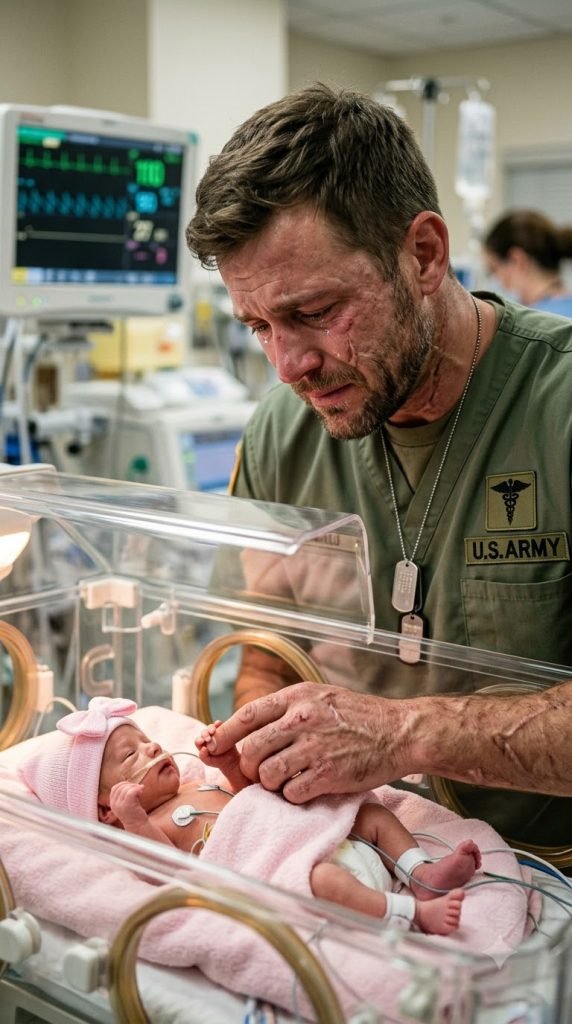
I reached my trembling right hand through the plastic porthole. The water from the sink still clung to my knuckles. “I’ve got you,” I murmured. My shaking fingertips gently made contact with her fragile, shivering chest.
Instantly, her tiny, translucent left hand—so small it looked like a folded bird wing—shot upward. Five microscopic fingers clamped around my scarred, trembling index finger. Her grip defied biology; it was the desperate, iron-clad grip of a drowning survivor.
The violent static in my brain began to quiet. The phantom smells of the desert faded. For the first time in ten years, my hand was perfectly, astonishingly still. On the monitor, her frantic, rabbit-like heartbeat settled into a steady, peaceful rhythm.
“Her mother left hours after birth,” Sarah whispered, tears welling in her eyes as she charted the miraculous drop in vitals. “Left nothing but a fake name and a plastic bag with some clothes and a necklace.”
Sarah pointed to a clear evidence bag resting on the stainless-steel counter. Inside was a scorched, silver St. Michael medallion on a broken chain.
My newly steadied hand suddenly turned to ice. My breath hitched in my throat. I knew that medallion. I knew the specific dent on the angel’s wing. It belonged to David Miller, my best friend, the squadmate who had thrown his own body over mine during the blast in Fallujah. He had given it to his estranged girlfriend right before our final deployment.
This wasn’t just an abandoned child. I was staring at the unborn daughter of the man who had died to save me. I owed her my life.
Just as the crushing weight of that realization hit me, my eyes drifted to the medication chart clipped to the end of the incubator. The dosage listed under her IV drip wasn’t methadone or phenobarbital. It was an alphanumeric code I recognized from my military medical training—a highly experimental, lethal neuro-suppressant that wasn’t approved for human use, let alone a premature infant.
Someone in this hospital was actively trying to kill her.