Imagine the night before your wedding. You’re filled with nervous excitement, hoping for a beautiful day with your family, despite your differences. That was me. I was home, ready to marry the man I loved. My relationship with my parents was strained, but I held onto a fragile optimism. That optimism was murdered with a pair of scissors. I awoke to find every wedding gown I owned deliberately destroyed. The perpetrators were not strangers. They were my own parents and my brother. Their reason? A bitter resentment over my career in the Navy, a resentment I never knew ran so deep. My father’s words, “You deserve it,” were meant to be the final sentence on my happiness.
In the aftermath, sitting in that dark room, I had a choice: to crumble or to stand up in the only armor I had. I chose to stand. I left that house of betrayal and went to the place that represented discipline, honor, and earned respect. A wise old Master Chief on base listened to my story and gave me the courage to see my own strength. He reminded me that my value was not in a wedding dress, but in my character and my service. I realized then that I would walk down the aisle not as the daughter they tried to diminish, but as the officer I had become. My dress whites were more than a uniform; they were a declaration of independence.
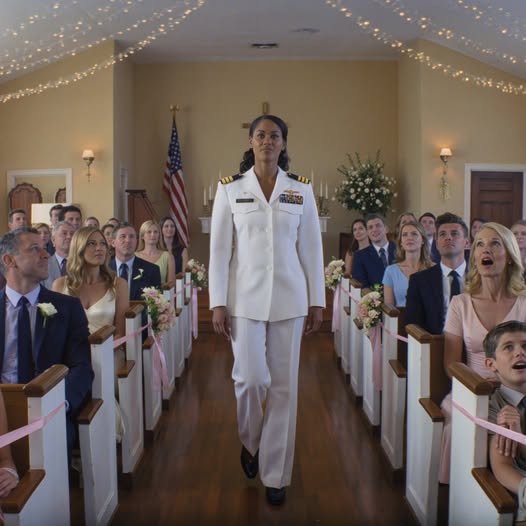
Walking into my own wedding in that uniform was a powerful, silent rebuttal. The stunned silence, followed by my brother’s audible shock at my military ribbons, told the entire congregation everything they needed to know. My parents’ shame was visible. They had tried to embarrass me, but instead, they had unwittingly presented me to our entire community at my most dignified and accomplished. The support from David’s family and the older veterans in the room created a wall of moral support around me. It was clear whose side decency was on.
The most surprising turn was not my walk down the aisle, but what happened after. Faced with the undeniable truth of their actions and the respect I commanded from others, my family began to crack. During the ceremony, my father stood and offered a stumbling, raw public apology. It wasn’t graceful, but it was the first real acknowledgment of my worth I had ever received from him. My brother and mother also expressed their regret. It was the beginning of a painful but genuine reckoning. They had to confront the people they had been.
Healing is a long road. In the months after the wedding, my family and I began a slow, tentative journey toward a new relationship. It required patience, counseling, and my unwavering commitment to maintaining healthy boundaries. They learned to see me, perhaps for the first time. They asked about my career. They showed up. The story is not about a perfect redemption, but about the possibility of change. It proves that sometimes, standing firm in your own truth is the only way to teach others how to truly see you, and perhaps, how to finally begin to love you correctly.