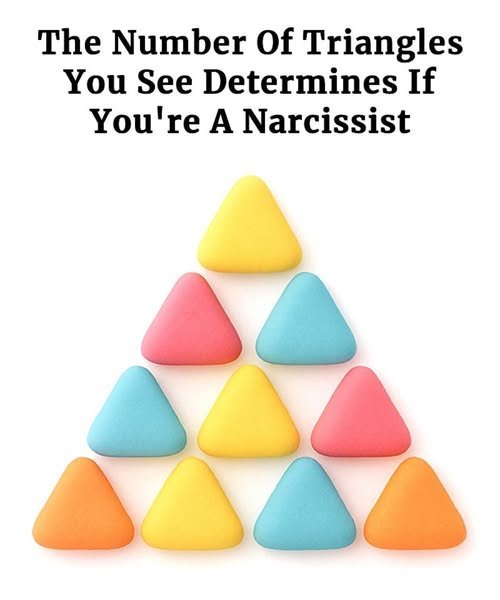
A playful optical illusion featuring a pyramid of triangles has become a global conversation starter. The prompt is basic: how many do you see? Yet the answers create a fascinating spectrum. Some people see only the obvious, while others discover layers upon layers. This divergence is the magic of the test. It moves beyond a simple counting game to highlight how your brain’s wiring influences not just what you see, but how you interpret reality, solve problems, and connect with others.
Psychologically, this touches on our Gestalt processing—the mind’s drive to create unity from separate parts. Your immediate response to the image acts as a snapshot of your cognitive default setting. Are you a simplifier who seeks clear boundaries, or a complexifier who enjoys uncovering hidden dimensions? This tendency echoes in your daily life, shaping your approach to work, relationships, and creative pursuits. Each style has its virtues, and understanding yours can be remarkably illuminating.
Individuals who count approximately nine triangles are often realists at heart. You trust concrete facts and prefer straightforward, structured approaches. Your thinking is linear and pragmatic, making you a pillar of reliability in chaotic situations. You help others stay grounded. However, this virtue can sometimes limit your ability to perceive underlying patterns, metaphorical meanings, or emotional subtexts. Your power is in your commitment to the truth as it is plainly presented.
If your tally landed in the 13–16 range, you operate with a harmonious dual perspective. You can analyze specifics without sacrificing a holistic view. This balanced perception makes you an adept negotiator and a compassionate friend, as you naturally consider both rational and emotional facets of any scenario. You are likely seen as wise and fair, someone who can translate between different ways of thinking and find a middle path that respects all sides.
Those who spot more than twenty triangles possess a richly creative and associative mind. You are a natural pattern-seeker, constantly constructing narratives and seeing possibilities invisible to others. This visionary quality drives innovation and artistic expression. The accompanying challenge is that your intricate inner world can sometimes distance you from simpler, more conventional viewpoints, potentially leading to misunderstandings. The goal is to harness this expansive perception while staying connected to diverse perspectives. This viral illusion, in the end, is a celebration of human diversity. It confirms that we all look at the same picture, but we each paint a different story with it, and therein lies the beauty of our individual minds.