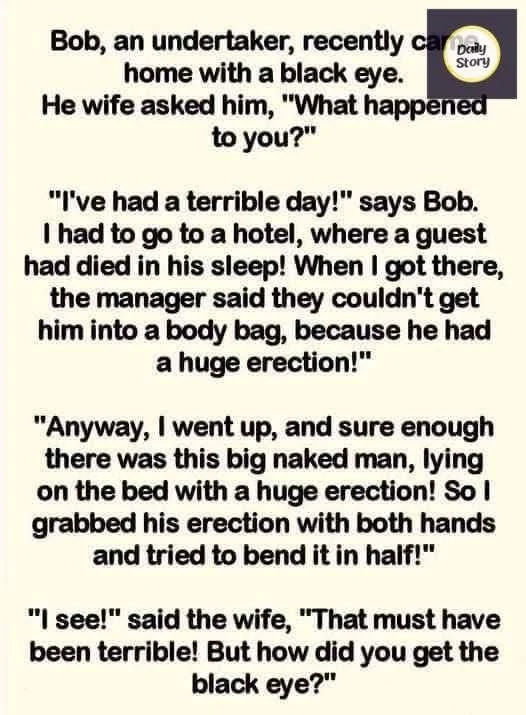
Even in the most serious professions, a moment of distraction can lead to a wildly comic and painful outcome. Bob, an undertaker, learned this firsthand. His wife was greeted one evening not just by her husband, but by a pronounced and colorful black eye that adorned his face. When she inquired about the injury, Bob sighed and relayed the tale of his disastrous day, a story that hinged on one critical error.
The trouble began with a call to collect a body from a hotel. The manager informed Bob of a sensitive issue: the deceased gentleman had a powerful erection that made placing him in a standard body bag impossible. Bob, considering himself a problem-solver, headed to the room to handle the situation. He entered, saw a large naked man on the bed with the described condition, and moved to address the logistical hurdle.
Adopting a practical, no-nonsense approach, Bob decided the quickest solution was to manually reposition the erection. He took a firm, two-handed grip and attempted to bend it, viewing it as a simple matter of physics standing in the way of his duty. It was a clinical action, devoid of any context beyond the immediate task of preparing a body for transport.
His wife murmured her understanding of the awkward predicament. But she pressed the point: how did manipulating a dead man lead to a fistfight? Bob’s answer revealed the stunning flaw in his story. His professional focus had been so intense that he had neglected to confirm he was in the right room. The man he had so boldly grabbed was not the deceased guest, but a living, breathing hotel patron who was simply enjoying a private moment of rest. The furious punch that followed was a direct and emphatic communication that Bob had made a terrible, and painfully memorable, mistake.