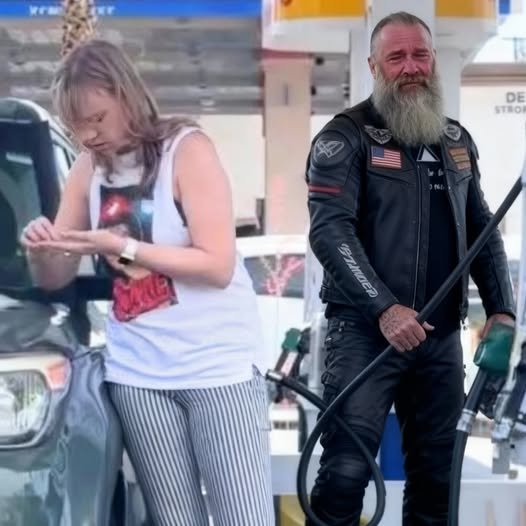
The sight was enough to make anyone look twice. A young woman, visibly shaking and crying, stood beside her car with a handful of coins that wouldn’t cover the cost of a full tank of gas. A motorcyclist pulling into the station saw her distress and acted without fanfare, swiping his card to fill her tank. He expected gratitude, but what he got was a frantic whisper and a plea for him to leave. She explained that her boyfriend would be enraged, convinced she had solicited the help. The biker realized the profound depth of her predicament. Her problem wasn’t financial; it was a life of walking on eggshells, where even a stranger’s kindness could be twisted into a reason for abuse.
The situation came to a head when the boyfriend appeared, his anger palpable. He immediately began interrogating them, his voice sharp and demeaning. The biker watched as the young woman seemed to fold into herself, bracing for the storm. But then, something shifted. Instead of enduring the abuse, she looked directly at the biker, her eyes pleading, and whispered two words that would change her life: “Help me.” In that instant, the biker saw the full picture—the fear, the control, the invisible prison she was living in. He knew he had to act, and he immediately contacted the police.
That day marked the beginning of the young woman’s escape. With the intervention of the authorities, she was removed from a dangerous and controlling environment. She found refuge in a shelter where she could finally breathe, finally speak her truth without fear of reprisal. She began the difficult but liberating work of putting her life back together, rediscovering her own strength and worth. She was no longer just a victim; she was a survivor taking back her narrative.
The biker later received a heartfelt letter from her. She was safe, living with her mother, and pursuing an education. She had even bought her first car with her own money, a powerful symbol of her independence. She told him that his act had reminded her that she was seen and that she mattered. He keeps that letter as a permanent reminder of the power of a single moment. It proves that courage is contagious and that sometimes, stopping to help a stranger can be the catalyst that gives them the strength to save themselves.