“If you can get that thing going, I’ll give you my job right now, kid!”
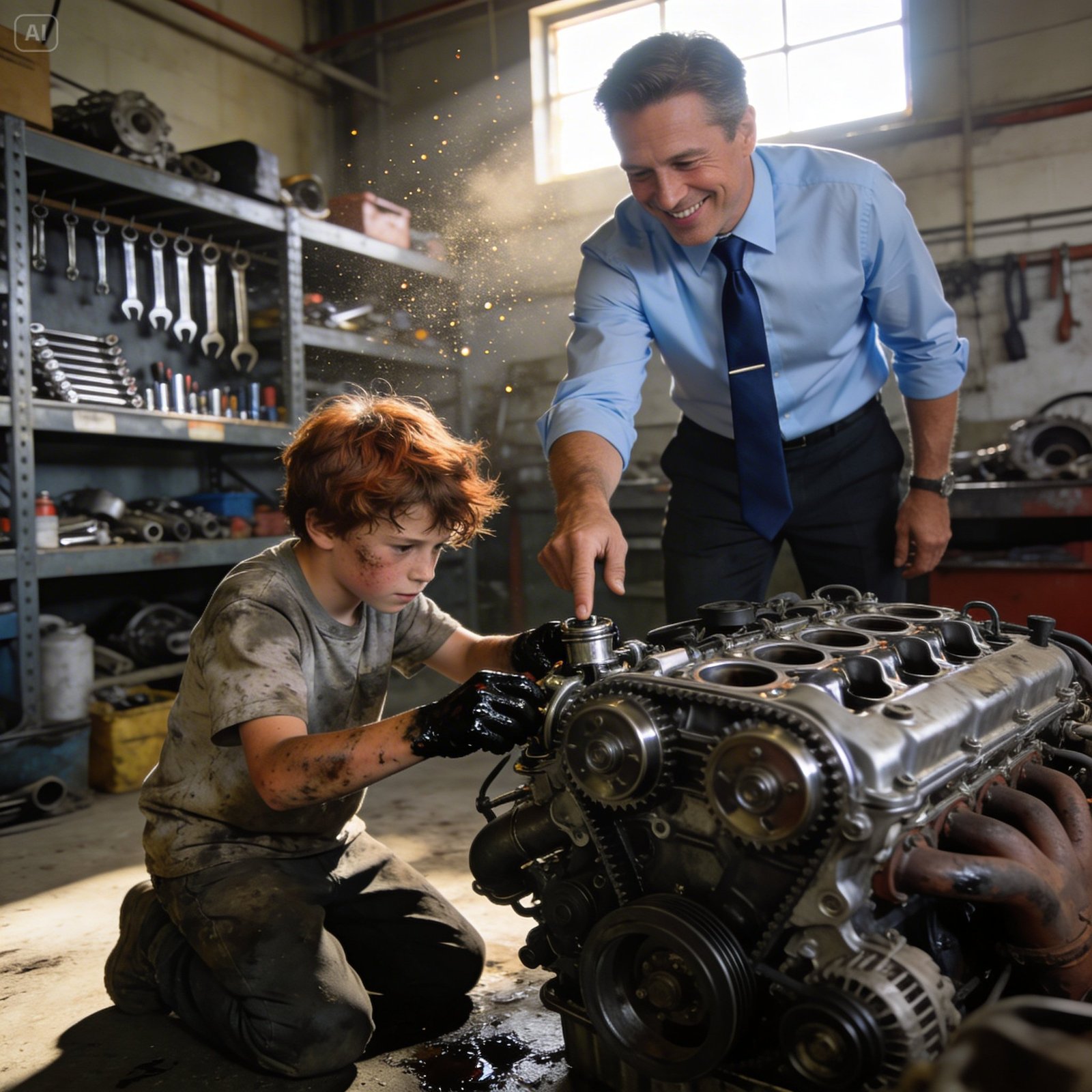
Esteban Morales’s laughter echoed off the concrete walls of the workshop, bouncing off the hydraulic lifts and the pungent smell of gasoline and old grease. It wasn’t a laugh of joy; it was pure contempt, the kind of laugh that tries to make you feel small. He pointed with his index finger, adorned with a gold ring that was too tight, toward the disassembled engine on the main workbench. Around him, the other mechanics let out nervous giggles, not because they found it funny, but because they knew that contradicting the manager was a surefire way to get fired.
At the center of the ridicule was Miguel. At fourteen, the boy was all skin and bones, elbows and a determination that seemed to burst from his body. He wore a t-shirt that had seen better days, stained with oil from weeks past, and sneakers patched with gray duct tape. For a month he’d been hanging around the workshop like a stray cat, asking to sweep, clean tools, or simply watch, begging for a chance that Esteban systematically denied him with the same hurtful excuse: “This isn’t a daycare, go play in the dirt.”
But that day the atmosphere was different. That engine wasn’t just any engine. It belonged to an imported sedan, a beast of European engineering worth more than Doña Patricia, the woman who had taken Miguel in when he was abandoned on her doorstep as a baby, would earn in ten lifetimes cleaning floors. The best mechanic in the shop, a man with twenty years of experience, had quit that very morning, frustrated and defeated, after three days of trying unsuccessfully to revive the machine. The official diagnosis was “mechanical brain death.” Nobody understood why it wasn’t working
“Are you serious?” Miguel asked. His voice didn’t tremble, though his knees did shake slightly beneath his worn pants. The hunger of the day was taking its toll, but his pride kept him standing tall as a post.
Esteban adjusted his tie, looking down at him with the superiority of someone who believes the position defines the person.
“I’m as serious as my name is Esteban Morales. You have one week. If you manage to fix this mess, you get my job as manager, my office, and my salary. But if you fail—and I guarantee you will—I want you gone. I don’t want to see your dirty face hanging around my workshop again. Or on the sidewalk across the street. Deal?”
The workshop fell into a deathly silence. The air felt heavy, electric, charged with a tension you could almost taste. Miguel stared at the jumble of scrap metal. To others, it was expensive junk. To him, it was a puzzle whispering secrets. He had spent his nights reading manuals salvaged from dumpsters, understanding the logic of gears before he even learned division in school. Machines didn’t lie, they didn’t judge, they didn’t look down on you for being an orphan. Machines only asked to be understood with patience.
“Deal,” said Miguel, sealing his fate.
Esteban let out one last laugh, a dry, sharp one, and turned away, certain of his victory. What the manager didn’t know, and what Miguel couldn’t even imagine at that moment, was that the engine wasn’t simply broken. That cold, silent machine concealed a secret, a hidden signature etched in the metal that would connect the painful past of a dead man, the uncertain present of an orphaned child, and a destiny that no one, absolutely no one in that room, could have predicted. What was about to happen would not only change the workshop’s hierarchy but would also bring to light a truth buried fifteen years ago that would make even the toughest man in the place weep.
The first night, Miguel didn’t touch a single screw. He simply observed. Under the pale, buzzing light of the security lamps, the boy circled the engine like a predator studying its prey, or rather, like a doctor listening to the silence of a comatose patient.
Doña Patricia always said that Miguel had “hands that see.” And it was true. While previous mechanics had tried to force the pieces to fit according to the standard manual, banging and cursing, Miguel noticed something subtle, almost invisible. There was a pattern in the chaos. The pieces weren’t broken from use; they seemed to be fighting each other, as if someone had tried to modify the original design with a stroke of genius that no one had understood. It was like trying to fit a chess piece onto a checkerboard.
It was on the third day that things began to change, and it wasn’t thanks to a tool, but to a human gesture. Guadalupe, the workshop secretary, a woman in her fifties who had seen many mediocre managers and few true leaders come and go, approached him with a sandwich wrapped in paper napkins.
“Eat, son. Your brain doesn’t run without fuel,” she said tenderly, watching out of the corner of her eye to make sure Esteban didn’t see her. “And don’t let that idiot scare you. Esteban can’t tell a spark plug from a screw. He’s only there because his father’s a politician. You have something he’ll never have: passion.”
Those words were the first real fuel Miguel received. With a full stomach and a slightly warmer heart, he returned to work with renewed energy. It was then, while cleaning an intake valve covered in soot and burnt oil, that he saw it. A tiny engraving, hand-cut with a punch, almost imperceptible to the human eye, but clear under the magnifying glass he had found in a drawer: RM – Future Project 2009 .
“RM.” Those initials were familiar to him. He’d seen them in the old engineering manuals he treasured under his bed like superhero comics. Ricardo Morales. A legendary engineer, known in the industry for his revolutionary and eco-friendly designs, who had died suddenly years ago. Miguel felt a chill. What was the signature of a dead genius doing on a modern car?
The news that the “garbage boy” was making progress reached Esteban, who began to feel a cold sweat trickle down his back. The mockery was turning into a threat. But real help arrived in the most unexpected way. One afternoon, an elegant woman with silver hair and a wistful gaze entered the dealership. She wasn’t looking to buy a brand-new car; she wanted to experience the atmosphere, the smell of work. It was Beatriz Castillo, a minority shareholder and the widow of Ricardo Morales himself.
Seeing Miguel bent over the engine, with that almost religious concentration, Beatriz stopped dead in her tracks. She put a hand to her mouth.
“He reminds me of him,” she whispered, her eyes glassy. “He has the same posture, the same obsessive look.”
She approached the boy and, after talking with him and seeing his humility, decided to offer him something worth more than all the money in the safe: her late husband’s tools. The next day, she arrived with a fine wooden box lined with velvet. They were precision instruments, custom-made, that smelled of time, of effort, and of nostalgia.
“My Ricardo used to say that a tool is an extension of a mechanic’s soul,” Beatriz told him, handing him a calibrated wrench that seemed to glow with its own light. “Use them. I think he would want you to have them. I don’t know why, but I feel like these tools have been waiting for your hands.”
With the right tools, Miguel didn’t work; he flowed. It was as if the spirit of the former owner guided his fingers. He discovered that the engine wasn’t defective, but rather a hybrid ahead of its time. The previous mechanic had tried to “fix” it by returning it to a standard state, thus stifling its innovation. Miguel understood that he didn’t have to repair it; he had to restore it to its original design, a design he understood intuitively, as if he could read the mind of its creator.
La noche antes de la fecha límite, Esteban, desesperado al ver que el chico podría lograrlo, jugó su carta más sucia. Entró al taller cuando nadie lo veía y cortó la luz general desde el panel principal.
Cuando Miguel llegó para su última jornada nocturna, se encontró en la penumbra total. Podría haberse rendido. Podría haber llorado y culpado a la mala suerte. Pero Miguel era un superviviente. Pidió velas a Doña Beatriz. Encendió docenas de ellas y las colocó alrededor del motor. Y siguió trabajando. La imagen era casi mística, digna de una pintura renacentista: un niño de catorce años, sucio de grasa, rodeado de herramientas de un maestro muerto, devolviendo la vida a una máquina bajo la luz vacilante y sagrada de las llamas.
A la mañana siguiente, el día del juicio, el taller estaba lleno. La noticia de la apuesta se había corrido. Mecánicos, vendedores, personal de limpieza e incluso Alejandro Castillo, el dueño de la concesionaria y hermano del fallecido Ricardo, habían aparecido. Esteban estaba cruzado de brazos junto a la puerta, con una sonrisa nerviosa que no le llegaba a los ojos, esperando el fracaso para poder expulsar al intruso.
—Está listo —dijo Miguel. Su voz era un susurro ronco por el cansancio y el humo de las velas. Se limpió el sudor de la frente con el antebrazo, dejando una marca negra.
Giró la llave de encendido.
El silencio se estiró durante dos segundos que parecieron siglos. Esteban abrió la boca para soltar su veneno, pero el sonido se le murió en la garganta.
El motor no arrancó con un estruendo tosco; cobró vida con un ronroneo suave, potente, perfecto. Una sinfonía metálica. Los monitores de diagnóstico conectados al ordenador se iluminaron en verde: eficiencia al 140%. Emisiones casi nulas. Potencia estable. Era una obra maestra de la ingeniería.
—Imposible… —masculló Esteban, retrocediendo un paso como si el motor le hubiera gritado.
—No es imposible —respondió Miguel con calma, acariciando el metal—. Es ingeniería pura. Alguien intentó tratar este motor como si fuera común, pero es un prototipo. Tiene modificaciones para ahorrar combustible que nadie entendió porque eran demasiado avanzadas.
Alejandro, el dueño, se acercó al motor, pálido como un fantasma. Sus manos temblaban.
—Este diseño… —murmuró, tocando el bloque del motor—. Solo conozco a una persona en el mundo capaz de hacer esto.
Beatriz dio un paso adelante, con lágrimas corriendo libremente por sus mejillas, y señaló el grabado oculto que Miguel había encontrado y limpiado meticulosamente.
—Lee esto, Alejandro. RM. Proyecto Futuro. Para mi hijo, donde quiera que esté.
The revelation hit the workshop like a nuclear bomb. Alejandro looked at Miguel, truly seeing him for the first time. He saw the dark, intelligent eyes, the shape of the jaw, but above all, he saw the hands. His brother Ricardo’s hands.
The story came out right there, amidst sobs and whispers. Ricardo had had a secret son in his youth, a love that had gone far away because of fear and misunderstandings. He had searched for that child until the day he died, tormented by the absence. That engine was his legacy, his love letter in the form of pistons and valves, left in the world with the blind hope that one day, his own flesh and blood would find him.
A DNA test would confirm days later what everyone already knew for sure: Miguel was Ricardo Morales’s long-lost son. The owner’s nephew. The heir to an unparalleled talent.
Esteban, pale, sweaty, and trembling, tried to stammer an excuse, trying to save his skin, but Alejandro raised a hand, silencing him instantly.
“The bet was clear, Esteban. But don’t worry, I won’t take your position to give it to a kid; that would be irresponsible. I’m firing you because you don’t have the dignity, the vision, or the heart to lead this team. You tried to humiliate someone who was more talented than you. Get out of here.”
Alejandro turned to Miguel, a mixture of regret for the lost years and hope for the future in his voice.
“The job is yours if you want it, Miguel. Or you can come live with me. I’ll give you the life you deserve. You’ll study at the best universities, you’ll make up for lost time. You won’t have to worry about anything anymore.”
Miguel looked at Doña Patricia, the humble woman who had loved him when he was nobody, who had shared her poverty with him. He looked at Guadalupe, who had given him food and courage. He looked at Beatriz, who had given him tools and faith. And then he looked toward the workshop gate, where other neighborhood boys, their clothes dirty and their eyes full of curiosity, watched the scene. Poor boys, without opportunities, just like him a week ago.
“I don’t want to be a manager,” Miguel said firmly, surprising everyone. “And I don’t want to live in a mansion and forget who I am either.
” “Then what?” his uncle asked, puzzled. “You can ask for whatever you want.”
“I want this workshop. But not to fix rich people’s cars. I want to turn it into a school. I want to use the prize money to teach other kids like me how to understand machines. If my father left this knowledge, it wasn’t so I could get rich, but so the knowledge wouldn’t be lost. Talent is everywhere, Mr. Alejandro; it’s just a lack of opportunity.”
The proposal left everyone speechless. At fourteen, Miguel wasn’t asking for power, he was asking for purpose. He wasn’t asking for a throne, he was asking for a classroom.
And so it was. With Beatriz’s unwavering support and Alejandro’s resources, the old workshop was transformed into the “Ricardo Morales Technical Training Center.” It wasn’t just any place. There, tuition wasn’t paid with money, but with a desire to learn and discipline. Doña Patricia became a “mother” to all the students, making sure no one studied on an empty stomach.
Years later, the place was a hotbed of nationally recognized talent. Miguel, now a brilliant engineer who turned down million-dollar offers from multinationals, walked among the workbenches. Sometimes, he’d see a new kid, scared, with patched clothes and grease-black hands, staring desperately at an impossible engine. Miguel would approach him, put a hand on his shoulder, and give him a wrench, the same one Beatriz had given him that day.
“It’s not impossible,” he’d say, repeating the lesson that had changed his life. “It’s just a puzzle you haven’t figured out yet. Listen to the machine; it’ll tell you what’s wrong.”
Esteban, for his part, learned the hardest lesson of all. After months without finding work, rejected everywhere for his arrogance, he returned to the center, humiliated, head bowed, begging for a chance to truly learn, not to give orders. And Miguel, demonstrating that his greatness lay not in his surname or his heritage, but in his enormous heart, accepted him as a student. He put him to work sweeping and cleaning parts, teaching him humility before mechanics. Because in the workshop of life, a broken engine can always be repaired, and sometimes, with enough patience and forgiveness, even a lost soul can be mended.
Miguel showed the world that true success isn’t about reaching the top and looking down with disdain, but about reaching the top and then stepping back down to help others climb. And every time an engine started up in that workshop, with that perfect, rhythmic purr, you could almost feel Ricardo’s satisfied laughter in the air, knowing that his greatest invention hadn’t been a revolutionary engine, but the son who had the courage and kindness to fix it.