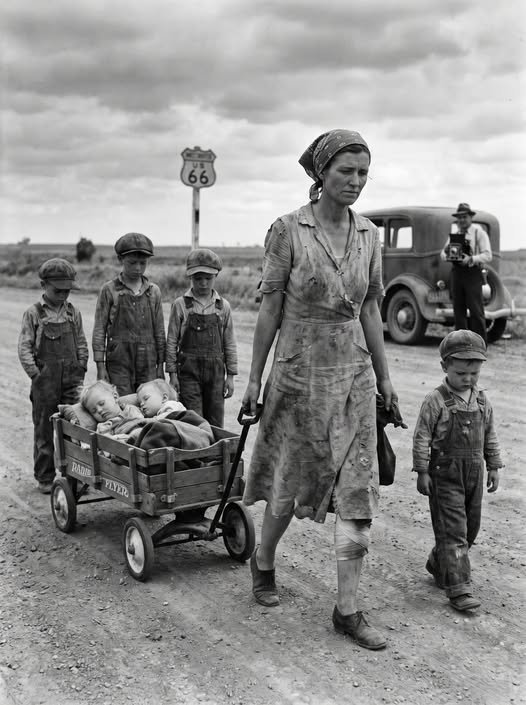
A Road That Carried a Nation’s Collapse
In the summer of 1936, Route 66 was more than a highway. It was a migration corridor carved through the American landscape, carrying thousands of families fleeing economic collapse, drought, and agricultural failure.
Known later as the “Mother Road,” Route 66 connected rural communities in the Midwest to the promise of employment and stability in California. But for many who traveled it during the Great Depression, it was not a road of opportunity—it was a road of necessity.
Among those travelers, according to archival references from the Resettlement Administration, was a woman named Martha Evans.
Her story survives not as a complete biography, but as a fragment of historical documentation and a widely circulated photograph that became symbolic of Depression-era migration.
Martha Evans: A Life Interrupted by Loss
By 1936, Martha Evans was thirty-two years old. According to reconstructed accounts, she had already experienced a sequence of losses that were common—but devastating—in rural America during the Depression.
Her husband had died of tuberculosis in Oklahoma earlier that year. Like many rural families, they had been vulnerable to both economic instability and limited access to medical care. Tuberculosis, still widespread in the early twentieth century, often spread rapidly in overcrowded or impoverished living conditions.
Following his death, the family farm was foreclosed. This event marked the collapse of their remaining economic foundation.
With no land, no income, and no immediate support system, Martha faced a decision that many families in similar circumstances were forced to confront: remain in place with no resources, or attempt migration toward regions perceived to offer work.
She chose migration.
But she did not travel alone.
The Journey West
Martha’s journey westward followed one of the most documented migration routes of the Depression era: the path toward California’s agricultural regions.
She traveled with six children. The youngest were twins, only eleven months old at the time. The older children, ranging from three to six years old, were still too young to understand the full implications of displacement, but old enough to experience its physical demands.
With limited resources, she used a small wagon—often referred to in later accounts as a Radio Flyer wagon—to carry supplies and, at times, the youngest children during sections of the journey.
The physical demands of such a journey were extreme. The distance from Oklahoma through New Mexico to California spans hundreds of miles of harsh terrain, including desert heat, limited water access, and long stretches without formal infrastructure.
Martha reportedly walked for three days through parts of New Mexico before being noticed by federal photographers traveling under the Resettlement Administration, part of a New Deal initiative documenting rural poverty in America.

The Photograph That Defined an Era
The encounter between Martha Evans and the photographer is one of those moments where historical documentation intersects with human narrative.
According to records associated with the Resettlement Administration’s photographic archives, the photographer offered assistance, likely in recognition of the severity of the situation.
Martha reportedly declined immediate transport.
Her reasoning, preserved through oral reconstruction, reflects a mindset shaped by long-term hardship: she believed that accepting repeated assistance might weaken her children’s ability to endure hardship independently.
Whether or not this exact phrasing is historically verbatim, it aligns with documented attitudes among many Depression-era migrants who prioritized resilience as a survival strategy.
The resulting photograph was circulated widely in newspapers across the United States.
It became part of a broader visual archive documenting displacement, poverty, and migration during the 1930s.
Route 66 and the Migration Crisis
To understand Martha Evans’ journey, it is necessary to place it within the broader context of the Dust Bowl migration and the Great Depression.
Between 1930 and 1940, hundreds of thousands of families left the central United States due to a combination of economic collapse and environmental disaster. Severe droughts across the Great Plains destroyed crops and intensified rural poverty.
Route 66 became a primary corridor for westward migration. Families traveled in overcrowded vehicles, wagons, or on foot. Many carried minimal possessions and relied on informal networks of assistance along the way.
Federal agencies such as the Resettlement Administration documented these movements extensively, both for policy development and public awareness.
Photographs from this period were often used not only as documentation but also as tools for shaping national understanding of poverty and migration.
Survival Under Extreme Conditions
Martha’s journey illustrates the physical and emotional extremes faced by migrant families during this period.
Traveling with very young children required constant attention to hydration, protection from heat, and improvisation in shelter. Injuries were common, and medical treatment was rarely accessible.
Accounts indicate that Martha sustained a leg injury during the journey, reportedly caused by barbed wire. She treated it using makeshift materials, including cloth from a feed sack.
Such improvisation was not unusual among Depression-era migrants. Medical infrastructure was limited in rural and transit regions, forcing families to rely on self-care and communal assistance when available.
Despite these conditions, Martha continued westward.
Arrival in California and Agricultural Labor
Upon reaching California, Martha joined a large population of migrant agricultural workers. Many families arriving from the Midwest and Southwest found employment in seasonal farm labor, particularly in fruit and vegetable harvesting.
Records suggest that Martha worked in grape harvesting in the Bakersfield region.
Agricultural labor during this period was physically demanding and poorly compensated. Migrant workers often lived in temporary housing conditions and moved frequently based on seasonal crop needs.
Despite these challenges, agricultural labor provided a crucial survival pathway for displaced families.
Education and Intergenerational Mobility
One of the most frequently cited elements of Martha Evans’ story is the long-term outcome for her children.
According to later family accounts, all six children survived into adulthood. Three reportedly attended college—an outcome that would have been highly significant given the economic constraints of their upbringing.
If accurate, this reflects a broader pattern observed among some migrant families: while immediate conditions were extremely difficult, long-term mobility was sometimes achieved through education, labor diversification, and post-Depression economic recovery.
However, as with many oral histories, exact verification of educational records varies across sources.

The Role of the Resettlement Administration
The Resettlement Administration, established in 1935, played a key role in documenting rural poverty and migration in the United States.
Photographers such as Dorothea Lange and others created a visual archive intended to support federal relief programs and inform public understanding of economic hardship.
These photographs often became iconic representations of the Depression era.
However, historians emphasize that photographs, while powerful, are selective representations. They capture specific moments but do not necessarily convey full narrative context.
Martha Evans’ image, like many others, exists within this framework of partial documentation and interpretive meaning.
The Wagon and the Symbol of Mobility
One of the most enduring elements of the story is the wagon itself, later reportedly preserved in a museum collection.
In historical context, such objects often gain symbolic significance beyond their functional use. The wagon represents not only transportation but also adaptation—a mobile survival system for families without permanent residence.
Material artifacts from the Depression era frequently serve as tangible connections to broader social histories of displacement and resilience.
Memory, Documentation, and Narrative Construction
Like many Depression-era accounts, the story of Martha Evans exists at the intersection of documentation and oral tradition.
While certain elements are supported by archival references—such as migration patterns, agricultural labor, and federal documentation programs—other details rely on reconstructed memory or family narrative.
This blending of sources is common in historical storytelling, particularly when dealing with individuals who were not part of institutional or elite records.
Historians approach such narratives with careful distinction between verified fact, probable context, and interpretive storytelling.
Why Stories Like Martha Evans Persist
The enduring interest in Martha Evans’ story reflects broader cultural engagement with themes of hardship, migration, and maternal resilience.
These narratives resonate because they encapsulate fundamental human experiences: loss, adaptation, and survival under pressure.
They also serve as reminders of the scale of displacement during the Great Depression, when entire populations were forced to redefine their relationship to land, work, and stability.
However, it is important to distinguish between symbolic representation and precise historical reconstruction.
A Journey Across Distance and Memory
The story of Martha Evans is not only about a journey across Route 66. It is about the broader movement of families across a nation in crisis.
Whether viewed through the lens of archival documentation or oral tradition, her narrative reflects the lived reality of thousands of families who experienced similar displacement during the 1930s.
Her walk across New Mexico, her arrival in California, and her work in agricultural fields form part of a larger historical pattern of migration and adaptation.
And while individual details may blur over time, the underlying reality remains clear:
The Great Depression was not only an economic collapse, but a human migration event on a massive scale.
And within that movement, stories like Martha Evans’ continue to remind us that history is not only made in cities and institutions, but also along roads, in wagons, and in the long, determined steps of those who refused to stop moving forward.