At seventy-five, you think you know your own mind and heart. I believed I did when I told Charles, my husband of fifty years, that our marriage was over. The children were grown, our careers were behind us, and the days stretched out in a predictable pattern that felt less like peace and more like a prison. I blamed him for my unhappiness, for the feeling that I had disappeared into the role of his wife. I was certain that a divorce was my only path to rediscovering who I was.
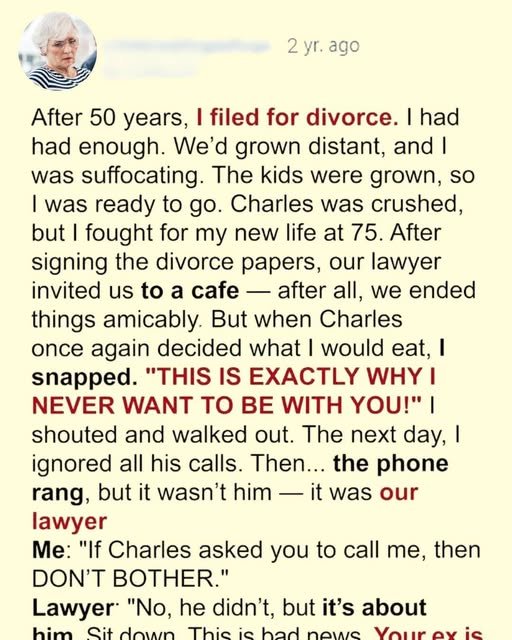
The process was civil and cold. On the evening we signed the papers, we went to a restaurant. It was there, when he reached up to dim the light above our table for my comfort, that I finally snapped. I accused him of controlling me, of never letting me breathe. I left in a fury, proud of my defiance. The following morning, I received the call that changes a life in an instant. Charles was in the hospital, his heart having given out under a weight I now realize I helped place there.
In our home, waiting for me, was a letter. His handwriting was so familiar, a part of the landscape of my life. He did not write with anger. He wrote to explain a lifetime of love. He explained that his attention to my needs, from the dimmed lights to the countless other small daily considerations, was not a desire to control, but a desire to cherish. He had spent fifty years learning me, not to manage me, but to love me better. He was setting me free, as I asked, but he was also setting the record straight.
I arrived at the hospital a different woman than the one who had left the restaurant. Seeing him so vulnerable, I understood the true strength of the man I was leaving. His love had been a quiet, constant force, and I had mistaken its steadiness for suppression. I begged for his forgiveness, which he gave with a gentle press of his hand.
Charles survived, and I was given a second chance I know I do not deserve. The freedom I was so desperate for was never about geography or marital status. It was about the liberation that comes from being fully seen and loved without condition. I had it all along. It took nearly losing him to see that the walls of my prison were built by my own ingratitude, and the key to my freedom was always in his hand.