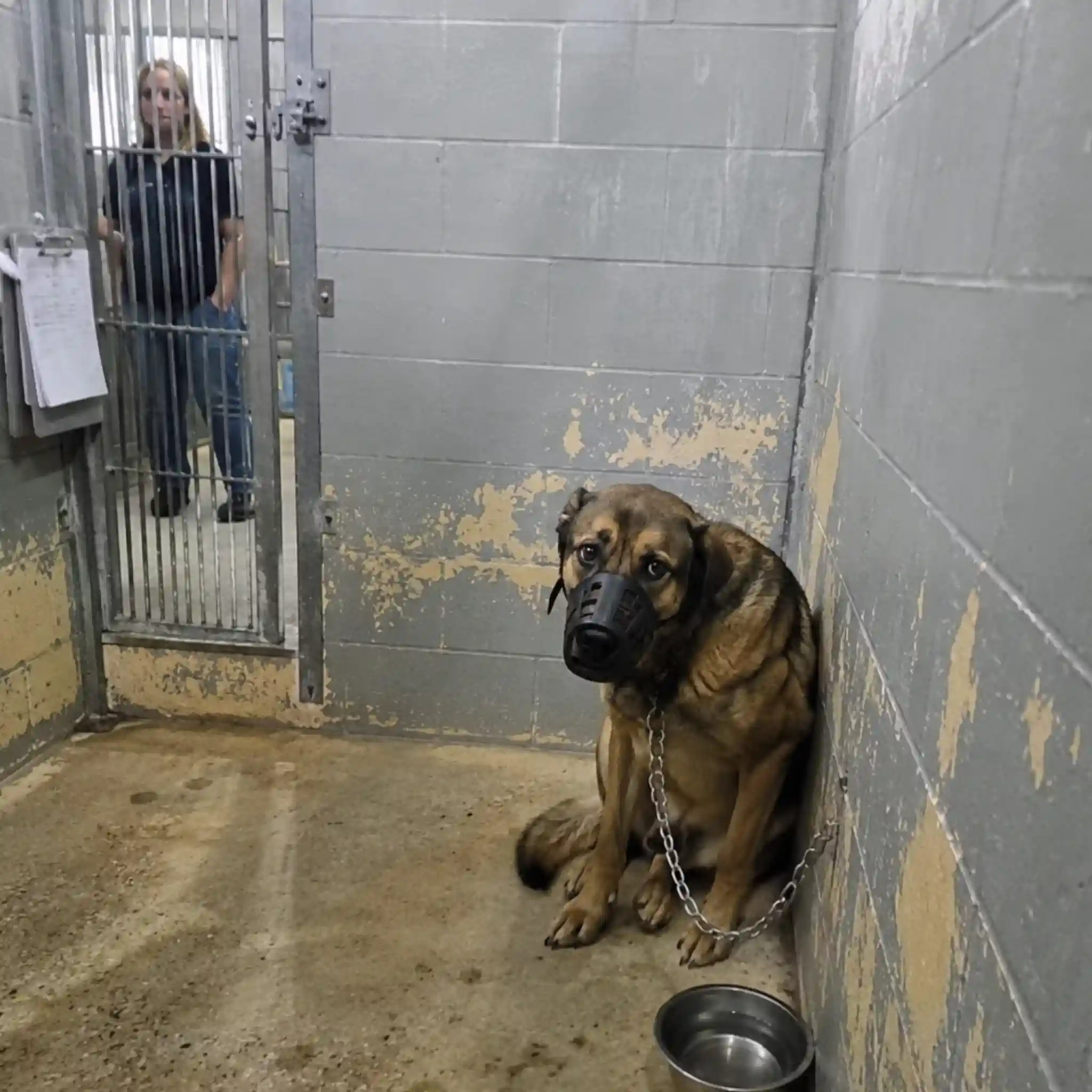
The dog was chained to the concrete floor at the county shelter, muzzled, and set to die in six hours when I walked in.
The paperwork said he had attacked a man in a parking lot for no reason. Aggressive. Unadoptable. Recommended for immediate euthanasia.
I asked to see him anyway.
The volunteer looked at me like I was insane. “Ma’am, this dog put a grown man in the hospital. You don’t want him.”
But something in the photo they had posted online the night before had grabbed me and wouldn’t let go. It was his eyes. He wasn’t looking at the camera. He was looking past it, like he was watching for something to come around the corner.
I signed the papers with my hand shaking.
They warned me three more times before they let him out. The vet tech said the dog hadn’t eaten in four days. He wouldn’t drink water. He just sat in the corner of his kennel and stared at the wall.
When they opened the kennel door, he walked out slow. He didn’t sniff me. He didn’t wag his tail. He looked at me for exactly two seconds, then walked to the front door of the shelter like he had been there before and he was ready to leave.
I put him in the back of my truck. He curled up on the blanket without a sound.
The whole drive home, I kept looking at him in the rearview mirror. And that’s when I noticed it.
He had a tattoo inside his ear.
Not a shelter ID. Not a rabies tag. A real tattoo, faded and small, with a number and three letters I didn’t recognize.
I didn’t think much of it. I figured he must have been someone’s pet before.
But that night, when I sat on my back porch and he lay at my feet, my neighbor Frank came over the fence to say hello. A man I’d known for twelve years.
Frank saw the dog.
He stopped walking. He dropped his coffee cup on the grass. His face went completely white.
“Where did you get that dog?” he whispered. “Because I know who owned him. And he was murdered six months ago. And the man who did it was never caught.”
I sat there for a long time without saying anything.
Frank had spent thirty-two years as a deputy in the same county sheriff’s office as a man named Ray Callahan. Ray retired the year before Frank did. Ray had been a K9 handler for the last fifteen of his years on the job.
His last partner had been a Belgian Malinois named Barrett. And Barrett had gone missing the night Ray was killed.
“That tattoo in his ear,” Frank said. “That’s not a random mark. That’s how the department tagged their K9s. Those three letters are the unit designation. The number is his badge ID.”
I looked down at the dog at my feet. He looked back up at me. Steady. Calm. Watching.
“His name,” Frank said, “is Barrett.”
I said the name out loud.
The dog’s tail thumped against the porch boards once. Just once.
Then he stood up and walked to the screen door and waited for me to let him inside.
Frank came inside with me. He sat at my kitchen table and drank the coffee I put in front of him and told me the whole story.
Ray had lived alone in a small house on the north side of the county. His wife Elaine had died of cancer three years before he retired. He didn’t have children. Barrett was pretty much his whole life after she was gone.
On the night of April 14, Ray was found dead in his living room. Someone had broken in through the back door. Ray had been shot twice at close range.
Nothing was taken. Not his wallet. Not the cash on the counter. Not the two hunting rifles in the case in the hallway.
Just Ray. And Barrett was gone.
The investigators figured the dog had run off in the chaos. They put out alerts. They searched the woods behind the house. Nothing.
“Everyone assumed he’d been shot too,” Frank said. “Or hit by a car. Or picked up by someone who didn’t know what he was.”
“But he wasn’t,” I said.
“No. He wasn’t.”
Frank set his coffee down. He looked at Barrett, who was lying in the doorway between the kitchen and the living room. Barrett was looking right back at him.
“Ray was working on something before he died,” Frank said. “He wouldn’t tell me what. Said it was better if I didn’t know until he had proof. Said it was old business. A case from when he was still on the job.”
“A cold case?”
Frank nodded. “Ray had a photographic memory for cases. He kept files at home. Boxes of them. Every open case from every county he ever worked. He used to go through them in his retirement. Just checking. Just looking for a detail he might have missed.”
“Do you know which case?”
“No. But whatever it was, it got him killed.”
I looked at Barrett. Barrett looked at me.
“And the man he bit in the parking lot?” I said. “The one who put him on death row?”
Frank shook his head slow. “I don’t know. But I don’t think that dog attacks anyone for no reason. That dog was trained to identify threats. That dog was trained to hold a suspect until his handler said release.”
He looked at me steady.
“If that dog put a man in the hospital,” Frank said, “there was a reason.”
The next morning I called the sheriff’s office and asked for the detective who had been assigned to Ray’s case.
Her name was Detective Reyes. She was in her mid-forties, quiet, with tired eyes. She met me in a small room with a table and two chairs and a fluorescent light that buzzed.
I told her everything. About the dog. About the tattoo. About what Frank had said.
She listened without interrupting. When I finished, she pulled a manila folder out of her drawer and set it on the table.
“I want to show you something,” she said.
She opened the folder. Inside was a photograph. A big dark dog standing next to a man in his sixties. The man was smiling. The dog was watching the camera with the same still, steady expression Barrett always had.
“This is Ray Callahan and his K9 partner Barrett,” she said. “Taken the day Ray retired.”
I stared at the picture.
It was my dog.
“We put out an APB for that dog the morning after Ray was killed,” she said. “We had his description in every shelter database in three states. But somehow he ended up in a shelter forty miles from Ray’s house under a different name, and nobody flagged him.”
“How?”
She was quiet for a moment.
“Because the paperwork they filed on him at intake had the wrong description,” she said. “Wrong color. Wrong weight. Wrong age. Somebody changed it.”
I felt my stomach drop.
“Somebody at the shelter?”
“Or somebody who dropped him off,” she said. “Ma’am, do you know the name of the man your dog bit?”
I didn’t. I hadn’t asked. I hadn’t wanted to know. I had wanted to bring my dog home and forget the whole thing.
Detective Reyes flipped through the folder and pulled out a copy of the intake form.
Under “Complainant” was a name.
Todd Bishop.
She turned the paper around and slid it across the table to me.
“I need you to be very careful for the next few days,” she said. “We don’t know for a fact that this man is the person who killed Ray. But we know for a fact that this dog knew him well enough to attack him on sight. And this man knew this dog well enough to lie on the intake form to make sure Barrett would be euthanized before we ever found him.”
She stood up.
“Take the dog home. Don’t answer the door. Don’t open the mail. Don’t tell anybody you have him. I’ll be in touch tomorrow.”
I drove home with Barrett in the passenger seat.
He was watching my face the whole way. Like he could feel that something had shifted in the air between us.
I got home. I locked the doors. I closed the blinds. I sat at my kitchen table with a cup of coffee I couldn’t drink and I stared at Barrett, and Barrett stared back at me.
And I thought about what Frank had said. About Ray working on something. About the boxes of files.
I called Frank at ten that night.
“Do you know what happened to Ray’s things?” I said. “His files. His boxes.”
Frank was quiet for a second.
“They’re in his sister’s garage,” he said. “In Georgetown. She kept everything. Said she couldn’t stand to throw any of it out.”
“Would she let me look at them?”
Another pause.
“Diane, what are you doing?”
“I want to know what he was working on,” I said. “I want to know why he died. And I want to know why my dog was almost killed for identifying the man who probably did it.”
Frank sighed.
“I’ll call her in the morning,” he said. “I’ll drive with you.”
Ray’s sister was a small woman with white hair and hands that shook a little. Her name was Beverly. She hugged Frank at the door and looked at Barrett for a long time without speaking.
“Ray always said that dog was smarter than most people he knew,” she said. “He said Barrett would find his way home to somebody, someday.”
She let us into the garage. There were seventeen boxes stacked against the back wall. Every one of them was labeled in Ray’s handwriting.
Frank and I sat on the concrete floor and started going through them.
It took us four hours.
We found what we were looking for in box number eleven.
A folder marked “Marchetti, 2007.”
Inside was a case file for a home invasion. An elderly couple in the next county over had been tied up and beaten during a robbery. The husband died three days later from his injuries. The wife lived, but she never fully recovered.
The prime suspect had been a man named Daniel Marchetti. He had done cash work for the couple’s landscaper the summer before the crime. He had known the house. He had known where the safe was.
He was arrested and released on a technicality. He disappeared before the retrial. He had never been seen again.
Ray had a photograph of Daniel Marchetti clipped to the inside of the folder.
I looked at the photograph for a long time.
Then I looked at the intake form Detective Reyes had given me.
Todd Bishop and Daniel Marchetti had the same face.
I called Detective Reyes from Beverly’s kitchen.
I told her what we had found.
She was silent for a long time.
Then she said, “I’m sending two units to your house right now. Do not go home tonight. Stay with your neighbor. Do not answer your phone unless it’s me.”
She paused.
“I’ll be there in an hour.”
Frank and I drove back with Barrett in the back seat.
We didn’t talk much. Frank kept looking at Barrett in the rearview mirror. Every once in a while Barrett would lift his head and meet Frank’s eyes in the glass.
I stayed at Frank’s house that night. I put Barrett in his kitchen with a bowl of water and a blanket. Frank made up the guest bed for me. I didn’t sleep.
Around three in the morning, Barrett started to growl.
It was a low sound. Deep in his chest. The kind of sound that makes the hair stand up on the back of your neck.
Frank came out of his bedroom with his old service pistol in his hand.
“Stay behind me,” he said.
He pushed the curtain back an inch and looked out the front window.
There was a car parked across the street. Lights off. Engine running.
A man was sitting in the driver’s seat, watching my house.
Frank called Detective Reyes.
She was there in seven minutes with three squad cars.
The man in the car tried to run. He didn’t get very far.
His real name was Daniel Marchetti. He had been living in the county under the name Todd Bishop for six years. He had a wife. He had a job at a lumber yard. He had a small quiet life he had built on top of a murder that nobody had ever solved.
Until a retired deputy named Ray Callahan started going through his old case files.
The trial took a year. Detective Reyes called me every couple of weeks with updates. Frank came over most Sundays and we sat on the porch and drank coffee and threw a rope toy for Barrett in the yard.
Marchetti was convicted of Ray’s murder. He was also charged with the 2007 case. The wife of the couple he had beaten was still alive. She was in her nineties. She sat in the courtroom for the entire trial. She looked at him every day like she was trying to memorize his face for the last time.
He got two consecutive life sentences.
The night the verdict came in, I sat on my back porch with Barrett at my feet.
The sun was going down. The porch light hadn’t come on yet. The grass was long and green and the air smelled like cut hay from the field next door.
Barrett rested his chin on my knee.
I put my hand on the top of his head.
“Good boy,” I said.
His tail thumped against the boards. Just once.
Then he closed his eyes and slept for the first time since I brought him home. Really slept. Deep and slow and safe.
I thought about Ray sitting in his kitchen with his boxes of old files, pulling on a thread that had waited fifteen years to come loose. I thought about a dog running through the woods in the dark, hurt and alone, looking for somebody to bring the truth to. I thought about how close we had come to killing that dog for doing exactly what he had been trained his whole life to do.
Barrett was seven years old. The vet said he was in good shape. He had another six or seven good years in him, if we were lucky.
He was mine now. And I was his.
Ray Callahan was in the ground. But the case he died working was closed. The man who killed him was in a cell. And the dog who had witnessed all of it was asleep on my porch with his chin on my knee.
Sometimes the paperwork gets it wrong.
Sometimes the animal they say is dangerous is the only one in the room who knows exactly what happened.
Sometimes a dog on death row is not a bad dog.
Sometimes he is the last honest witness left.