PART ONE: THE SUITCASE THAT WOULD NOT DIE
By the time the suitcase breathed, I had already spent thirty-three years pretending the airport had not swallowed my brother.
That was the truth I never said out loud, not to my mother, not to my partner, not even to myself on the nights when Denver International Airport went hollow after midnight and every shadow looked old enough to remember my name.
Most people believe airports are places of beginnings and endings, but I have always known better.
An airport is a mouth.
It takes in the joyful, the frightened, the lonely, the careless, and sometimes it does not give them back.
My brother Caleb was six years old when he vanished near baggage claim, wearing red sneakers, a blue sweatshirt, and the small silver airplane pin my father had bought him from a gift shop because Caleb wanted to fly before he ever learned to drive.
I was eight.
I remembered the smell of floor wax, coffee, wet wool, and my mother’s panic.
I remembered my father’s voice breaking as he shouted Caleb’s name over the thunder of luggage carts and arriving passengers.
I remembered a young airport security officer with sandy hair promising us, “We’ll find him, sweetheart.”
That officer’s name was **Mike Donnelly**, and thirty-three years later he was my partner.
People call life strange when they are trying to avoid calling it cruel.
I had grown into Officer Elena Brooks, forty-one years old, Black American, airport police, divorced, childless, practical, and careful with my grief.
I wore my hair pinned tight, kept my boots polished, remembered faces, counted abandoned bags, and never admitted that carousel seven still pulled at something inside me every time I passed it.
That night, the last delayed flight from Phoenix had emptied itself into baggage claim like a tired lung.
Grandparents hugged grandchildren.
Businessmen dragged wheeled cases toward rideshare doors.
A young mother carrying a sleeping toddler cried quietly because her stroller had not arrived.
Then, one by one, they left.
The baggage belt circled for fifteen more minutes, carrying nothing but its own groan.
Denver International Airport feels different after midnight.
The white peaked roof hangs above you like a storm caught under canvas, and the bright floors reflect the lights so sharply they make your eyes ache.
Cleaning machines hum across distant tiles.
Escalators keep climbing toward floors nobody is using.
Announcements echo into emptiness with the soft authority of ghosts.
At 12:43 a.m., carousel seven stopped.
The black suitcase remained.
It was a hard-shell case with a broken handle, a blue ribbon tied to one side, and a small silver sticker near the wheel.
I had noticed it circling earlier because that was my habit.
A woman who has lost something does not stop watching what everyone else ignores.
I stood twenty feet away with my hand near my radio and felt that old sour taste rise under my tongue.
Abandoned luggage in an airport is never just abandoned luggage.
Training teaches distance, perimeter, procedure, patience.
Trauma teaches something else.
It teaches you that every ordinary object is waiting to betray you.
“Carousel seven,” I said into my radio.
My voice sounded bored because I had spent half my life learning how not to sound afraid.
“Unclaimed black hard-shell suitcase, broken handle, blue ribbon, silver sticker near lower right wheel.”
Static answered.
Then dispatch said, “Copy, Brooks.”
I took one step closer.
The suitcase moved.
Not far.
Not enough that anyone rushing by would have seen it.
It gave the smallest jerk, like a sleeping body twitching in a bad dream.
At first, I blamed the vents.
Then the zipper trembled.
Just once.
**A tiny black nose pushed through the split seam.**
For one second, I did not breathe.
That is what fear does when it becomes confusion.
It stops the body before the mind can catch up.
The nose disappeared, then came back, wet, shaking, desperate.
A sound followed.
It was not a bark.
It was not even a proper cry.
It was a thin, broken whimper, the kind of sound that should never have to exist in the world.
It slid across the empty baggage claim and found the place in my chest where Caleb still lived.
I dropped to one knee.
“Hey,” I whispered.
The suitcase answered with another whimper.
“Lord have mercy,” I said before I could stop myself.
My mother used to say that when the world became too ugly for ordinary language.
I keyed my radio.
“Possible live animal inside abandoned luggage at carousel seven,” I said.
“I need airport med kit, animal control, and supervisor response now.”
Dispatch began to answer, but I had already unclipped my pocket tool.
My hands were steady.
That bothered me later.
Sometimes a heart can be breaking while the hands do their job like nothing at all is wrong.
I worked the zipper slowly because the nose was pressed near the seam and I was afraid one careless pull would catch skin or fur.
The smell came first.
Hot plastic.
Urine.
Fear.
Cheap lavender dryer sheets.
The stale trapped air of something that had been breathing itself empty.
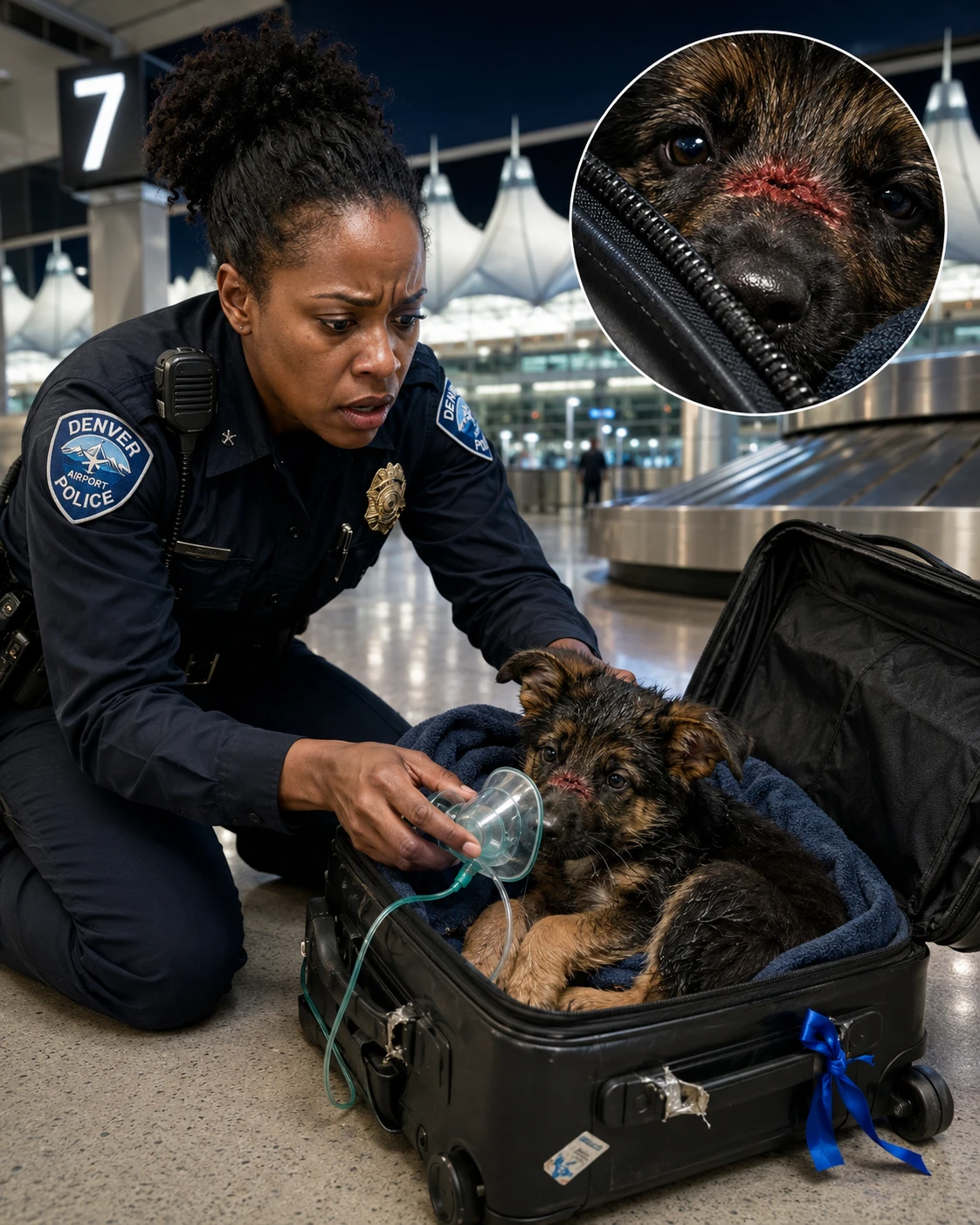
I opened the suitcase and saw the puppy folded inside a gray gym towel.
He was a German Shepherd, maybe ten weeks old, black and tan, with ears still soft enough to bend like felt.
His ribs showed through damp fur.
One paw was trapped under the towel.
His mouth opened and closed without sound, and his eyes were cloudy with panic.
A tiny white patch under his chin looked like the mark of someone’s thumb.
Across the bridge of his muzzle was a raw red scrape where he had rubbed himself bloody against the zipper.
**He had been trying to save his own life with the only part of him that could reach the air.**
I placed two fingers against his neck.
Nothing.
For one terrible second, there was nothing.
Then I felt it.
A heartbeat.
Small.
Fast.
Still arguing with death.
My partner, Officer Mike Donnelly, came running from the west corridor with the oxygen kit.
He was fifty-seven then, broad in the shoulders, pale in the face, with the kind of worried eyes that made strangers trust him before they knew his name.
Behind him came June Carter, the baggage supervisor, sixty-two years old and three months from retirement, with her radio swinging from one hand and her rosary beads wrapped around the other.
June stopped short when she saw inside the suitcase.
“Oh, Lord,” she whispered.
Mike knelt beside me.
“What the hell did somebody do?”
“Pediatric mask,” I said.
My voice had gone flat.
Mike opened the kit and handed me the smallest mask.
I held it near the puppy’s nose, not sealed against his face, just close enough for him to draw what he could.
His chest fluttered.
His paws twitched.
His eyes found mine, and that ruined me more than the blood did.
There is a kind of trust only babies and animals have.
It is not earned.
It is simply offered, because they have not lived long enough to know better.
“It’s okay,” I told him.
But **nothing about it was okay.**
June knelt on the other side and searched the front pocket of the suitcase with shaking fingers.
She pulled out a fake luggage tag, a crumpled grocery receipt from Phoenix, a strip of blue cloth caught deep in the zipper teeth, and a lavender dryer sheet stuck to the lining.
“No name,” she said.
“The tag says Robert Caldwell, but the phone number’s missing a digit.”
“Address?” Mike asked.
June shook her head.
“Looks made up.”
The puppy breathed against my palm.
One tiny push.
Like a question.
I remembered Caleb’s little hand in mine the day he vanished.
I remembered how he had pulled away because he wanted to watch the bags come out.
I remembered saying, “Don’t go far.”
Those were the last words I ever said to my brother.
“Stay with me,” I whispered to the puppy.
His nose moved again.
Mike looked at me, and I saw something pass across his face.
At the time, I thought it was pity.
Later, I would understand that **some masks are made of kindness.**
We wrapped the puppy in a clean emergency blanket, kept the oxygen near him, and carried him through the service corridor to the waiting transport.
Outside, the night air was cold enough to make the puppy tremble harder.
Snow had been falling in thin, dry flakes, the kind that never look serious until you wake up buried.
The emergency veterinary clinic near Tower Road kept one doctor on overnight duty.
His name was Dr. Daniel Mercer.
I noticed him because he was younger than his tired eyes, maybe thirty-nine, with dark blond hair going silver at the temples and a scar near his left eyebrow.
He had the calm, gentle manner of a man who had learned not to waste motion around suffering.
He took one look at the puppy and said, “How long was he sealed inside?”
“We don’t know,” I said.
“Long enough,” Mike added.
Daniel lifted the puppy from my arms with a tenderness that made my throat tighten.
The puppy whimpered once.
Daniel froze.
Only for a second.
Then he leaned closer and murmured, “I know, little man.”
Something in the way he said it made me look at him.
Not because it was strange for a vet to comfort an animal.
Because his voice had gone hollow, as if the sound had fallen down a well inside him.
He caught me watching and gave a tired smile.
“Sorry,” he said.
“I hate suitcase cases.”
“You’ve seen one before?” I asked.
Daniel’s hands continued working, checking gums, pulse, temperature.
“I’ve seen things people put in containers when they don’t want to call themselves cruel.”
That should have been the first bell.
But grief is not the only thing that makes people blind.
Habit does, too.
We waited in the clinic lobby while Daniel and a vet tech worked behind swinging doors.
June sat with her hands folded so tightly her knuckles whitened.
Mike brought coffee from a vending machine and set one in front of me.
“You did good,” he said.
I stared at the cup.
“I opened a bag.”
“You saved a life.”
“There’s a difference between saving something and arriving before it dies.”
Mike sighed and sat beside me.
He smelled faintly of winter air, coffee, and the peppermint gum he chewed on every late shift.
“Elena,” he said softly, “you can’t put Caleb into every case.”
My head turned.
He looked immediately sorry.
“I didn’t mean it like that.”
“Yes, you did.”
He rubbed a hand over his face.
“You know what I mean.”
I did know.
Everybody who loved me, or thought they did, had been telling me some version of that sentence since I was eight years old.
You cannot search every crowd for Caleb.
You cannot check every closed door.
You cannot hate every suitcase.
You cannot stay on watch forever.
But nobody ever explained how to stop.
Daniel came out at 2:18 a.m.
His scrub top was wet near the chest where the puppy had been pressed against him.
“He’s alive,” he said.
June crossed herself.
My knees went weak so suddenly I had to grip the arm of the chair.
Daniel looked at me first, not Mike, not June.
“He’s dehydrated, hypothermic, and bruised,” he continued.
“The muzzle wound is painful, but not life-threatening.”
“Will he make it?” I asked.
Daniel paused.
Then he said, “He has decided to.”
That answer stayed with me.
Not because it was scientific.
Because it sounded true.
We went back to the airport with the empty suitcase sealed as evidence.
The cameras showed the bag appearing on carousel seven after the Phoenix flight, but the angle that should have captured who placed it on the belt had gone black for nine minutes.
Nine minutes.
I hated that number.
Caleb had vanished during a weather delay in a span of eleven.
Back then, the police called it a crowd-control failure.
My father called it the end of his life.
The fake luggage tag led nowhere.
The Phoenix receipt had no useful prints.
The blue cloth was too ordinary.
The silver sticker near the wheel showed a tiny embossed number seven inside a circle, but nobody could identify the maker.
Animal control opened a neglect case.
Airport police opened an abandonment report.
Mike told me gently that we might never know who had done it.
June told me she would pray that the person who zipped that bag never slept again.
I told both of them I was fine.
Then I went home after sunrise, stood in my kitchen with my uniform still on, and threw up into the sink.
My mother Pearl was sleeping in the guest room because her memory had begun to wander and I did not like her being alone across town anymore.
She came out in her robe, eighty pounds lighter than when she used to chase neighborhood kids off her roses, her gray hair wrapped in a scarf, her eyes still sharp when they wanted to be.
“You sick?” she asked.
“No, Mama.”
“You lying?”
“Yes, ma’am.”
She stood beside me and put one thin hand on my back.
Pearl Brooks had once taught fourth grade, directed the church Christmas pageant, and scared grown men into lowering their voices in public places.
Now she forgot the kettle on the stove and called the television remote “the clicker thing,” but she still knew when my heart was breaking.
“Was it Caleb?” she asked.
“No.”
She waited.
“It was a puppy,” I said.
“In a suitcase.”
Her hand stopped moving.
For a moment, her face changed.
Not confusion.
Recognition.
Then she whispered, “Some suitcases are graves unless somebody opens them.”
“Mama?”
She blinked and looked toward the window.
“Snow coming down.”
I stared at her.
“What did you mean?”
She shook her head as if clearing smoke.
“About what?”
I wanted to ask again.
Instead, I rinsed the sink, took off my badge, and watched the snow climb the glass.
**The puppy lived.**
For three days, that was all I allowed myself to know.
On the fourth day, Daniel called me at the station.
“He’s standing,” he said.
I closed my eyes.
“Is he eating?”
“Like a fugitive.”
I laughed before I could stop myself, and the sound surprised me.
Daniel laughed too, but softly.
“He still gets scared when someone touches the zipper wound,” he said.
“That may take time.”
“Can I see him?”
“He seems to be expecting you.”
“He doesn’t know me.”
“Sometimes bodies remember kindness before minds know what to call it.”
I drove to the clinic after shift.
The puppy was in a warmed kennel, wearing a bandage across his muzzle like a tiny soldier who had lost a battle and survived it anyway.
When I crouched, he lifted his head.
His ears flopped.
His tail moved once, a weak little sweep against the blanket.
I put my hand near the kennel door.
He pressed his nose to my fingers.
One tiny push.
Like the question had returned.
Daniel stood beside me.
“He needs a name,” he said.
“Animal control will assign one.”
“I did not ask what the paperwork needs.”
I looked at the puppy.
His eyes were clearer now, dark and watchful.
He had been found beside carousel seven.
He had lived through what should have killed him.
I whispered, “Seven.”
Daniel looked at me.
“Seven?”
“Lucky number,” I said, though that was not what I meant.
Daniel opened the kennel door.
Seven crawled into my arms and tucked his head under my chin.
He smelled like medicine, puppy breath, and the faint ghost of lavender dryer sheets.
I held him until my arms ached.
That was the moment I stopped pretending the case was only a case.
**Something had been buried in that suitcase besides a dog.**
I just did not know yet that it was the truth.
PART TWO: THE DOG WHO LEARNED TO TRUST
Seven came home with me on a Tuesday because Tuesdays are ordinary days, and life likes to hide miracles inside ordinary things.
Animal control called it a foster arrangement at first.
The clinic called it medical recovery.
Mike called it predictable.
My mother called it providence.
Seven called it nothing because he was too busy chewing one corner of my kitchen rug with the solemn focus of a carpenter restoring a cathedral.
“He needs boundaries,” I told Mama.
“He needs teeth,” she said from the table.
“He has teeth.”
“Then he needs something to do with them.”
Pearl had taken to speaking to Seven as if he were a visiting child from church whose parents had not taught him manners.
She told him where the sunny patches were.
She told him which neighbors were nosy.
She told him not to trust the mailman’s smile because “a man who brings bills is never innocent.”
Seven listened to her with grave attention.
He was still too thin.
His muzzle wound healed into a faint pale line across the bridge of his nose.
For weeks, he woke crying in the dark.
Not barking.
Crying.
The sound was small and terrible, and every time it happened, I found myself back beside carousel seven with my pocket tool in my hand and stale air on my tongue.
At first, I tried to let him settle himself.
That is what the books said.
Then one night he screamed in his sleep, and I forgot every book I had ever read.
I found him curled in the laundry room, shaking so hard the metal crate rattled.
I opened the door.
He crawled straight into my lap, all elbows and ribs and panic.
“You’re out,” I whispered.
“You hear me, Seven?”
His claws dug into my pajama pants.
“You’re out.”
Mama stood in the doorway, holding her robe closed at the throat.
“You talking to him or yourself?” she asked.
I looked down at the trembling dog.
“Yes,” I said.
She nodded.
“That’s honest.”
Seven became my shadow.
He followed me from room to room, keeping his body angled so he could see both me and the nearest exit.
He hated closed doors.
He hated laundry baskets.
He hated the sound of zippers so badly that the first time I opened my duty bag near him, he flattened to the floor and wet himself.
I sat down beside him and cried with my hand over my mouth because I had seen grown men bleed without crying, but I could not bear the shame in a puppy’s eyes.
“It’s all right,” I said.
His ears trembled.
“I’m sorry.”
He crawled to me slowly, as if kindness might still turn into a trap.
When he reached my boot, he laid his chin across it.
That became his answer to fear.
Not flight.
Not biting.
He placed himself against me and waited for the world to decide what kind of place it wanted to be.
Daniel Mercer saw him twice a week for follow-ups.
He never rushed Seven.
He never grabbed from above.
He let the dog smell his hands, his sleeve, his stethoscope, the cuff of his pants.
“Trust is not a switch,” Daniel said one afternoon while Seven sniffed a rubber toy shaped like a tire.
“It is a road.”
“People say things like that when they don’t have to walk it,” I said.
Daniel looked at me.
There was no offense in his expression.
Only recognition.
“I have walked some of it.”
I wanted to ask what he meant, but Daniel had a way of stepping back into silence before a question could reach him.
He asked about Seven.
He asked about the airport.
Once, while updating Seven’s chart, he asked if Brooks was my married name.
“No,” I said.
“Born with it.”
His pen stopped.
Then it moved again.
“Denver family?”
“Mostly.”
“That must be nice.”
“Depends which day you ask.”
He smiled faintly.
“I suppose that is true of all families.”
I noticed little things about him.
He flinched when metal carts banged behind him.
He never sat with his back to the clinic’s front door.
He wore no wedding ring, but there was a pale band where one had been.
He remembered every rescued animal’s name and forgot to drink his coffee until it went cold.
Once, I saw him staring at Seven’s blue hospital collar with such sorrow that I asked, “Are you all right?”
He blinked.
“Yes.”
“You sure?”
“No.”
That answer made me like him more than I wanted to.
Mike noticed.
Of course he did.
Mike noticed everything people wished he would miss.
“So,” he said one night while we watched arriving passengers from the mezzanine.
“The vet.”
“What about him?”
“He looks at you like you’re a door he’s afraid to knock on.”
“You write greeting cards now?”
“I’m serious.”
“So am I.”
Mike grinned and held up both hands.
“Fine, fine.”
He had a big, easy laugh.
People leaned toward it.
For years, I had leaned toward it too.
After Caleb vanished, Mike stayed close to my family.
He came to cookouts.
He shoveled snow after my father’s back went bad.
He drove my mother to appointments when my father was too proud to ask.
When I joined airport police, he told everyone I had more nerve than half the men in uniform and twice the sense.
When my marriage ended, he brought barbecue and did not ask questions.
He was not my father, but grief makes people adopt substitutes without signing papers.
That was why I missed what Seven saw.
The first time Mike came to my house after the rescue, Seven was sleeping under the kitchen table.
Mike stepped in carrying a bag of groceries because Mama had told him I was working too much and eating like a gas station.
“Where’s the miracle mutt?” he asked.
Seven lifted his head.
His body went still.
Not frightened exactly.
Not at first.
Then Mike set the groceries on the counter, and Seven backed into the wall so hard the chair legs scraped.
“Hey, buddy,” Mike said.
He crouched and held out his hand.
Seven growled.
It was low and thin, barely more than a warning sewn into breath.
I had never heard him make that sound.
“Seven,” I said.
Mike withdrew his hand slowly.
“Smart dog.”
“He’s not usually like that.”
“Maybe he smells airport on me.”
Maybe.
Maybe grief wants reasonable explanations because unreasonable ones cost too much.
Seven did not settle until Mike left.
Afterward, Mama stood at the sink, drying a plate that had already been dry for five minutes.
“That dog knows something,” she said.
“He knows fear.”
“Fear is something.”
I took the plate from her.
“You tired?”
She looked at me with sudden sharpness.
“Your father trusted too many men in uniforms.”
The room went quiet.
“What does that mean?”
Pearl frowned.
“I don’t know.”
“Ma.”
“I said I don’t know, Elena.”
Her voice broke on my name.
Then she turned away and began wiping the counter with her sleeve.
Memory was taking her unevenly.
Some days she forgot the year.
Other days she remembered details nobody had ever told me.
She remembered Caleb’s blue sweatshirt.
She remembered the red sneakers.
She remembered a sound from the service corridor, a child coughing, a man saying, “Keep walking.”
But when I asked her to explain, the memory dissolved like paper in water.
It made me angry.
Then it made me ashamed.
Then it made me more determined.
I filed requests for old records from Caleb’s disappearance.
Most had been digitized poorly.
Some were missing.
Some had been mislabeled under weather incidents from the same week.
The original security tapes were gone.
The paper reports were thin enough to be insulting.
At 1:02 p.m. on August 14, 1989, Caleb Brooks was reported missing from baggage claim.
At 1:24 p.m., airport security widened the search.
At 2:10 p.m., Denver police were notified.
At 4:45 p.m., an officer wrote, “Subject likely exited terminal with unknown adult.”
Unknown adult.
Two words can be a coffin.
Mike found me in the records room one evening with a folder open in front of me.
He did not speak at first.
He simply leaned against the doorframe.
“You’re hurting yourself,” he said.
“I’m reading.”
“You’re not going to find him in those boxes.”
“No, Mike.”
I looked up.
“I’m going to find who took him.”
His face changed.
Only a little.
Only around the mouth.
“You were eight.”
“So?”
“Children remember fear bigger than facts.”
I closed the folder.
“And adults remember lies smaller than they were.”
He stared at me for a long second.
Then he sighed.
“I loved your family.”
“I know.”
“I searched for that boy until my feet bled.”
“I know that too.”
“Then let the dead rest.”
The words landed hard.
I said, “Caleb has never been declared dead.”
Mike’s eyes softened.
“Elena.”
“No.”
He looked away first.
I remember that because Mike almost never looked away first.
Seven grew.
His soft ears rose.
His ribs filled out.
His paws became too big for his patience.
His fear did not vanish, but it changed shape.
He learned that zippers could open without hurting him.
He learned that crates could be safe if the door stayed wide.
He learned that hands could feed, stroke, guide, and comfort.
He learned that my voice meant home.
At six months, he found my missing keys under the sofa, then sat in front of them like he had solved a murder.
At eight months, he woke me before Mama wandered out the back door during a snowstorm.
At ten months, he placed himself between me and a drunk passenger shouting near a taxi stand, not lunging, not barking, just standing with such quiet authority that the man stepped backward and apologized to the dog.
That was when Mike said, “You ever think about K9?”
“No.”
“You should.”
“He’s been through enough.”
“So have you.”
I hated that answer because it was not wrong.
The K9 trainer was Earl Whitaker, sixty-eight, retired military, retired sheriff’s deputy, retired from everything except telling younger people when they were being fools.
He watched Seven move across the training yard one gray morning and said, “That dog carries weather in him.”
“What does that mean?”
“It means he knows when the air changes.”
Seven sniffed a row of sample containers, ignored the food decoy, sat beside the target scent, and looked at me as if the whole exercise had been mildly insulting.
Earl spat into the dirt.
“Well, I’ll be damned.”
“He’s good?”
“He’s better than good.”
Earl looked at Seven’s healed muzzle.
“Who hurt him?”
“We don’t know.”
Earl grunted.
“Dogs remember hands.”
Those words stayed with me too.
**Dogs remember hands.**
They remember the hand that feeds.
The hand that strikes.
The hand that trembles.
The hand that closes the lid.
Training gave Seven purpose.
It gave me structure.
We worked mornings, evenings, weekends, and holidays.
Seven learned to search luggage, vehicles, service corridors, loading docks, unattended packages, and the narrow spaces under airport benches where people lose phones, faith, and patience.
He was trained for explosives, but his strongest gift was not scent alone.
It was stillness.
When Seven knew something, the whole world seemed to stop inside him.
His ears lifted.
His muscles locked.
His nose pointed toward truth.
By the time he earned his airport K9 badge, he had become a dog people turned to watch.
Children pointed at him.
Veterans nodded at him.
Older women smiled and said he looked like Rin Tin Tin, which made Earl roll his eyes and made Mama tell them, “He has better manners.”
On the morning of his certification, Daniel came to the training yard with a paper bag of biscuits from a bakery near the clinic.
“For the handler,” he said.
“And for the hero?” I asked.
He pulled a small packet of vet-approved treats from his coat.
“For the man himself.”
Seven pressed his head against Daniel’s leg.
Daniel knelt and rested his forehead briefly against Seven’s.
It was an unexpectedly intimate gesture.
When he stood, his eyes were wet.
“You okay?” I asked.
He smiled without much success.
“He deserved a better beginning.”
“He has a good life now.”
“Yes.”
Daniel looked at me then, and for a moment I thought he was going to say something important.
Instead, Mike appeared behind us, clapping.
“There he is,” Mike called.
“Airport’s finest.”
Seven turned.
His body stiffened.
Daniel noticed.
So did I.
Mike did not seem to.
He approached with his usual smile, but Seven stepped in front of me.
Not against a stranger.
Against Mike.
“Still hasn’t forgiven me for smelling like the job,” Mike said lightly.
Earl watched from near the fence.
“Dogs are particular about devils,” he said.
Mike laughed.
I did not.
That evening, Mama pinned Seven’s badge certificate to the refrigerator with a magnet shaped like a sunflower.
Then she stood back and saluted him.
Seven sat proudly.
“He’s going to protect people,” I said.
Mama turned to me.
“So are you.”
“I already do.”
“No.”
Her eyes were suddenly clear.
“You watch the doors, baby.”
I felt the room tilt.
“What doors?”
She touched my cheek with a hand that had once braided my hair before school and slapped my father’s arm when he cursed in church.
“The one they took Caleb through.”
I whispered, “Who, Mama?”
Her face twisted.
She tried to hold on.
I saw her trying.
Then the light went out behind her eyes, and she said, “Did I turn off the stove?”
I did not sleep that night.
I sat at the kitchen table with Seven’s head on my foot and Caleb’s old file spread before me.
There was one photograph I could never put away for long.
Caleb stood beside me in the old terminal, grinning at the camera, his silver airplane pin crooked on his sweatshirt.
Behind us, half visible near a service door, stood a young man in an airport security uniform.
Sandy hair.
Broad shoulders.
Soft eyes.
Mike Donnelly.
I had seen that photograph a hundred times.
That night, for the first time, I noticed his left hand.
It rested on the handle of a black hard-shell suitcase.
A blue ribbon was tied to one side.
PART THREE: THE SUITCASE CAME BACK
Two years after the night Seven came out of the suitcase, carousel seven was crowded again.
It was late afternoon, not midnight, and the airport was alive with all the noise that makes travelers forget they are vulnerable.
Families clustered near the belt with their coats over their arms.
A white-haired man in a Vietnam veteran cap stood beside his wife, holding her purse with the solemn dignity of a lifelong husband.
A teenager complained about the Wi-Fi.
A little girl in pink boots pointed at Seven and asked her grandmother if he was a wolf.
The grandmother said, “No, honey, he’s working.”
Seven stood at my left side in his black K9 vest, strong, steady, beautiful.
His ears were sharp now.
His shoulders had filled out.
His eyes had become the color of polished walnut.
People saw a police dog.
I saw the puppy who had once pressed a bloody nose into my palm and asked whether the world was safe.
I was forty-three by then.
Mama was living in a memory-care facility in Aurora where the nurses called her Miss Pearl because she corrected anyone who tried to call her sweetie.
Mike had retired from full-time duty after a minor heart scare, though he still appeared around the airport often enough that everyone joked he had separation anxiety from the place.
June Carter had retired to Pueblo and mailed Seven a Christmas card with five dollars inside every year.
Daniel Mercer still ran the emergency clinic, and though neither of us had given whatever stood between us a name, it had become something more durable than friendship and more careful than romance.
Some people are too bruised to rush.
Some people are worth not rushing.
That day, Seven and I were conducting a routine sweep after a delayed arrival from Phoenix.
I remember the city because Phoenix had become one of those words that made my nerves lift their heads.
“Search,” I said.
Seven moved along the row of luggage with disciplined calm.
He sniffed a red duffel.
A silver roller bag.
A cardboard box wrapped in tape.
A golf case.
Then he stopped.
His body did not stiffen at first.
It simply paused.
His nose rose.
The hair along his spine lifted one section at a time.
I followed his gaze to the belt.
A black hard-shell suitcase was moving slowly around carousel seven.
Broken handle.
Blue ribbon.
Small silver sticker near the wheel.
The air left my lungs so fast I nearly bent forward.
For one impossible second, I was back at midnight.
Back on my knees.
Back with the smell of hot plastic and fear.
Seven took one step toward the suitcase.
Then another.
The crowd noise faded until all I heard was the belt’s low mechanical growl.
“Back up,” I said to the nearest travelers.
My voice was sharp enough that people obeyed before they understood.
“Everyone step away from the carousel.”
A man complained.
Seven’s ears flattened.
The man stopped complaining.
I keyed my radio.
“K9 alert at carousel seven.”
Dispatch answered immediately.
“Explosives?”
“Unknown.”
My mouth had gone dry.
“Black hard-shell suitcase, broken handle, blue ribbon, silver sticker.”
There was a pause.
Then dispatch said, “Copy.”
Seven lowered his nose toward the suitcase as it came around.
He did not sit in the clean alert posture he used for explosives.
He froze.
Every muscle locked.
His eyes were not on the suitcase now.
They were on the far side of the carousel.
I turned.
Mike Donnelly stood near the arrivals doors.
He was wearing a navy coat and holding a paper coffee cup, his retirement beard neatly trimmed, his expression open and surprised.
“Elena?” he called.
“What’s going on?”
Seven growled.
Not loudly.
Not wildly.
It was the same low thread of sound I had heard in my kitchen two years earlier.
Only now he was no trembling puppy.
Now he was ninety pounds of memory.
“Mike,” I said.
“Stay where you are.”
His eyebrows rose.
“What?”
“Do not move.”
People turned toward him.
Mike gave an embarrassed chuckle.
“You serious?”
Seven’s growl deepened.
I put one hand near his harness.
“Mike.”
His smile faded.
For the first time in all the years I had known him, Mike looked at Seven the way guilty men look at locked doors.
The bomb squad arrived.
The crowd was moved back.
The suitcase was lifted into a containment area and opened by remote protocol.
No puppy was inside.
No bomb.
No weapon.
Inside were three objects wrapped in a gray gym towel.
A pediatric oxygen mask.
A small silver airplane pin.
A cassette tape labeled in blue ink: **FOR ELENA BROOKS. TRUST THE DOG.**
I stared at the image on the monitor until the room swayed.
June was retired.
Mama was ill.
My father was dead.
Caleb was gone.
Only a handful of people alive knew about the silver airplane pin, and one of them was standing twenty yards away with his coffee shaking in his hand.
The technician asked if I wanted to take a minute.
“No,” I said.
My voice did not sound human.
I had spent my career waiting for one piece of luggage to tell the truth.
Now the truth had arrived tagged to my name.
Mike came toward me as the containment team cleared the bag.
Seven lunged to the end of his leash.
“Whoa,” Mike said, stepping back.
“Easy.”
“Stay back,” I said.
“Elena, look at me.”
“I am looking.”
His eyes glistened.
“That is a cruel prank.”
“You know what’s in it?”
“Dispatch said enough.”
“No, Mike.”
I stepped closer.
“How do you know it’s cruel?”
His jaw tightened.
A man can spend decades building a face.
One question can crack it.
He said, “Because whoever left it knows about Caleb.”
The name struck the air between us.
Seven stared at Mike’s left hand.
I looked down.
Mike’s hand had curled into a fist around the coffee cup.
Near his thumb was a faint white scar I had seen a thousand times and never wondered about.
A crescent scar.
Like a bite.
“Where did you get that?” I asked.
He looked at his hand.
“Old injury.”
“From what?”
“A dog.”
Seven’s ears lifted.
Mike swallowed.
“Long time ago.”
“When?”
He gave me the wounded look of a man accused unfairly.
“Elena, you need to stand down.”
The cassette was old, but the lab transferred the recording within the hour.
I listened in a secure room with Seven lying at my feet and Captain Rhodes standing by the door.
Rhodes was new to the airport and did not know the old emotional geography.
That helped.
The tape hissed.
Then a woman’s voice came through, thin with age but steady with purpose.
“My name is Viola Hayes.”
I did not know the name.
“I worked in baggage services at Stapleton in 1989 and later at Denver International during the transition years.”
Seven lifted his head.
“I am recording this because I am dying, and dying makes a person poor company for secrets.”
The tape crackled.
“Elena Brooks, your brother Caleb was not lost.”
My hand closed around the edge of the table.
“He was taken through service door C-17 by a uniformed airport security officer and passed to a private courier under a false medical transport order.”
Captain Rhodes looked at me.
I could not move.
“The officer was Michael Donnelly.”
The room shrank.
Seven rose to his feet.
“My God,” Rhodes whispered.
The tape continued.
“The mark was a blue ribbon on the luggage handle and a silver sticker near the wheel.”
“There were others.”
“Children.”
“Animals later.”
“Anything small enough to move and valuable enough to sell.”
A sound came from me.
Not a word.
Not a sob.
Something torn loose.
Viola Hayes coughed on the recording.
“I kept quiet because I was a coward and because they told me the children were going to good homes.”
“I told myself it was mercy.”
“I was wrong.”
There was a pause.
Then her voice softened.
“Caleb lived.”
I grabbed the recorder.
Rhodes said my name, but he sounded far away.
“He lived,” Viola said.
“He was renamed Daniel Mercer by the couple who bought him.”
I stopped breathing.
Seven pressed against my leg.
“Daniel found the first dog before Officer Brooks did.”
“He cut the seam so the puppy could breathe, then fled when he recognized Donnelly.”
“He did not know all his own history then, but the body remembers its captors before the mind finds the words.”
The tape clicked and went on.
“Elena, the man who helped you save that dog was the man who buried him.”
“And the veterinarian who saved him after midnight is the brother you have mourned for thirty-three years.”
The tape ended.
No one spoke.
There are moments when the mind rejects mercy as violently as it rejects horror.
I could have accepted that Mike was a liar.
I could have accepted that Caleb had died.
I could not accept that both loss and hope had been standing near me in the same room for two years, wearing human faces I thought I understood.
Captain Rhodes said, “Officer Brooks, sit down.”
I did not sit.
Seven whined.
I walked out.
No one stopped me.
Maybe they should have.
I drove to Daniel Mercer’s clinic with the tape still in my hand and Seven in the back seat.
The sky had turned the hard gray color of old pewter.
Traffic moved slowly along Peña Boulevard, but I remember none of it.
I remember only my mother’s voice saying, “The one they took Caleb through.”
I remember Mike saying, “Let the dead rest.”
I remember Daniel’s face the first time I told him my last name.
I reached the clinic at dusk.
Daniel was outside near the side entrance, loading boxes of medical supplies into his truck.
He turned when he saw me.
Then he saw my face.
“Elena,” he said.
That one word held too much.
I got out of the car.
Seven jumped down beside me, but he did not bark.
He walked straight to Daniel and leaned against his leg.
Daniel closed his eyes.
I held up the cassette tape.
“Tell me she lied.”
He did not ask who.
He did not ask what.
His eyes filled, and that was the answer.
“Tell me,” I said.
He opened his mouth.
Nothing came out.
I stepped closer.
“Are you Caleb?”
The clinic door behind him swung in the wind.
Daniel looked at Seven.
Then at me.
“I don’t know how to answer that without hurting you.”
“You can start with yes or no.”
His face broke.
“Yes.”
The word was barely sound.
I staggered backward.
Daniel reached for me, then stopped himself because some instincts are merciful.
“My name is Daniel Mercer,” he said.
“That is the name on my diplomas, my license, my taxes, my house.”
His voice shook.
“But when I dream, someone calls me Caleb.”
The parking lot lights flickered on.
Seven sat between us.
I said, “You knew?”
“Not at first.”
“Do not soften this for me.”
“I am not.”
“You treated my dog.”
“Yes.”
“You heard my name.”
“Yes.”
“You let me talk about my missing brother.”
“Yes.”
I hated him for each yes because I had no place to put the pain.
Daniel’s tears fell without drama.
“I thought grief had made you see patterns.”
He gave a bitter laugh.
“Then I started seeing them too.”
“What changed?”
“My adoptive mother died last winter.”
“Viola Hayes?”
He shook his head.
“No.”
“Viola was her sister.”
“My adoptive mother left me a locked box.”
“In it were payments, forged records, an old hospital bracelet with the name Caleb Brooks, and a photograph of you and me at the airport.”
My knees weakened.
“Why didn’t you come to me?”
“Because Mike came to me first.”
The wind cut across the lot.
Seven stood.
Daniel said, “He told me you were unstable about Caleb.”
“He said if I opened wounds I did not understand, he would make sure I lost my license.”
“He knew details from my childhood that I had never told him.”
“Details from the place they kept me after the airport.”
I whispered, “Where?”
Daniel’s face went pale.
“A farmhouse east of the city.”
“The children called it the Blue House because every suitcase had a blue ribbon.”
My stomach turned.
I thought of Caleb at six.
Caleb afraid of thunder.
Caleb wanting me to tie his shoes even though he knew how.
I said, “You should have told me.”
“I know.”
“Why now?”
Daniel looked toward the darkening road.
“Because he started moving animals again.”
I heard the echo of Seven’s whimper.
Daniel continued.
“The first night, I was coming back from a veterinary conference in Phoenix.”
“I saw Mike near the service belt with that black suitcase.”
“I did not understand why his face terrified me until I heard the sound inside it.”
“You saw Seven?”
“I heard him.”
Daniel’s jaw tightened.
“I followed the suitcase as far as I could.”
“Mike had a call, or someone interrupted him.”
“He walked away.”
“I used my pocket knife to open a small break in the zipper seam.”
My hand went to my mouth.
Daniel’s voice fractured.
“I should have opened it all the way.”
“I should have stayed.”
“But I saw Mike turn back, and my body became six years old.”
“I ran.”
Seven pushed his nose against Daniel’s hand.
Daniel bent, shaking, and touched the scar across Seven’s muzzle.
“I thought I had killed him by running.”
“You saved him,” I said.
The words came out before forgiveness did.
Daniel looked at me.
“No.”
“You did.”
“He was sealed tight before you cut that seam.”
Daniel covered his eyes with one hand.
The image destroyed me.
This man was my brother and not my brother.
He was a stranger with Caleb’s shadow.
He was a grown man carrying a child’s terror in bones that had learned to look ordinary.
I wanted to embrace him.
I wanted to strike him.
I wanted to wake up before the suitcase moved.
Instead, I said, “We are going to take him down.”
Daniel lowered his hand.
“He will run.”
“Then we will chase him.”
“He will make people doubt you.”
“He already did.”
“He has friends.”
“So do I.”
Seven stood between us like a verdict.
Daniel whispered, “I have more.”
“What?”
He opened the back of his truck.
Inside was a metal lockbox.
He unlocked it with trembling fingers.
There were photographs, documents, old luggage tags, adoption forms, names, dates, payment ledgers, and a list labeled **BLUE RIBBON TRANSFERS.**
Halfway down the first page, I saw it.
**BROOKS, CALEB J., MALE, AGE 6, TRANSFERRED AUG. 14, 1989.**
Beside it, in another column, was the name of the handling officer.
**M. DONNELLY.**
My knees finally gave.
Daniel caught my elbow.
This time, I let him.
PART FOUR: THE BLUE HOUSE
The Blue House stood thirty-seven miles east of Denver, beyond the clean new subdivisions and the last honest grocery store, where the land flattened into winter grass and old fences leaned like tired men.
It had once been white, but weather had stripped it to gray.
Blue ribbons hung from the bare branches of a cottonwood tree near the driveway.
Some were fresh.
Some had faded to the color of veins beneath skin.
Captain Rhodes wanted FBI support before anyone went near it.
He was right.
I knew he was right.
But right is sometimes slower than fear.
Daniel drove us there the next morning because he remembered the road without remembering how.
“I hate that,” he said, staring through the windshield.
“What?”
“When the body knows the way before the mind does.”
Seven sat in the back, silent and rigid.
Earl Whitaker had insisted on coming in his own truck after I told him enough to make him swear for a full minute without repeating himself.
“You are not walking into old evil with just a badge and a traumatized dog,” Earl said.
“Seven is not traumatized.”
“Everybody worth loving is traumatized.”
That was Earl’s way of volunteering.
We parked behind a line of scrub trees half a mile from the house and waited for Rhodes’s team.
Wind moved across the grass, carrying the dry smell of dust and winter.
Daniel’s hands were locked together in his lap.
I watched him struggle not to shake.
“You don’t have to go in,” I said.
He laughed softly.
“Elena, I have been trying to get out of that house my whole life.”
The words did what a hand on my shoulder could not.
They steadied me.
I said, “Did they hurt you?”
He stared ahead.
“Not the way you are afraid they did.”
That was both mercy and devastation.
“They drugged us when we traveled.”
“They told us our parents had given us away.”
“They taught us new names with candy and punishment.”
“They separated the ones who cried too much.”
His voice became distant.
“I remember a girl named Rose who sang under her breath.”
“I remember a boy who bit a man’s hand and disappeared.”
“I remember a woman with a red scarf telling me I was lucky.”
He turned to me.
“I remember you.”
I could not speak.
“Not your face,” he said.
“Not clearly.”
“But I remembered a girl yelling my name like she could pull me back with sound.”
My tears came hot and sudden.
“I tried.”
“I know.”
“No, Caleb, I tried.”
He flinched at the name, then closed his eyes as if letting it cut him.
“I know, Lena.”
No one had called me Lena since my father died.
The child inside me heard it and fell to her knees.
Seven whined and pushed forward between the seats.
Daniel reached back, and Seven licked his hand.
When Rhodes arrived, the farmhouse became a police operation.
Orders moved over radios.
Agents took positions.
A warrant was confirmed.
Earl stood beside me, his jaw hard.
“You ready?” he asked.
“No.”
“Good.”
“Good?”
“Only fools feel ready for hell.”
The front door gave way with one strike.
The house was empty.
That was worse.
Empty rooms hold their breath.
Seven entered at my side, nose working.
The living room smelled of dust, mouse droppings, old wood, and something faintly sweet.
Lavender.
I looked at Daniel.
He had gone white.
“Dryer sheets,” he said.
“They put them in the suitcases.”
A crime scene technician photographed every room.
In the kitchen, a calendar from the previous month hung on the wall with no markings except blue dots on certain dates.
In a back bedroom, we found stacked plastic kennels, all clean, all empty.
In the closet were black hard-shell suitcases with broken handles.
Some had blue ribbons.
Some had silver stickers.
In the basement, Seven stopped at a wall of shelves.
He froze.
Not an explosives alert.
Not a body alert.
Memory.
The shelves held children’s shoes.
Not many.
Enough.
A red sneaker.
A tiny sandal.
A pair of blue church shoes.
Daniel made a sound and turned away.
I wanted to cover his eyes, but he was not six anymore, and I had no right to protect him from evidence of what had already happened.
Earl muttered, “Dear God.”
Behind a false panel under the stairs, Rhodes found a metal cabinet.
Inside were ledgers, photographs, birth certificates, death certificates, adoption papers, veterinary records, and recent shipping documents for purebred puppies sold through shell rescues.
The operation had changed with the times.
Children had become too risky.
Animals were easier.
Less noticed.
Less investigated.
As if cruelty retires from one business and opens another under a nicer name.
On the inside of the cabinet door was a faded Polaroid.
A young Mike Donnelly stood beside an older man in a gray suit.
Between them was a small boy in a blue sweatshirt.
Caleb.
Daniel.
My brother.
His eyes were unfocused.
His silver airplane pin was missing.
I stared at the picture until the basement blurred.
Rhodes touched my shoulder.
“Elena.”
I did not look at him.
“Take it down,” I said.
“We need to process it first.”
“Take it down before I tear the door off.”
Rhodes removed it carefully.
Daniel stood at the far wall, one hand pressed to his stomach.
I carried the photograph to him.
He looked once.
Then he sank onto the bottom stair.
Seven went to him immediately.
Daniel’s fingers found the dog’s fur.
“I thought I invented that suit,” he whispered.
“What suit?”
“The gray suit.”
He nodded toward the older man in the photograph.
“He gave me lemon candy.”
Rhodes said, “We are identifying him.”
“I know him,” Earl said.
We all turned.
Earl’s face had gone hard in a way I had never seen.
“That’s Harold Wexler.”
The name meant something to me.
“Former airport security director?” I asked.
“Before your time,” Earl said.
“Before DIA, back at Stapleton.”
Rhodes pulled out his phone.
“Wexler died eight years ago.”
Earl shook his head.
“I hope he died screaming.”
The ledger showed decades of transfers under initials and codes.
H.W.
M.D.
V.H.
Others.
Viola Hayes had not lied.
She had minimized herself, as guilty people sometimes do when their conscience wakes late.
Her name appeared beside baggage authorizations, false routing slips, and payment receipts.
But Mike’s initials appeared most often.
M.D. approved transfer.
M.D. cleared corridor.
M.D. confirmed delivery.
M.D. removed tape.
The old anger inside me became something colder.
Something useful.
“Where is he?” I asked Rhodes.
“Donnelly?”
“Yes.”
“We have units heading to his house.”
“He won’t be there.”
Rhodes looked at me.
“Why?”
“Because he knows the airport better than his own blood.”
My radio crackled before Rhodes could answer.
A unit had checked Mike’s house in Thornton.
Empty.
No car.
Phone off.
Neighbor reported seeing him leave before dawn with two suitcases.
Seven barked once.
It echoed through the basement like a gavel.
We found one more thing before leaving the Blue House.
In a locked freezer in the mudroom, wrapped in plastic evidence sleeves, were dozens of old collar tags.
Some belonged to dogs.
Some belonged to children’s medical bracelets.
One bracelet was cracked yellow with age.
**CALEB J. BROOKS.**
Daniel touched the plastic through his gloves.
“That was on me?”
“Yes.”
He looked at me.
“I do not remember wearing it.”
“You were six.”
“I remember the candy.”
He laughed, but there was no humor in it.
“I remember the dryer sheets.”
“You remember what your body needed you to remember.”
He stared at the bracelet.
“What does that make the rest of me?”
I answered without thinking.
“Alive.”
His mouth trembled.
“Is that enough?”
I thought of Mama in the memory-care facility, holding Caleb’s picture on good days and asking whether he had eaten lunch on bad days.
I thought of my father, who had died with Caleb’s name folded in his wallet.
I thought of the dog standing beside us, scarred and whole.
“No,” I said.
“But it is where we start.”
Daniel nodded.
Then he leaned forward, and for the first time since I had learned who he was, he rested his forehead against my shoulder.
I stood very still.
Then I put my arms around him.
He shook once.
Only once.
Then the grown man took over again, because stolen children learn early not to take up too much space with need.
The search for Mike Donnelly became public by sunset.
The news called him a former airport police officer wanted for questioning in connection with an interstate trafficking investigation.
They did not say Caleb’s name.
They did not say Seven’s.
They did not say that the trusted man who brought oxygen to a dying puppy might have been the one who zipped him into darkness.
Captain Rhodes put me on administrative leave because I was emotionally compromised.
He was right again.
I ignored him again.
Not recklessly.
Carefully.
There is a difference, though police captains rarely appreciate it.
Daniel and I went to see Mama that evening.
I had not planned to tell her everything.
I had planned to sit beside her, hold her hand, and wait for some gentle opening.
Instead, we found her in the common room arguing with a television weather reporter.
“That man doesn’t know snow from flour,” she said.
Daniel stood in the doorway.
His face had gone soft with terror.
I said, “Mama.”
Pearl turned.
Her eyes moved over me, then over Daniel.
For a moment, nothing happened.
Then her whole body changed.
She stood slowly, one hand gripping the arm of her chair.
“Caleb?” she whispered.
Daniel made a broken sound.
“I don’t know how much of me is him.”
Pearl walked toward him.
No confusion.
No hesitation.
No mercy for doubt.
She put both hands on his face.
“I know my baby.”
Daniel folded.
Not dramatically.
Not like in movies.
His knees bent, his shoulders collapsed, and he made the sound of a child who had held his breath for thirty-three years.
Pearl held him.
She was small, and he was grown, but motherhood does not measure strength by size.
She rocked him once.
“My boy,” she said.
“My boy came home.”
I turned away because some happiness is too private even for witnesses.
Seven sat at their feet, watching with solemn approval.
When Mama finally looked at me, tears shining on her cheeks, she said, “I told you the suitcase was a grave.”
“You did.”
“But somebody opened it.”
“Yes, ma’am.”
She looked down at Seven.
“That dog opened more than one.”
Daniel stayed for an hour.
Mama drifted in and out.
At times she called him Caleb.
At times she called him Daniel.
Once she called him by my father’s name and apologized for burning the biscuits in 1978.
Daniel answered each version of her with gentleness.
When we left, she held his hand and said, “Don’t go through the blue door.”
His face changed.
“What blue door?”
Pearl’s eyes sharpened.
“The one under the airport.”
“What do you mean, Mama?” I asked.
She pointed at me.
“You were there.”
“No.”
“You heard him coughing.”
The room fell silent.
Pearl’s hand trembled.
“They told us it was thunder, but it was a cart.”
Daniel whispered, “Service tunnel.”
Pearl nodded.
“Blue door.”
Then her gaze slipped away.
“Where is my purse?”
On the drive back, Daniel stared out the window.
“There was a blue door in the basement of the house,” he said.
“Maybe she meant that.”
“No.”
His voice was barely above breath.
“I remember another one.”
“Where?”
He closed his eyes.
“Under the airport.”
DIA was built after Caleb disappeared, but parts of old airport operations, storage systems, and private contractors moved between facilities during the transition years.
Mike had worked both sites.
So had Wexler.
Some records mentioned long-term leased storage tunnels and cargo rooms under the old service infrastructure, later repurposed.
Most had been sealed, renovated, or forgotten.
But Mike would know which forgotten doors still opened.
Rhodes told me to stay away from the airport.
Then he sent me a map by encrypted text.
He did not include a message.
He did not need to.
The old service level beneath Concourse B held a maintenance corridor marked B-17, painted blue.
I stared at the map until the line of the corridor became the line of a zipper.
Then my phone rang.
Unknown number.
I answered.
Mike’s voice said, “You should have let the dead rest.”
Seven rose from the floor.
I did not speak.
Mike sighed like a disappointed uncle.
“Is Daniel with you?”
My eyes went to Daniel.
He shook his head slowly.
I said, “You mean Caleb.”
Silence.
Then Mike said, “He was better off.”
That was the moment my heart stopped thinking of him as family.
Whatever old love had protected him inside me died cleanly.
“You took my brother.”
“I moved a child from a doomed house to a better one.”
“You sold him.”
“You were eight, Elena.”
His voice hardened.
“You do not know what poverty does to families.”
I nearly laughed.
“My parents did not sell Caleb.”
“No.”
“But someone else would have taken him eventually.”
“That is what monsters say when they want credit for choosing the knife.”
Mike breathed into the phone.
“Bring the ledgers to the blue service door at midnight.”
“You think I’m coming alone?”
“I think you want answers.”
“I have answers.”
“No.”
His voice lowered.
“You have paper.”
“I have the thing paper never gives.”
“What?”
“The reason your father stopped searching the west corridor.”
My blood chilled.
“What did you do to my father?”
“Midnight, Elena.”
The line went dead.
Daniel looked at me.
“What did he say?”
I told him.
His face grew still.
Seven pressed against my leg.
I called Rhodes.
Then I called Earl.
Then I stood in my kitchen, looking at Caleb’s old photograph on the table and Seven’s K9 vest hanging near the door.
Daniel said, “He wants the evidence.”
“Yes.”
“He wants you emotional.”
“Yes.”
“He wants me afraid.”
I looked at him.
“Are you?”
He swallowed.
“Yes.”
“Good.”
He gave a small, cracked smile.
“Earl says that.”
“Earl is annoying and often correct.”
Daniel touched the scar near his eyebrow.
“If I freeze—”
“You won’t.”
“If I do.”
I stepped closer.
“Then Seven and I will stand in front of you until you thaw.”
His eyes filled again.
“You keep saying things like a sister.”
“I have been a sister all my life.”
He looked away.
“I do not know how to be a brother.”
I took his hand.
“Start by surviving tonight.”
PART FIVE: THE HANDS THAT BURIED HIM
At 11:47 p.m., the airport looked innocent.
That is what I hated most.
People slept across chairs with coats over their faces.
A janitor polished a floor that would be dirty again by dawn.
A young couple argued quietly beside a vending machine.
Somewhere above us, a plane lifted into the dark, carrying strangers toward promises they might or might not keep.
Seven wore his vest.
I wore a concealed transmitter, a backup weapon, and my badge under a plain black coat.
Daniel wore a wire beneath his shirt and fear beneath everything.
Rhodes had a tactical team staged near two access points.
Earl watched the service monitors from a maintenance room with a retired man’s righteous fury and a thermos of black coffee.
No one liked that Daniel and I were part of the approach.
No one had a better way to make Mike talk.
We reached the service elevator at 11:59.
The doors opened with a tired metallic sigh.
Seven stepped in first.
Daniel followed.
I pressed the button for the lower maintenance level.
The elevator descended.
For every floor we passed, I felt years falling away.
I was eight again.
I was forty-three again.
I was both, and neither age was strong enough alone.
The doors opened onto a concrete corridor washed in fluorescent light.
Pipes ran along the ceiling.
The air smelled of dust, oil, and old cold.
At the far end stood a blue metal door.
B-17.
Seven stopped.
His ears lifted.
Daniel’s breathing changed.
“Do you remember?” I whispered.
He stared at the door.
“I remember wheels.”
“Luggage carts?”
“I remember being inside something.”
His voice thinned.
“I remember not having enough air.”
I touched his arm.
“You are here now.”
He nodded, but his eyes stayed on the door.
We walked forward.
The blue paint was chipped around the handle.
A strip of faded ribbon had been tied to the hinge.
My radio earpiece clicked once.
Rhodes was listening.
I opened the door.
The room beyond was not large.
It had old storage shelves, rolled carpet, broken signage from a terminal renovation, and a conveyor access hatch built into one wall.
Mike Donnelly stood beneath a hanging bulb.
Two black suitcases sat beside him.
He looked older than he had the day before.
Not weaker.
Just stripped.
Without the easy smile, without the partner’s warmth, he was only a man with a history standing too close behind him.
“Elena,” he said.
“Caleb.”
Daniel flinched at the name.
Seven growled.
Mike looked at the dog.
A strange expression crossed his face.
Not fear.
Recognition.
“Well,” he said softly.
“Look at you.”
Seven’s body became stone.
I said, “Step away from the suitcases.”
Mike smiled.
“Still giving orders.”
“Hands where I can see them.”
He lifted his hands.
The left one shook.
Seven stared at it.
“You remember me, don’t you?” Mike asked the dog.
My throat tightened.
“Do not talk to him.”
Mike ignored me.
“I came back for you that night.”
Seven’s growl deepened.
“I did.”
Mike looked at me.
“I got delayed.”
“You zipped him in.”
“I was moving him.”
“To sell.”
“To deliver.”
“That is what selling means when the cargo is alive.”
Mike’s eyes hardened.
“You think the world runs on clean hands?”
“No.”
“I think dirty hands love speeches.”
Daniel took one step forward.
“Why me?”
Mike looked at him, and for a second I saw the old charm try to return.
“You were a beautiful child.”
Daniel recoiled as if struck.
I moved slightly in front of him.
Mike sighed.
“That came out wrong.”
“No,” Daniel said.
His voice trembled but held.
“I think that came out exactly right.”
Mike’s face changed again.
He looked tired.
“You were going to a couple who wanted you.”
“I had parents.”
“You had a father drowning in debt and a mother who could barely keep food on the table.”
“That is a lie.”
“They all say that.”
Daniel’s voice broke.
“You took me.”
Mike’s jaw clenched.
“Wexler chose you.”
“But you carried me.”
Silence.
There it was.
The truth between them.
Mike looked toward the conveyor hatch.
“I was twenty-four.”
“Old enough,” I said.
“Scared.”
“Old enough.”
“Poor.”
“Old enough.”
“Wexler said the children were unwanted.”
“My mother searched until her voice gave out.”
Mike looked at me then.
Something like irritation passed through his eyes.
“That was the problem with your mother.”
I felt my whole body go cold.
“She would not stop.”
Daniel whispered, “What did you do to their father?”
Mike smiled sadly.
“Frank Brooks was a proud man.”
“Don’t say his name,” I said.
“He came close.”
Mike looked at the floor.
“Too close.”
My hand tightened.
“Tell me.”
“He found Door C-17 at Stapleton.”
The old designation.
The old wound.
“He found a transport order with Caleb’s false initials.”
“What did you do?”
Mike shrugged with one shoulder.
“Wexler handled it.”
“Meaning?”
“Meaning your father was told that if he kept digging, your family would lose more than one child.”
The room tilted.
“My father stopped because you threatened me?”
Mike said nothing.
That silence was a confession with its hands in its pockets.
All my life, I had believed my father’s grief had exhausted him.
I had believed he stopped searching because hope had finally broken under him.
But he had stopped because he was protecting the child he still had.
**My father had not given up.**
**He had stood between me and monsters, and I had mistaken his silence for surrender.**
The grief of that realization nearly took me to the floor.
Daniel reached for me.
I stayed upright.
Seven pressed against my leg.
Mike saw the movement and laughed softly.
“Faithful animal.”
“Yes,” I said.
“That is why you never became one.”
His eyes flashed.
There was the man beneath the mask.
Cruelty is often less controlled than it believes.
“Give me the ledgers,” Mike said.
“They are already with federal agents.”
His face went blank.
I watched him understand.
The wire.
The room.
The delay.
The trap.
He moved faster than I expected.
His right hand went into his coat.
Seven launched.
I had given no command.
He did not need one.
He struck Mike’s left arm first, not the right, clamping onto the sleeve near the wrist with a force that drove Mike backward into the shelving.
A gun clattered to the floor.
Mike screamed.
I kicked the gun away and drew mine.
“Down!”
Seven held.
Mike cursed and swung his free hand toward the dog.
Daniel moved before I did.
He grabbed Mike’s right arm and slammed it against the shelf with a sound that echoed through the room.
For one wild second, I saw not a veterinarian, not a stolen child, but my brother finally refusing the hand that had carried him into darkness.
Rhodes and the tactical team flooded in.
“Drop!”
“Hands!”
“Call off the dog!”
I gave the release command.
Seven let go and backed to my side, breathing hard, eyes still fixed on Mike.
Mike slid down the shelf, bleeding through his sleeve, his face twisted with hatred.
“You stupid girl,” he spat at me.
There it was.
Not partner.
Not uncle.
Not friend.
Just a man angry that the property he had once spared had learned to speak.
Rhodes cuffed him.
Mike looked at Daniel.
“You think this makes you Caleb again?”
Daniel’s face went white.
I stepped forward, but Daniel lifted a hand.
“No,” he said.
His voice was quiet.
“It makes me free.”
Mike laughed once.
“You don’t even remember half of it.”
Daniel looked at Seven.
“Neither does he.”
Then he looked back at Mike.
“But we both remembered your hand.”
The room went silent.
Even Rhodes seemed to understand that something larger than an arrest had just happened.
A dog who had been buried alive had recognized the man who buried him.
A stolen child had stood in the room where his name was taken.
A sister had finally heard the truth that had been waiting beneath concrete for thirty-three years.
The two suitcases beside Mike were opened after the room was secured.
One held cash, passports, forged animal transport papers, and a list of buyers.
The other held old family items taken from children before transfer.
Tiny shoes.
Hair ribbons.
Photographs.
A baseball card.
A plastic dinosaur.
A small blue sweatshirt, folded with bureaucratic neatness.
Inside its pocket was Caleb’s silver airplane pin.
I picked it up with gloved hands.
The metal was tarnished, but the little wings were still clear.
Daniel stood beside me.
“That was mine?”
I nodded.
“You loved it.”
He touched the pin with one finger.
“What was I like?”
The question nearly undid me.
How do you give a man back the child he was?
How do you summarize a laugh, a run, a preference for grape jelly, a fear of thunder, a habit of sleeping with one sock off?
“You were bossy,” I said.
He smiled through tears.
“I was?”
“You sang the same cereal commercial until Mama threatened to move out.”
His smile broke wider.
“You loved airplanes.”
“I became afraid of airports.”
“You hated carrots.”
“I still hate carrots.”
We both laughed then.
It came out broken.
But it was laughter.
Seven leaned against both of us, as if stitching the moment closed.
Mike Donnelly pleaded not guilty at first.
Men like him often do.
They believe denial is a house they can live in forever.
But the ledgers were detailed.
The recording was clear.
The Blue House yielded DNA, documents, payment records, and enough corroborating evidence to reopen missing-child cases across several states.
Viola Hayes had died three weeks before the second suitcase returned to carousel seven, but not before mailing copies of her confession to three places.
One to Daniel.
One to a federal prosecutor.
One to my mother’s old church, addressed simply to **Pearl Brooks, whose son was not lost.**
Mama never opened it.
The church secretary did, then called me crying so hard I could barely understand her.
June Carter came back from Pueblo to give a statement.
She brought Seven a new blue collar and told him, “I always knew you were more than handsome.”
Earl testified about the old airport structure and Wexler’s access.
Rhodes apologized for putting me on leave.
I told him he had been right.
He said, “That may be the worst apology acceptance I have ever heard.”
Daniel and I went through DNA testing because the law likes proof even when a mother’s hands already know.
The results came back with numbers cold enough to convince strangers of what grief had known the moment Mama touched his face.
**Daniel Mercer was Caleb James Brooks.**
Brother.
Son.
Stolen child.
Living man.
The first time he visited Mama after the results, she was having a bad day.
She thought she was twenty-eight and waiting for my father to come home from the barbershop.
Daniel sat beside her anyway.
He brought the silver airplane pin in a small box.
She opened it and gasped.
“Caleb’s,” she said.
“Yes, ma’am.”
She looked at him.
Her eyes cleared.
Not slowly.
All at once.
“Put it on,” she said.
Daniel pinned it to his sweater with shaking hands.
Mama touched it, then touched his cheek.
“My baby flew all the way back.”
He bowed his head into her palm.
I stood in the doorway with Seven.
For once, I did not feel like the airport had taken more than it gave.
For once, I felt the world returning something with both hands.
But the final truth did not come from court.
It came from Seven.
Three months after Mike’s arrest, Daniel asked me to come to the clinic after closing.
His voice on the phone was careful.
Too careful.
I arrived with Seven just after sunset.
The clinic smelled of disinfectant, kibble, and the warm animal musk that had become strangely comforting to me.
Daniel stood in the examination room where Seven had first fought his way back from the edge.
On the table was the gray gym towel from the original suitcase.
It had been sealed in evidence and recently released.
I stared at it.
“Why do you have that?”
“Because I asked for it.”
“Why?”
Daniel looked at Seven.
“There is something sewn into the hem.”
My skin prickled.
“What?”
“I found it on the original X-rays, but I did not know what I was seeing.”
“You never told me?”
“I thought it was a fold in the fabric.”
He picked up a seam ripper.
“I checked today.”
Seven watched the towel without fear.
That mattered.
Daniel opened the hem carefully and pulled out a small plastic capsule no bigger than a vitamin.
Inside was a rolled strip of paper.
The ink had faded but remained legible.
Daniel handed it to me.
My hands trembled as I unrolled it.
There were only five words.
**FOR LENA. HE KNOWS MIKE.**
I stared at the message.
Then I looked at Daniel.
His face was pale.
“I did not write that,” he said.
“I know.”
“Viola?”
“No.”
The handwriting was uneven, slanted, cramped by haste.
I knew it.
Not from letters.
Not from notes.
From the old birthday cards Mama kept in a shoebox.
My father’s handwriting.
The room tilted.
Daniel gripped the table.
“Your father?”
“Our father,” I said.
The words made him close his eyes.
I read the note again.
**FOR LENA. HE KNOWS MIKE.**
My father had known.
Not everything.
Enough.
At some point before he died, Frank Brooks had found Seven or another dog connected to Mike’s renewed operation.
He had hidden a message in the towel.
But Seven had been only ten weeks old when I found him.
My father had died five years earlier.
The dates did not fit.
Daniel saw it at the same time I did.
“Elena,” he whispered.
Seven stepped toward the towel and sniffed the capsule.
Then he moved to the clinic’s storage cabinet and sat.
Daniel frowned.
“What is it, boy?”
He opened the cabinet.
Inside were old donated supplies, blankets, leashes, and a stack of storage boxes from a closed rescue organization.
Daniel pulled out the box Seven indicated.
On the lid was a faded label.
**BROOKS FAMILY DONATIONS.**
I stopped breathing.
“When did you get that?” I asked.
Daniel looked confused.
“Years ago.”
“Before Seven?”
“Yes.”
He opened the box.
Inside were old towels, collars, and a leather leash with my father’s name stamped near the handle.
Beneath them was a sealed envelope.
**For Elena, when the dog finds you.**
I sat down before my legs could fail.
Daniel handed me the envelope.
The paper smelled faintly of dust and cedar.
I opened it.
The letter inside was dated six years earlier, one year before my father died.
My father’s handwriting filled the page in shaky lines.
Lena,
If you are reading this, then I was right about the dog.
I followed Donnelly after your mama saw him near the old service roads.
I found the Blue House.
I found records, but not enough to move without risking you and your mother.
I found a pregnant shepherd in a cage there.
She had been trained to know Donnelly’s scent.
She bit him once.
He hated her for it.
I took one of her pups before he could sell the litter.
I meant to train him, to bring you proof, but my heart got bad faster than my courage got strong.
A man hates writing that.
The puppy was placed with a rescue under another name.
If Donnelly is moving animals again, the dog may find you before the truth does.
Trust him.
Dogs remember hands.
Forgive me for stopping where I stopped.
I was trying to keep one child alive after I failed to bring the other home.
Daddy.
For a long time, no one spoke.
The room was full of the dead, but not in a frightening way.
It was full of witnesses.
My father had not solved it.
He had not saved Caleb.
He had not stopped Mike.
But he had planted a living clue in the world.
Seven was not random.
Seven was not only a victim.
Seven was the son of the dog who had bitten Mike, the last living thread my father had managed to pull from the Blue House before his heart and fear gave out.
Mike had found Seven later.
Recognized the bloodline.
Zipped him into a suitcase to dispose of him or sell him, depending on which profit arrived first.
But my father had been right.
**The dog found me.**
Not because fate is sentimental.
Because love, even frightened love, sometimes hides evidence where evil forgets to look.
Daniel covered his mouth.
“He sent Seven to you.”
“No,” I said, crying so hard the words shook.
“He sent us to each other.”
Seven rested his head in my lap.
I pressed my face into his fur and smelled soap, clinic air, and the warm living scent of the creature who had carried my father’s last warning, my brother’s first rescue, and his own terrible memory inside one scarred body.
That was the twist no court record would ever capture.
The suitcase had not breathed by accident.
The first seam had been cut by Caleb.
The hidden warning had been left by my father.
The final accusation had been made by a dog who remembered the hand that sealed him away.
And I, who had spent my life watching the airport for what it had taken, had failed to see that the lost had been searching for me too.
Mike Donnelly died in prison before trial, which angered me for a while.
I wanted a verdict.
I wanted him to hear guilty spoken by twelve strangers.
I wanted him to grow old with no door opening unless someone else allowed it.
But Daniel said something one morning that changed how I carried it.
We were walking Seven near the park, where cottonwoods shook their leaves in the early light.
Daniel had begun answering to Caleb with family, Daniel with work, and both names with a kind of weary grace.
He said, “He does not get to be the ending.”
I looked at Seven trotting ahead of us.
“No,” I said.
“He does not.”
Mama lived long enough to have one Christmas with both her children at the table.
She mistook Daniel for my father twice, called Seven a police horse once, and ate three slices of sweet potato pie while accusing me of making the crust too healthy.
After dinner, Daniel washed dishes beside me.
The kitchen window reflected us back like a corrected photograph.
Brother.
Sister.
Older.
Scarred.
Still there.
He said, “Do you think Caleb would have liked me?”
I handed him a plate.
“You are Caleb.”
“You know what I mean.”
I did.
I dried the plate slowly.
“He would have followed you around asking questions until you begged him to stop.”
Daniel smiled.
“That sounds exhausting.”
“He was.”
“I wish I knew him.”
I looked at my brother, this gentle man built around a stolen boy.
“You will.”
It was the truest thing I could give him.
Mama died in March, during a snowstorm that closed half the flights out of Denver.
Daniel and I were both with her.
Seven lay beside the bed, his muzzle on her blanket.
Her last clear words were not dramatic.
They were practical, because Pearl Brooks had never trusted drama when instructions would do.
“Open every suitcase,” she said.
Then she slept, and did not wake again.
At her funeral, June sang louder than the choir.
Earl wore a tie that looked as if it had survived three wars.
Captain Rhodes stood in the back with his hat in both hands.
Daniel read Psalm 139 because Mama had underlined the line about being known.
I could not read anything.
I held Seven’s leash and let the dog hold me upright.
Afterward, Daniel gave me Caleb’s silver airplane pin.
“She would want you to keep it.”
“No,” I said.
“She would want us to stop passing grief around like a family heirloom.”
I pinned it to Seven’s K9 vest.
Daniel laughed through tears.
“That is absurd.”
“That is correct.”
Seven stood proudly beneath the little tarnished airplane, as if he had always known he was supposed to wear it.
One year later, carousel seven was remodeled.
The old belt was replaced.
The floor was polished.
The sign was modernized.
Travelers complained about waiting for bags, because travelers always complain about waiting for bags, and thank God for ordinary complaints.
I was still airport police.
Seven was still my partner.
Daniel had started using Brooks-Mercer on certain documents, not because the law required it, but because names can be bridges when they are chosen freely.
On the first night the new carousel opened, I walked the floor after midnight.
The airport hummed around me.
The white roof held the dark sky up.
Seven walked at my side, older now in the eyes but still powerful, still watchful, still certain that the world contained scents worth following.
We stopped where the old suitcase had breathed.
For a moment, I let myself remember everything.
The whimper.
The oxygen mask.
Mike’s false worry.
Daniel’s shaking hands.
Mama’s recognition.
My father’s letter.
The blue door.
The arrest.
The pin.
The impossible mercy of a living brother.
Seven leaned against my leg.
“What do you think?” I asked him.
His ears lifted toward the empty belt.
Then he looked up at me with the grave brown eyes of an animal who had survived human cruelty and somehow not become cruel himself.
I knelt and touched the scar across his muzzle.
“You did good,” I said.
That was what Mike had said to me once, but the words were clean now.
Seven pressed his nose into my palm.
One tiny push.
The same question.
The same answer.
I looked across the empty baggage claim and imagined Caleb at six, running toward me in red sneakers.
I imagined my father young and strong, lifting a suitcase not as a coffin but as evidence.
I imagined my mother standing under the bright lights, hands on her hips, telling the whole airport it had kept her waiting long enough.
Then I stood.
Somewhere, a belt began to move.
A new flight had arrived.
New bags came through the wall, one after another, ordinary and silent.
Seven watched them.
So did I.
Because some people are born into watchfulness.
Some are trained into it.
And some of us learn, late and painfully, that vigilance is not the opposite of peace.
Sometimes it is the road that leads there.
The suitcase beside carousel seven should have been empty, forgotten, and dead still.
Instead, it moved.
And because it moved, a dog lived.
Because the dog lived, a brother came home.
Because a brother came home, a father was forgiven.
Because a father was forgiven, a mother died with both her children near.
And because love had hidden itself inside terror, **the airport that swallowed my family finally gave us back our names.**
“`