The message arrived on Daniel’s phone while we were choosing flowers for the ceremony tables.
We were sitting at our dining-room table with six small sample arrangements lined up between us. White roses. Cream carnations. Eucalyptus. A dusty pink flower I could never remember the name of, even though the florist had repeated it three times.
Daniel was comparing two photographs when his phone vibrated.
He glanced at the screen and stopped moving.
“What?” I asked.
He placed the phone facedown.
“Nothing.”
“You make a terrible liar.”
“It’s your dad.”
That explained the hesitation.
My father rarely contacted Daniel directly. When he did, it was usually to discuss a practical detail he believed men should handle without involving women.
Car repairs.
Insurance.
Tools.
Once, he messaged Daniel to say our fence needed replacing, as though the fence belonged to Daniel alone.
“What does he want?”
Daniel did not answer immediately.
“Let me see.”
He handed me the phone.
The message was long enough that I had to scroll.
Daniel,
I am contacting you directly because I expect you to understand how serious this is and because I don’t want Maya becoming emotional before we have a clear answer.
If Harun Rahman is invited to the wedding, I will not attend. My brothers will also not attend. We will not sit in a room with a man who has disrespected me and my family.
If you refuse to confirm whether he is invited, we will assume that he is and make our decision accordingly.
This should be simple. A daughter should not choose an outsider over her father.
Please handle this like a man and let me know.
For several seconds, I heard only the soft buzz of the refrigerator and traffic outside our apartment.
Then Daniel said, “I haven’t replied.”
“Good.”
“I didn’t know whether to tell you immediately.”
“He knew you would tell me.”
“Probably.”
“No. He wanted you to pressure me.”
Daniel sat back.
“He may think I can discuss it calmly.”
“He thinks you’re the authority now.”
“That’s not how I see us.”
“I know.”
I read the message again.
The words did not become less insulting.
Harun Rahman was not an outsider.
He had been part of my family for most of my life.
In our culture, he occupied the place of an elder even though we were not directly related by blood. He had married my grandmother’s younger sister, Laila, nearly forty years earlier. After my maternal grandfather died, Uncle Harun became one of the older men everyone called during major family events.
He attended births, funerals, graduations, engagements, and weddings.
He gave advice whether people asked for it or not.
He remembered every child’s birthday.
He drove my mother to hospital appointments when she was too ill to go alone.
When my grandmother died, Harun stood beside the grave and held my mother upright because my father had left early after an argument with one of his brothers.
I had called him Uncle Harun since before I understood the difference between actual uncles and honorary ones.
His wife, Aunt Laila, was my grandmother’s sister and one of the most important women in my mother’s family.
Inviting her while excluding her husband would be humiliating.
It would also be cruel.
My father knew that.
That was why he made the demand.
He had not chosen a guest who could be quietly removed.
He chose someone whose exclusion would force the entire family to recognize his authority.
“What happened between them?” Daniel asked.
I put the phone down.
“The same thing that always happens with Dad.”
“That doesn’t answer the question.”
“I know.”
I stood and walked toward the window.
The street below was crowded with people leaving work. A bus stopped near the corner. Two cyclists argued with a delivery driver.
Ordinary life continued while my father attempted to turn my wedding into a test of loyalty.
“Last year, Uncle Harun told him he needed to stop asking my mother for money,” I said.
“That’s it?”
“That’s the latest version.”
“The latest?”
“They’ve disliked each other for years.”
“Why?”
“Because Uncle Harun doesn’t flatter him.”
Daniel waited.
I knew he needed more than that.
He would support me regardless, but he did not want to make decisions based on vague family history.
I returned to the table.
“At my cousin’s engagement dinner, Dad made a speech about how he had kept our family together after Grandma died. Uncle Harun corrected him.”
“In public?”
“Yes.”
“What did he say?”
“He said my mother and Aunt Laila were the ones who did most of the work.”
Daniel raised his eyebrows.
“That seems accurate.”
“It was.”
“And your dad never forgave him.”
“My dad doesn’t forgive being contradicted.”
I picked up the phone again.
The final line irritated me most.
Please handle this like a man.
My father had spent my entire life avoiding direct conversations when he could recruit someone else to deliver pressure.
He sent my mother.
His brothers.
Older relatives.
Now my fiancé.
He believed control became more respectable when another person carried it into the room.
“What do you want to do?” Daniel asked.
“Nothing.”
“You mean not respond?”
“Not to the ultimatum.”
“He’ll follow up.”
“I know.”
“He may contact your mother.”
“He definitely will.”
“What about the guest list?”
“It stays exactly as it is.”
“And walking you down the aisle?”
I looked at him.
That question hurt more than the threat of absence.
My father was supposed to walk me from the entrance of the garden to the ceremony arch.
We had discussed it only once.
He said, “Of course I’ll do it. I’m your father.”
At the time, I interpreted the statement as love.
Now it sounded like ownership.
“He’s not walking me,” I said.
“Even if he comes?”
“Even if he apologizes tomorrow.”
Daniel studied my face.
“You don’t need to decide that while you’re angry.”
“I’m not angry.”
That was not completely true.
But beneath the anger was something clearer.
A wedding role should belong to someone who helped the bride move toward her marriage.
My father had turned the role into leverage before the day arrived.
He had removed himself from it.
“I’ve spent my whole life rewarding him for stopping just before the worst possible outcome,” I said. “He threatens something, everyone gives in, and then we praise him for attending.”
Daniel reached across the flowers and took my hand.
“You don’t have to do that this time.”
“I know.”
The realization felt both freeing and frightening.
My father had always taught me that peace depended on his satisfaction.
For the first time, I was planning a family event where peace might require allowing him to remain dissatisfied.
My name is Maya Nasser.
I was thirty-two when my father threatened to boycott my wedding unless I removed an elder from my mother’s family.
By then, I had spent years describing his behavior with softer words.
Difficult.
Traditional.
Proud.
Sensitive.
Controlling only when worried.
Harsh because he cared.
My relatives preferred those descriptions.
They kept the family functioning.
The word narcissistic made people uncomfortable. It sounded clinical and dramatic. I was not qualified to diagnose him, and I never wanted to reduce a human being to a label.
But patterns mattered even without diagnoses.
My father needed control.
He experienced disagreement as humiliation.
He treated affection like a reward he could withdraw.
He rarely apologized without explaining why someone else forced him to behave badly.
He viewed family events as stages where everyone’s behavior reflected on him.
And when direct authority failed, he used absence as punishment.
The wedding ultimatum was not a sudden change.
It was the clearest version of something I had watched for more than thirty years.
My earliest memory of my father’s anger involved a red dress.
I was six.
My mother had bought the dress for a cousin’s birthday party. It had a full skirt and tiny gold buttons.
I loved it.
My father hated it because my mother purchased it without asking him.
The issue was not money. The dress was inexpensive.
The issue was that the decision had already been made.
He stood in the hallway while my mother adjusted the ribbon around my waist.
“Take it off,” he said.
My mother’s hands stopped.
“Why?”
“I said no red.”
“You never said that.”
“I’m saying it now.”
“She likes it.”
“That is not the point.”
Even at six, I understood the point was not the dress.
My mother looked at me in the mirror.
Her face changed in the way it always did when she decided resistance would cost more than surrender.
“Go put on the blue one,” she said.
I cried in my bedroom while changing.
At the party, my father behaved warmly.
He carried me.
He gave me cake.
He told relatives I looked beautiful.
Everyone saw a loving father.
Only my mother and I knew the price of the blue dress.
That became the structure of our family.
Private control.
Public charm.
Then confusion whenever I struggled to explain why being around him made me tense.
He loved me.
I believe that.
This was never a story about a father who felt nothing.
He attended school events.
He taught me to drive.
He worked long hours.
He saved money for my education.
When I became ill at fourteen, he slept in a hospital chair beside me.
When I graduated from university, he cried.
He could be funny, generous, and deeply protective.
Those qualities made the manipulation harder to recognize.
Cruel people are easier to leave when they are cruel every day.
My father created loyalty through inconsistency.
He could make me feel treasured and controlled in the same conversation.
If I obeyed, he was proud.
If I resisted, I became ungrateful.
The affection remained available, but only through the correct door.
My mother, Samira, adapted to him so completely that for years I mistook her adaptation for agreement.
She checked his mood before making plans.
She changed restaurant reservations if he disliked the location.
She warned relatives not to discuss subjects that might upset him.
She apologized for things she did not do because an apology ended the argument faster.
Whenever I challenged him, she whispered, “Please, Maya. Not today.”
There was never a good day.
Not birthdays.
Not holidays.
Not funerals.
Not ordinary Sundays.
Keeping peace became a permanent emergency.
My father’s brothers supported him.
Uncle Kareem and Uncle Fadi described him as the eldest and said younger family members should respect his decisions.
He was not actually the eldest.
He behaved like it, and everyone accepted the fiction because opposing him required energy.
When he threatened not to attend an event, his brothers often withdrew too.
They called it unity.
It functioned like enforcement.
Uncle Harun was one of the few elders who refused to participate.
He was not a gentle man in every situation.
He had strong opinions and sometimes delivered them too bluntly.
But he did not worship hierarchy.
He believed respect traveled in both directions.
When my father raised his voice at my mother during a holiday dinner, Harun said, “Lower your voice. We are all sitting here.”
My father replied, “This is my family.”
Harun answered, “She is also someone’s daughter.”
The room became silent.
My father left early.
For months, he said Harun had embarrassed him in front of everyone.
He never mentioned that he had embarrassed my mother first.
That was how their conflict worked.
Harun confronted behavior.
My father discussed disrespect.
The subject shifted from what he did to how someone reacted.
The financial dispute began after my grandmother died.
My mother inherited a modest amount of money and part ownership of a small apartment overseas.
My father immediately began discussing investments.
He wanted to use the money in a business project with one of his brothers.
My mother hesitated.
She had spent her adult life depending on shared finances and wanted to keep the inheritance separately.
She told Aunt Laila.
Aunt Laila told Harun.
Harun advised her not to sign anything until she spoke with an independent lawyer.
My father discovered the conversation and became furious.
He accused Harun of interfering in his marriage.
Harun replied that advising a family member to understand legal documents was not interference.
The investment never happened.
My father blamed Harun.
For the next two years, he refused to attend events if Harun sat at the same table.
Most relatives adjusted seating plans.
People warned Harun not to provoke him.
No one asked my father to behave like an adult.
Then came my cousin’s engagement dinner.
My father gave a speech about family unity.
Harun corrected his description of how my grandmother’s affairs had been managed.
The disagreement was brief.
My father treated it as war.
By the time Daniel and I became engaged, everyone knew the two men disliked each other.
No one imagined my father would demand control over our guest list.
I should have imagined it.
Weddings gave him everything he loved.
Tradition.
Public roles.
Family attention.
Opportunities to measure loyalty.
Daniel proposed during a weekend trip to the coast.
There was no photographer hiding nearby.
No crowd.
No carefully arranged sign.
We had been walking after dinner when he stopped near a bench overlooking the water.
He said, “I planned a speech, but I forgot most of it.”
Then he took out the ring.
I laughed and cried at the same time.
We called my parents first.
My mother screamed happily.
My father said, “Let me speak to Daniel.”
I handed over the phone.
He welcomed Daniel to the family, then immediately asked when he intended to speak with him properly “as men.”
Daniel looked confused.
Later, my father explained that he expected Daniel to ask for his blessing.
Not permission, he insisted.
Blessing.
The difference seemed important to him.
Daniel agreed to meet him because he knew the tradition mattered in my family.
At dinner, my father asked about salary, housing, children, and debt.
Daniel answered politely.
Then my father said, “Maya is strong-minded, but she needs someone who can guide her.”
Daniel replied, “We guide each other.”
My father smiled.
He did not like the answer.
I saw it in his face.
The wedding became his opportunity to correct the balance he believed Daniel misunderstood.
At first, his involvement seemed helpful.
He recommended venues.
He offered to contact relatives.
He said he would contribute toward the reception.
We thanked him.
Then suggestions became decisions.
He wanted a larger guest list.
He wanted the ceremony in a religious hall we did not choose.
He wanted traditional musicians.
He wanted specific relatives seated near the front.
Each time we declined, he said he was only trying to help.
Then he complained to my mother that I had become disrespectful.
The guest list caused the most conflict.
Daniel and I planned a wedding of about one hundred and twenty people.
My father gave us seventy-three names from his side alone.
Some were relatives I had not seen since childhood.
Others were business associates I had never met.
“We can’t invite all of these people,” I told him.
“They know me.”
“It’s our wedding.”
“They will be offended.”
“They don’t know Daniel.”
“They know the family.”
“We have a limit.”
He leaned back.
“You are choosing strangers over blood.”
The strangers were Daniel’s relatives and our friends.
He viewed anyone outside his network as optional.
We reduced his list to twenty-five.
He did not speak to me for four days.
Then he called as though nothing happened.
That was another pattern.
Silence as punishment.
Return without repair.
Everyone expected me to accept the reset because he had decided the conflict was over.
When we invited Aunt Laila and Uncle Harun, I knew my father would be unhappy.
I did not expect an ultimatum because the invitation seemed obvious.
Aunt Laila had sat beside my mother at every major family event.
She was one of the last living connections to my grandmother.
Harun was her husband.
They were a social unit.
More than that, I loved them.
When I moved out for university, they drove three hours to help.
When I began my first job, Harun bought me a leather work bag that was far too expensive.
When Daniel and I moved into our apartment, Aunt Laila brought enough food to feed us for a week.
They had earned their seats through years of care.
My father believed his conflict outweighed all of that.
He expected me to remove Harun, embarrass Laila, and fracture my mother’s family to prove that his attendance mattered most.
The demand reached Daniel because my father assumed a man would understand leverage better than a daughter.
Instead, it clarified exactly what we needed to do.
We did not reply that evening.
The next morning, my mother called before seven.
“Your father says Daniel is ignoring him.”
“Daniel received a message after dinner.”
“He needs an answer.”
“No, he doesn’t.”
“Maya.”
“The guest list is not a negotiation.”
My mother lowered her voice.
“Is Harun invited?”
“Yes.”
She sighed.
“Why would you do that?”
“Because I love Aunt Laila and Uncle Harun.”
“You know your father cannot be around him.”
“He can. He chooses not to.”
“It will cause tension.”
“Only if Dad causes it.”
“You cannot expect them to sit together.”
“They are at different tables.”
“That is not enough.”
“What does Dad want?”
“You know what he wants.”
“I want you to say it.”
She became quiet.
Then she said, “He wants you to respect his position.”
“What position?”
“He is your father.”
“That is a relationship, not a command.”
“Maya, please.”
I closed my eyes.
There was the phrase.
Please.
Not because she believed he was right.
Because she wanted me to absorb the damage and restore quiet.
“He contacted Daniel instead of me,” I said.
“He thought Daniel would be calmer.”
“He thought Daniel would control me.”
“That is unfair.”
“It is exactly what he wrote.”
“What did he write?”
I read the line aloud.
Please handle this like a man.
My mother did not respond.
“Do you think Daniel should remove a guest because Dad ordered him to?”
“No.”
“Then why are you calling me?”
“Because your father is upset.”
“He is allowed to be upset.”
“He says his brothers won’t come.”
“That is their choice.”
“He is supposed to walk you down the aisle.”
“Not anymore.”
The silence on the phone became heavy.
“What?”
“He will not be walking me.”
“Maya, don’t say things when you’re angry.”
“I’m not saying it to punish him.”
“Then why?”
“Because that role means something. He used it as leverage.”
“He didn’t mention the aisle.”
“He used his attendance.”
“He is hurt.”
“So am I.”
My mother began crying.
That was the moment I nearly surrendered.
Her tears had controlled many of my decisions, though she never used them deliberately.
I hated causing her pain.
My father knew that.
He often created conflict, then watched my mother become the person who begged for resolution.
I was not only resisting him.
I was resisting my training to rescue her.
“I love you,” I said. “But I’m not changing the guest list.”
“You will regret this.”
“I already regret that he put me in this position.”
She ended the call.
By lunchtime, my uncles had joined.
Uncle Kareem sent a voice message.
Your father has one daughter. This is not how a daughter treats him before her wedding. Harun has caused problems for years. You should choose peace.
I replied:
Peace does not require excluding guests to satisfy an ultimatum. You are welcome to attend. I hope you do.
Uncle Fadi called Daniel.
Daniel did not answer.
Then my cousin Layla messaged privately.
My dad says they’re all boycotting. I’m sorry. I think this is ridiculous.
The word boycott spread.
My wedding had become a political event in the family group chats.
People asked whether Harun knew.
He did not.
I wanted to keep it that way until necessary.
I did not want him feeling guilty for accepting an invitation.
Aunt Laila called my mother frequently. If she learned what happened, the conflict would expand.
My father likely counted on that.
He wanted the pressure to become so uncomfortable that I removed Harun myself and allowed him to claim innocence.
I refused.
That evening, Daniel and I drafted one response.
We wrote it together, but it came from my phone.
Dad,
Daniel showed me your message.
Our guest list was decided by both of us. Aunt Laila and Uncle Harun are invited because they are important elders in my life and because we love them.
Your disagreement with Uncle Harun is not connected to our marriage, and we will not exclude either of them.
You, Uncle Kareem, and Uncle Fadi remain invited. Whether you attend is your decision. We will not respond to threats or conditions about the guest list.
Because you used your attendance as leverage, I have decided to walk into the ceremony without being escorted by you. This decision is final.
I hope you attend as my father and celebrate with us. I will not argue about this further.
Maya
I read it repeatedly.
The sentence about the aisle made my hands shake.
Daniel asked, “Ready?”
“No.”
“Do you still want to send it?”
“Yes.”
I pressed send.
My father read it within a minute.
He did not answer for three hours.
Then he wrote:
You have been poisoned against your own family. Do not expect me to be there when you realize your mistake.
I did not reply.
The following week was one of the most emotionally exhausting periods of my adult life.
My father called relatives individually.
He told them I had removed him from the wedding.
He omitted the ultimatum.
He said Daniel had become controlling.
He said Uncle Harun manipulated me through my mother’s family.
He said I valued outsiders more than blood.
Each version preserved him as the injured party.
Some relatives contacted me for clarification.
Others accepted his story.
My aunt told me, “Even if he was wrong, he is still your father.”
The sentence became a shield no behavior could penetrate.
I asked, “What does being my father require from him?”
She had no answer.
Another relative said, “You only get one father.”
I replied, “He only gets one daughter.”
That ended the conversation.
My mother stopped speaking to me for twelve days.
That hurt more than my father’s silence.
We usually spoke every morning.
She knew my work schedule, what groceries I needed, and when I had headaches.
Even when our relationship felt shaped by my father’s moods, she was still my mother and one of my closest people.
Each day without her felt like punishment delivered on his behalf.
I considered calling.
Daniel asked what I wanted from the conversation.
“I want her back.”
“Will you change the guest list?”
“No.”
“Will she ask you to?”
“Yes.”
“Then what happens?”
“I don’t know.”
He sat beside me on the sofa.
“You’re allowed to miss her without ending the boundary.”
That idea was new.
I had always treated longing as evidence that I should surrender.
Missing someone did not mean they were right.
Pain did not always indicate a bad decision.
Sometimes it was simply the cost of refusing an old pattern.
Aunt Laila learned about the dispute from someone else.
She called me late one evening.
Her voice was careful.
“Maya, is there a problem with our invitation?”
“No.”
“Tell me the truth.”
“You and Uncle Harun are invited.”
“Your father says he will not come if Harun does.”
I closed my eyes.
“I’m sorry you were dragged into this.”
“We can stay home.”
“No.”
“I don’t want your wedding damaged.”
“You staying home would damage it.”
“Your father should be there.”
“So should you.”
“I am not your father.”
“You are family.”
She became quiet.
Then she said, “Harun wants to speak to you.”
He took the phone.
“Maya.”
“Uncle.”
“I will not attend.”
My chest tightened.
“Please don’t do that.”
“This is between your father and me.”
“No. He made it about my wedding.”
“I do not want to be the reason he misses his daughter’s marriage.”
“You are not the reason.”
“He will say I am.”
“He says many things.”
Harun sighed.
“I have known your father for forty years.”
“Then you know giving in will not end this.”
“He may soften after the wedding.”
“And what happens at the next event?”
“That is not your problem today.”
“It has been my problem my whole life.”
The words surprised both of us.
I continued.
“He threatens not to come. Everyone changes plans. Then we thank him when he appears. I’m done.”
Harun remained silent.
“I invited you because I want you there,” I said. “Not to make a statement. Not to punish Dad. Because you and Aunt Laila matter to me.”
“What if he stays home?”
“That will be his decision.”
“He may never forgive you.”
“I’m not the one demanding forgiveness.”
Harun exhaled slowly.
“All right.”
“You’ll come?”
“If Laila wishes.”
She spoke from the background.
“I already bought a dress.”
For the first time in days, I laughed.
Three weeks before the wedding, my mother came to our apartment.
She did not call first.
Daniel opened the door and looked toward me before letting her in.
She carried a container of food.
My family often used food when words felt dangerous.
“I made lentil soup,” she said.
“Thank you.”
Daniel took the container into the kitchen, then quietly left us alone.
My mother sat at the dining table.
The flower samples were gone, replaced by seating charts and envelopes.
She looked at the place card marked Harun and Laila Rahman.
“You’re really doing this.”
“Yes.”
“Your father says he won’t come.”
“I know.”
“He expects you to call.”
“I know.”
“He thinks you’ll change your mind.”
“I won’t.”
She looked tired.
“Why are you so determined?”
“Because it’s our wedding.”
“That is not enough to lose your father.”
“He is choosing not to attend.”
“You removed him from the aisle.”
“After he threatened to boycott.”
“He was angry.”
“So was I.”
“You know how he speaks when he’s angry.”
“That has excused him for thirty years.”
My mother looked toward the kitchen.
“You make him sound terrible.”
“I’m describing what happened.”
“He has done everything for you.”
“No. He has done many things for me. That does not give him control over everything.”
“He paid for university.”
“I’m grateful.”
“He helped you buy your first car.”
“I’m grateful.”
“He worked his whole life.”
“I know.”
“Then how can you humiliate him?”
The word humiliate revealed what mattered in our family.
Not whether he hurt me.
Whether other people saw him lose control.
“I did not send an ultimatum to Daniel,” I said.
“He should not have contacted Daniel.”
“Thank you.”
“But you could have handled it privately.”
“I did. I sent one message directly to him.”
“You took away the aisle.”
“That role is not payment for raising me.”
My mother’s eyes filled.
“He dreamed about walking you.”
“Then why risk missing the whole wedding?”
“He thought you would choose him.”
“I am not choosing Harun over Dad.”
“That is how he sees it.”
“I’m choosing my right to decide the guest list.”
She covered her face.
“I don’t know how to fix this.”
I moved closer but did not apologize.
“You don’t have to fix it.”
“He won’t call you.”
“Then he won’t call.”
“You sound cold.”
“I’m trying not to panic.”
She lowered her hands.
“What will you do when the music starts?”
“Walk by myself.”
Her expression changed.
For the first time, she seemed to picture the ceremony without my father beside me.
“Alone?”
“Not alone. Toward Daniel. With everyone I love there.”
She began crying quietly.
“I wanted this to be happy.”
“So did I.”
“Can I walk with you?”
The question was so unexpected that I did not answer immediately.
My mother looked almost frightened.
“Only if you want,” she added.
I had imagined walking alone as a statement of independence.
But my mother had spent decades walking behind my father’s decisions.
Perhaps standing beside me could mean something for both of us.
“Do you want to?” I asked.
“Yes.”
“Even if Dad is angry?”
She looked down.
Then back at me.
“Yes.”
That was the first choice I had seen her make against his expectations.
I reached across the table and took her hand.
“Then walk with me.”
When my father learned, he became more furious.
He called my mother disloyal.
He said she had chosen my “public performance” over their marriage.
He moved into the guest bedroom.
My uncles told her she was encouraging disrespect.
For two days, she nearly withdrew.
I told her she did not have to walk with me if it made home unsafe.
She said, “No. That is how he always wins.”
Her words sounded like something I might have said.
Change can travel through families in both directions.
My father made one final attempt four days before the wedding.
He came to my workplace.
I was a project manager at an architecture firm, and the receptionist called to say my father was waiting in the lobby.
I almost refused to see him.
Then I decided the office was public enough to limit shouting.
We sat in a small meeting room with glass walls.
He wore a dark suit and carried no coat despite the cold.
“You have embarrassed your mother,” he began.
“Hello to you too.”
“This is not funny.”
“I know.”
“She thinks she is walking you down the aisle.”
“She is.”
“No.”
The certainty in his voice sounded almost familiar enough to frighten me.
I reminded myself that I was thirty-two, not six in a red dress.
“Yes.”
“I will walk you.”
“No.”
His face reddened.
“I am your father.”
“I know.”
“You cannot replace me with your mother.”
“She is not replacing you.”
“Then I will walk on the other side.”
“No.”
“You are being childish.”
“I made a decision.”
“Because of one angry message?”
“Because of what the message represented.”
“You invited a man who insulted me.”
“I invited an elder I love.”
“He interfered in my marriage.”
“He advised Mom to understand legal papers.”
“That is none of your business.”
“Then your conflict is none of mine.”
He leaned forward.
“If Harun attends, I do not.”
“I understand.”
His eyes narrowed.
“You expect me to believe you don’t care?”
“I care deeply.”
“Then prove it.”
There it was.
Love as obedience.
“What proof do you want?”
“Remove him.”
“No.”
“Then you have chosen.”
“You keep saying that because you need me to feel responsible for your choice.”
He stood.
“Do not speak to me like a therapist.”
“I’m speaking like your daughter.”
“You are not acting like one.”
The sentence hurt.
I allowed it to hurt without answering immediately.
Then I said, “And you are not acting like a father I want beside me at the ceremony.”
His face changed.
For one second, I saw the pain beneath the anger.
I almost softened.
Then he said, “When your marriage fails, don’t come to me.”
I looked toward the glass wall.
Several coworkers pretended not to watch.
“Please leave.”
He walked out.
I went into the bathroom and cried for ten minutes.
Holding a boundary did not make me invulnerable.
It only prevented pain from deciding for me.
On the morning of the wedding, I woke before my alarm.
For several seconds, I forgot the conflict.
Then I saw my phone.
No message from my father.
My mother had sent:
I’m coming to the hotel at nine. I love you.
Daniel sent from another room:
Today is ours.
The bridal suite filled slowly.
My sister-in-law.
Two friends.
My cousin Layla.
My mother.
Aunt Laila arrived carrying pastries.
When she saw my mother, they hugged for a long time.
Neither mentioned my father.
Uncle Harun stayed downstairs with other guests.
He had considered not coming until that morning.
Aunt Laila threatened to attend without him.
That settled the issue.
As the ceremony approached, my mother became quiet.
She wore a deep green dress with long sleeves.
I wore ivory.
While my friends adjusted my veil, she sat near the window holding her phone.
“Is he coming?” I asked.
“He hasn’t said.”
“Have you called?”
“No.”
“Do you want to?”
She looked at the phone.
“No.”
I believed her.
That did not mean she did not want him there.
It meant she was finally allowing him to carry responsibility for absence.
Guests gathered in the garden.
The ceremony arch stood beneath old trees.
White flowers lined the aisle.
Music began.
From behind a screen near the entrance, I could see only fragments of people.
Daniel at the front.
His father beside the first row.
My relatives.
Aunt Laila.
Uncle Harun.
Two empty seats reserved for my father and his brothers.
My father-in-law had traveled from another country to attend.
He arrived three days earlier after two flights and a long train journey.
He had met me only a handful of times, yet he treated the wedding as an honor rather than a negotiation.
That contrast hurt.
My mother stood beside me.
Her hand shook.
“Are you ready?” she asked.
“No.”
She smiled through tears.
“Neither am I.”
The music changed.
We stepped forward together.
Halfway down the aisle, I noticed movement near the back.
My father stood beside the final row.
Alone.
My uncles were not with him.
He wore the charcoal suit we had chosen months earlier.
For one second, my steps slowed.
My mother saw him too.
Her grip tightened.
He did not approach the aisle.
He did not demand a role.
He stood at the back as a guest.
I continued walking.
When we reached the front, my mother kissed my cheek and took her seat.
My father remained standing until an usher quietly showed him to the empty chair beside her.
I did not know whether he had arrived to support me, preserve his image, or prevent the family from discussing his absence.
Motives could wait.
He was there.
The guest list had not changed.
The ceremony continued.
During the vows, I stopped thinking about him.
Daniel’s hands were warm around mine.
He spoke clearly.
I cried before finishing my first sentence.
People laughed gently.
When we exchanged rings, I understood that marriage was not a transfer of authority from one man to another.
It was a choice between two adults.
That should have been obvious.
My father’s ultimatum had made the distinction necessary.
After the ceremony, guests moved toward the reception hall.
My father approached me near the garden steps.
Daniel remained beside me.
For several seconds, Dad said nothing.
Then he looked at my mother.
“You walked her.”
“Yes,” she replied.
His mouth tightened.
He turned to me.
“I came.”
“I see that.”
“Harun is here.”
“Yes.”
He glanced across the garden.
Uncle Harun stood with Aunt Laila, speaking to Daniel’s father.
“Keep him away from me,” Dad said.
“No.”
His eyes flashed.
“I’m not asking you to socialize,” I continued. “But I will not manage adults at my wedding. If he speaks to you, respond politely or walk away.”
“You have no respect.”
“Not today.”
Daniel touched my back lightly.
My father noticed.
Then he looked at my dress, the flowers, and the guests.
Something in his expression shifted.
Perhaps he realized the day would continue whether or not he approved.
“I won’t cause a scene,” he said.
“Thank you.”
It was not an apology.
It was enough for that moment.
My uncles did not attend.
They sent messages later saying they stayed away in solidarity.
My father did not appreciate their solidarity once he learned how peaceful the wedding had been without them.
Their boycott made them look absent rather than powerful.
That was the weakness in threats of nonattendance.
They work only while everyone believes the event cannot continue without you.
Our wedding continued.
The music played.
People ate.
My mother danced.
Uncle Harun remained at his table.
My father remained at his.
They did not speak.
The room did not collapse.
The father-daughter dance had been removed from the schedule weeks earlier.
We replaced it with a family dance inviting parents, siblings, elders, and children onto the floor.
When the band announced it, my father stayed seated.
My mother joined.
Aunt Laila joined.
Daniel’s father danced badly with his sister.
Children ran between adults.
After a minute, my father stood and moved toward the edge of the floor.
He did not dance with me alone.
He placed one hand on my shoulder briefly.
“Beautiful wedding,” he said.
“Thank you.”
Then he danced with my mother.
The gesture was imperfect.
So was the relationship.
I allowed the moment to exist without interpreting it as full repair.
Two days after the wedding, my father called.
“I want to discuss what happened.”
I almost laughed.
The sentence was more direct than anything he had said during the entire conflict.
We met at my parents’ house.
My mother stayed in the kitchen but did not act as mediator.
Dad sat across from me.
“You humiliated me by walking with your mother.”
“You chose not to confirm you were attending.”
“I came.”
“At the last minute.”
“You should have waited.”
“For what?”
“For me to decide.”
“That is the problem.”
He became defensive.
“I was angry.”
“You threatened to miss my wedding.”
“I wanted you to understand the seriousness.”
“I understood. I still disagreed.”
“You chose Harun.”
“No.”
“You keep denying what everyone saw.”
“What did they see?”
“My own daughter place another man above me.”
“Uncle Harun did not walk me down the aisle.”
“He was allowed in the room.”
“So were you.”
“Because I am your father.”
“And he was there because I invited him.”
Dad shook his head.
“You have become very hard.”
“No. I became clear.”
He looked toward the kitchen, perhaps expecting my mother to intervene.
She did not.
“I did everything for this family,” he said.
“I know you did many things.”
“Many?”
“I am grateful for your work, your support, and the good parts of my childhood.”
“Good parts?”
“Yes. There were also controlling parts.”
He leaned back.
“Now I’m a narcissist.”
“I did not call you that.”
“People are saying it.”
“I’m talking about behavior.”
“You sound like Harun.”
“No. I sound like myself.”
That sentence quieted him.
For years, he believed disagreement had to originate from someone else’s influence.
My mother.
Harun.
Daniel.
Therapy.
Western ideas.
Anything except my own judgment.
“I love you,” I said. “But I will not build my marriage around keeping you in control.”
“I never asked for control.”
“You asked to decide who attended.”
“One person.”
“It would not have stopped there.”
“You don’t know that.”
“I do.”
He looked hurt.
I felt hurt too.
Love did not make the conversation less painful.
It made honesty more necessary.
“I want a relationship with you,” I said. “But not one where you threaten absence whenever I say no.”
He was quiet.
“What happens now?” he asked.
“You decide whether you can accept that.”
“That simple?”
“No. That difficult.”
Our relationship changed after the wedding.
Not dramatically.
There was no complete transformation.
My father did not begin apologizing easily.
He still disliked Uncle Harun.
He still complained about Daniel’s influence.
But the ultimatum failed.
That mattered.
The family had seen an event continue without surrender.
My mother had walked beside me.
My father attended without controlling the guest list.
The world did not end.
A pattern weakened because it was no longer guaranteed to work.
Several months later, my cousin held a graduation dinner.
My father asked whether Harun would attend.
My cousin replied, “Probably.”
Dad said, “Then I may not come.”
She answered, “We’ll miss you.”
He attended.
He sat on the opposite side of the room.
No one rearranged tables.
No one begged.
The family slowly learned that his absence was a choice, not a disaster everyone had to prevent.
My mother changed too.
Not all at once.
She began making small decisions without checking his mood.
She attended events he declined.
She stopped calling me to negotiate on his behalf.
Once, during an argument, Dad told her, “Maya taught you disrespect.”
My mother replied, “Maya taught me that saying no is not disrespect.”
She told me about it later with a nervous smile.
I felt proud and sad.
She should not have needed her daughter’s wedding to discover that.
But families do not always change in the correct order.
Sometimes children model boundaries for parents who were never allowed to have them.
Uncle Harun never discussed the wedding dispute with my father.
At least not directly.
A year later, they attended a funeral and stood near each other outside the cemetery.
My father said, “You caused enough trouble.”
Harun replied, “Your daughter invited me.”
Then he walked away.
It was not reconciliation.
It was restraint.
That was more than either man had offered before.
People asked whether I regretted removing my father from the aisle.
I did not.
I regretted that the decision became necessary.
I regretted that my mother suffered.
I regretted the empty seats where my uncles should have been.
But the walk itself remains one of my clearest memories.
My mother’s hand trembling.
The garden opening ahead.
My father appearing near the back.
Daniel waiting at the front.
I was not being given away.
I was moving toward a life I had chosen, accompanied by someone who had finally chosen to stand beside me rather than carry another person’s command.
That was the right walk.
The wedding photographs tell a simpler story than the months surrounding them.
My father appears in family portraits.
Aunt Laila and Uncle Harun appear too.
No one looking at the album would know one man had tried to erase another from the day.
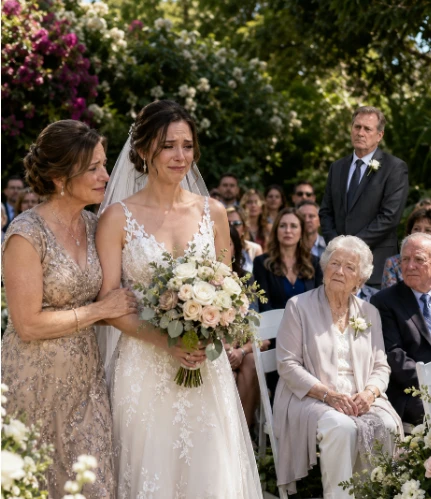
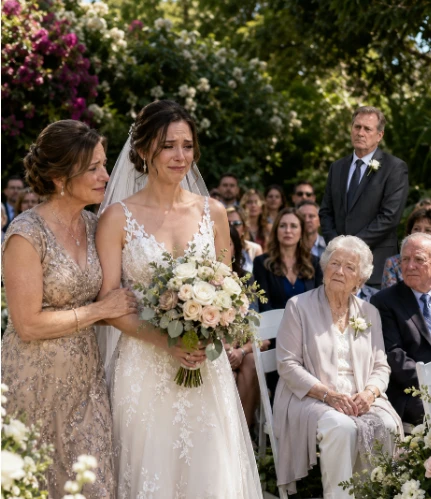
There is a photograph of my mother and me entering the ceremony.
Her face is emotional but steady.
My father stands in the background near the final row.
At first, I considered asking the photographer to crop him out.
Then I decided against it.
The image shows the truth.
He was not where he expected to be.
He came anyway.
I continued anyway.
Everyone remained inside the frame.
That felt important.
I no longer spend much time deciding whether my father is a narcissist.
The word once helped me identify the pattern.
It gave language to control disguised as concern, punishment disguised as hurt, and manipulation disguised as family loyalty.
But the label cannot make decisions for me.
I focus on behavior.
Does he respect no?
Does he communicate directly?
Does he use other relatives to pressure me?
Does he accept consequences without rewriting himself as the victim?
Sometimes he does better.
Sometimes he returns to old habits.
When he does, I respond to the behavior rather than debating his intentions.
That has made our relationship smaller in some ways.
Safer in others.
My father did not lose the privilege of walking me down the aisle because he disliked a guest.
He lost it because he treated his presence as a weapon.
A privilege offered through love cannot survive being converted into leverage.
He believed I would fear the empty space beside me more than I resented the control.
He was wrong.
The space did not remain empty.
My mother stood there.
And even if she had not, I would have walked alone.
Not because I did not need family.
Because family should not require surrender as the price of being present.
My father came to the wedding when he realized the day would happen without his permission.
That may have been the first time he saw me not as the daughter waiting for his approval, but as an adult whose life continued beyond it.
The realization hurt him.
It also gave us the only chance of having a real relationship afterward.
Not a relationship built on obedience.
One built, slowly and imperfectly, around the fact that I could love him and still refuse.