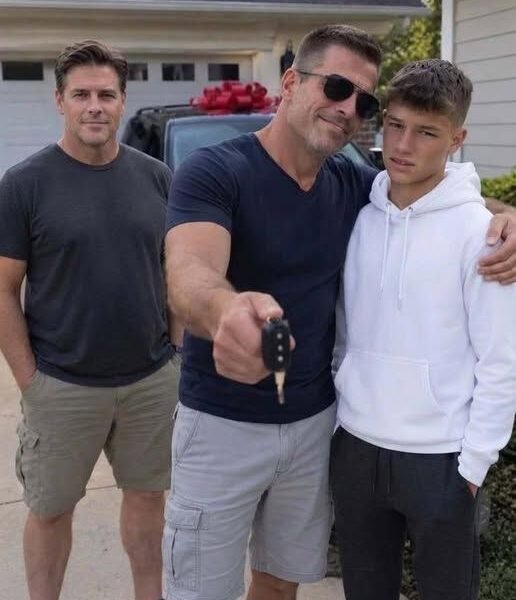
The judge pressed play.
Nothing moved on the courtroom monitor for three long seconds.
Grant Holloway smiled.
His father exhaled.
Then the court clerk leaned toward the screen and said, “Your Honor, the cloud archive is still decrypting.”
I sat beside my younger brother and watched Grant’s smile slowly disappear.
Eli’s hands were folded tightly in his lap.
He was sixteen years old, but when he became frightened, he sometimes made himself small in the same way he had when he was six.
Shoulders curved inward.
Eyes fixed on the floor.
Fingers pressing together until his knuckles turned white.
I placed my hand over his.
“You’re safe,” I whispered.
Across the courtroom, Grant’s mother heard me.
She gave a bitter laugh.
“Safe from what? A broken toy?”
Eli’s fingers tightened beneath mine.
I looked at the judge instead of answering her.
The monitor flickered.
A frozen image appeared.
The activity room.
The puzzle table.
Grant standing behind Eli.
The judge raised one hand.
“Before we view this,” she said, “I want everyone in this courtroom to understand that the issue before us is not the monetary value of a puzzle.”
Grant’s attorney shifted in his seat.
The judge continued.
“The allegations concern targeted harassment, destruction of property, physical intimidation, interference with surveillance equipment, attempted destruction of evidence, and the violation of an emergency protective order.”
Grant’s father shook his head.
“This is madness.”
The judge turned toward him.
“One more interruption, Mr. Holloway, and you will be removed.”
For the first time since the hearing began, he became silent.
The clerk pressed a key.
The video started.
But the story had begun long before that camera captured it.
My brother, Eli, had always loved puzzles.
When he was little, doctors used careful phrases around our family.
Developmental delay.
Cognitive impairment.
Adaptive limitations.
My mother listened to every specialist, wrote down every recommendation, and cried only when she believed Eli was asleep.
I was fifteen years older than him.
By the time he learned to tie his shoes, I had already left for college.
By the time he started middle school, I was finishing law school.
People sometimes assumed that because Eli needed extra time to understand complicated instructions, he did not understand cruelty.
They were wrong.
He understood tone.
He understood laughter.
He understood when a room became quiet because everyone was embarrassed for him.
Most of all, he understood when someone wanted him to feel small.
Puzzles gave him a place where no one could rush him.
Each piece had a shape.
Each shape had a purpose.
If a piece did not fit, it did not mean Eli had failed.
It only meant he had not found the right place yet.
The lighthouse puzzle had been a gift from our late grandfather.
One thousand pieces.
A white lighthouse standing against a black ocean while waves broke against the rocks.
Our grandfather had told Eli, “That lighthouse doesn’t stop the storm. It just keeps shining through it.”
Eli remembered those words exactly.
He brought the puzzle to the activity room at Hawthorne Academy’s community enrichment center because the table there was large enough to hold it.
Hawthorne was the kind of private school that printed its values in gold lettering.
Integrity.
Leadership.
Excellence.
Grant Holloway represented all three words in the school’s advertising materials.
He was handsome, articulate, and polished.
He wore tailored debate jackets and spoke to adults with practiced confidence.
Teachers called him “future senator.”
Parents called him “exceptional.”
Students called him whatever he wanted them to call him.
Grant had won regional debate championships.
His family donated heavily to the academy.
His father owned a chain of investment firms.
His mother chaired the school’s admissions foundation.
Grant had spent his entire life learning that consequences were things that happened to other people.
Six months before the puzzle incident, Grant entered an open-division legal debate exhibition hosted by Stanford.
The competition allowed advanced high-school debaters to challenge law students, professors, and practicing attorneys.
Grant’s team had begged for the opportunity.
He wanted publicity.
He wanted to show college admissions officers that he could defeat adults.
By chance, he drew me as his opponent.
The topic involved whether private institutions should be legally accountable when they ignored documented harassment.
Grant argued that institutions needed broad discretion.
He said reputations should not be destroyed because of “isolated emotional complaints.”
He said strict liability would encourage “weak people to weaponize victimhood.”
The audience shifted uncomfortably.
Then it was my turn.
I used Grant’s own sources against him.
I showed that every institution in his examples had received repeated warnings.
I demonstrated that administrators had protected influential offenders while discrediting vulnerable complainants.
Then I asked him a simple question.
“If a powerful person harms someone who cannot defend himself, and everyone stays silent to protect the powerful person’s future, whose future matters?”
Grant opened his mouth.
Nothing came out.
The judges ruled unanimously against him.
A recording of the debate spread online.
Grant had never experienced public defeat.
Not real defeat.
Not the kind his parents could erase with a phone call.
Two weeks later, he saw my name on a visitor form when I came to pick up Eli.
He made the connection immediately.
“You’re Professor Carter’s brother?” he asked.
Eli smiled because he thought Grant was being friendly.
“Yes. Nathan is my brother.”
Grant’s expression changed.
From that day forward, small things began happening.
A corner piece disappeared from Eli’s puzzle.
Then another.
Someone wrote “BABY GAME” on a sticky note and placed it on Eli’s chair.
Grant passed the table one afternoon and said, “Still working on that? Most people would have finished it weeks ago.”
Eli answered honestly.
“I like going slowly.”
Grant smiled.
“I can tell.”
Students nearby laughed.
Eli did not understand why until later.
He told no one.
He believed complaining would make things worse.
Grant understood that.
Bullies often do.
They test how much silence they can buy with embarrassment.
The missing pieces became insults.
The insults became threats.
One student, Maya Reynolds, quietly warned Grant to leave Eli alone.
Grant cornered her after debate practice.
“You’re applying to Hawthorne’s scholarship committee, right?” he asked.
Maya nodded.
“My mother chairs it,” Grant said. “Think carefully about what you saw.”
Maya stopped speaking to Eli.
Not because she stopped caring.
Because she was seventeen and terrified.
Grant mistook fear for loyalty.
On the day of the attack, Eli arrived in the activity room with only three pieces left.
He had kept them inside a small blue envelope so they would not disappear.
Several students gathered around the table.
Even students who had laughed before wanted to see him finish.
Eli picked up the first piece.
It completed the storm clouds.
The second completed the lighthouse window.
He reached for the final piece.
It was the light itself.
That was when Grant walked in.
He had lost another debate tournament the previous weekend.
One of the judges had quoted my Stanford argument while criticizing him.
Grant heard students whispering about it in the hallway.
Then he saw Eli surrounded by people.
For once, no one was paying attention to Grant.
“What’s this?” he asked.
Eli looked up.
“I’m almost finished.”
Grant picked up the final piece before Eli could reach it.
“Give it back,” Maya said.
Grant examined it between two fingers.
“This is what everyone’s excited about?”
Eli stood.
“Please.”
Grant turned to the room.
“Do you know what’s wrong with this school?”
No one answered.
Grant pointed at Eli.
“We celebrate people for doing things children can do.”
Maya stepped forward.
“Put it down.”
Grant’s face hardened.
“My family paid for half the equipment in this room.”
“That doesn’t make it yours,” she replied.
Grant looked around and saw several phones raised.
He should have stopped.
Instead, the audience made him bolder.
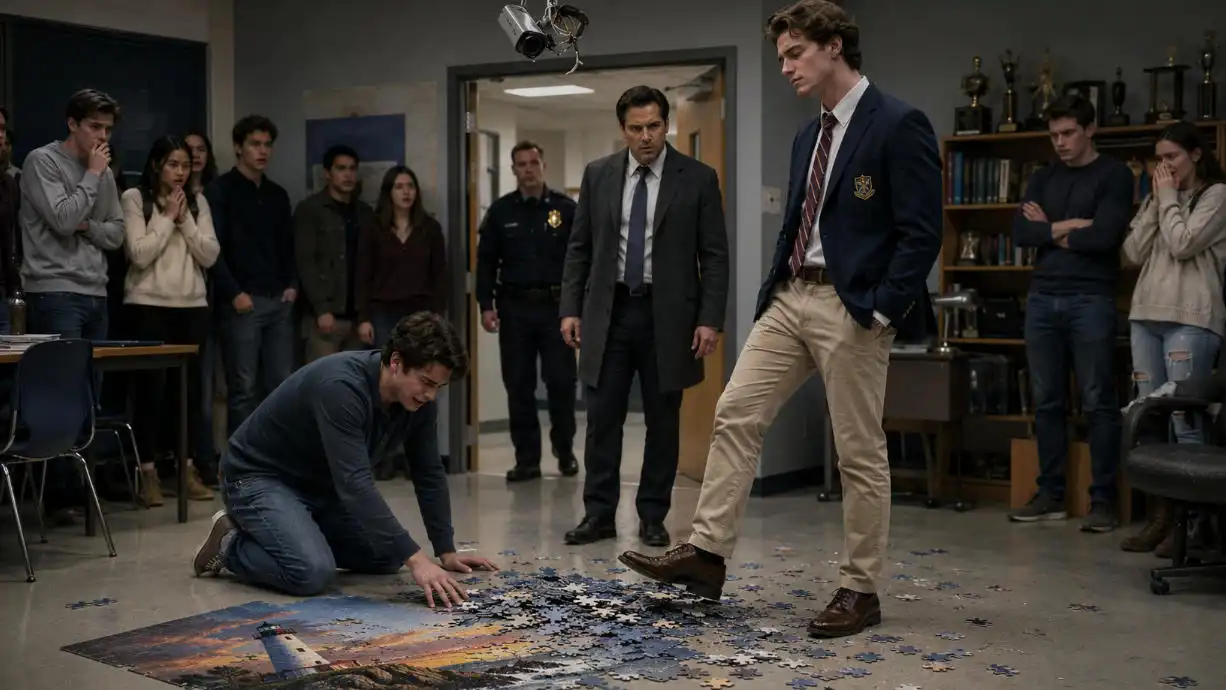
He dropped the final piece onto the puzzle.
Then he swept both arms across the table.
The lighthouse disappeared beneath an avalanche of cardboard.
Eli screamed.
Not loudly.
It was a short, broken sound.
He dropped to his knees and began gathering pieces with both hands.
“Please don’t step on them,” he begged.
Grant placed his shoe over the lighthouse.
Crunch.
Eli reached for the pieces.
Grant shoved his shoulder hard enough to knock him sideways.
Students gasped.
Grant looked down at him.
“A kid like you shouldn’t be touching something this advanced.”
A student said, “What is wrong with you?”
Grant smiled.
“People like him don’t belong in rooms built for winners.”
That sentence changed everything.
Not because it was the cruelest thing Grant had said.
Because the security camera recorded it clearly.
Grant noticed the camera only after Maya pointed toward it.
“It got all of that,” she said.
Panic flashed across his face.
He grabbed a chair, climbed onto it, and struck the camera with his metal bottle.
Once.
Twice.
The camera housing cracked.
The status light went dark.
Grant climbed down.
“Now it didn’t.”
He had no idea that Hawthorne’s insurer had required cloud-based surveillance after a previous vandalism incident.
Every five seconds, the camera sent encrypted footage to an off-site server.
The damaged camera could not be erased because the evidence was no longer inside it.
Maya called me.
She did not begin with hello.
“Professor Carter, Grant hurt Eli.”
I was teaching a seminar when the call came.
I walked into the hallway and asked four questions.
“Is Eli safe?”
“Yes.”
“Is Grant still there?”
“Yes.”
“Did anyone record it?”
“The security camera did, but Grant smashed it.”
“Did he threaten witnesses?”
Maya hesitated.
Then she told me about the scholarship committee.
I called our mother.
As Eli’s legal guardian, she electronically authorized me to act as the family’s attorney.
I contacted a local judge assigned to emergency civil matters.
I did not ask the judge to punish Grant without a hearing.
I requested three narrow measures.
A temporary no-contact order.
An evidence-preservation order covering surveillance systems, phones, messages, and school records.
And an order preventing Grant from leaving the property until court officers documented compliance and secured witness information.
The judge reviewed sworn statements from Maya, the activity-room supervisor, and two students.
She signed the order.
When I reached Hawthorne, the principal met me at the door.
“You didn’t need to involve a court,” he said.
“Your students reported repeated harassment.”
“We were investigating.”
“For how long?”
He looked away.
I entered the activity room with two court officers.
Eli was still on the floor.
He had placed the broken pieces in careful rows.
Grant stood near the exit, speaking to his father by phone.
When he saw me, he smiled.
“Here comes the famous professor.”
I walked past him.
I knelt beside Eli and wrapped my jacket around his shoulders.
“I’m sorry,” Eli whispered.
“For what?”
“I didn’t finish it.”
My throat tightened.
“You did nothing wrong.”
Behind me, Grant said, “This is dramatic even for you.”
One of the officers handed him the order.
Grant barely glanced at it.
“You can’t detain me.”
“You are not under arrest,” the officer explained. “You are being served with an emergency order. Leaving before evidence is secured would place you in violation.”
Grant’s father arrived first.
His mother arrived soon afterward.
Neither of them asked whether Eli was injured.
Neither of them asked what Grant had done.
His mother stared at me and said, “Do you understand what an accusation like this could do to his college prospects?”
I looked at Eli on the floor.
“Do you understand what your son just did to mine?”
“It was a puzzle.”
“It was targeted harassment.”
“It was cardboard.”
“It was property destruction.”
“He is a child.”
“He is eighteen.”
Grant’s father stepped closer.
“My attorneys will bury this.”
One of the court officers activated his body camera.
“Sir,” he said, “I recommend that you step back.”
Grant’s father lowered his voice.
“You are making an enemy of the wrong family.”
“No,” I replied. “Your son selected the wrong victim.”
That line later appeared in news reports.
But the most important moment happened after everyone stopped shouting.
Eli stood.
He wiped his face.
Then he pointed at Grant.
“He did it because you beat him.”
Grant laughed too quickly.
“What are you talking about?”
“At the debate,” Eli said. “You told me I had to pay for making you look stupid.”
The room became still.
I had not known that.
Neither had Grant’s parents.
The court officers immediately instructed everyone to stop speaking about the incident until formal statements could be taken.
Grant ignored them.
“He’s confused.”
Eli looked at me.
I nodded.
He continued.
“You said hurting me would hurt Nathan.”
Grant’s mother grabbed her son’s arm.
“Stop talking.”
That afternoon, investigators secured the cloud archive.
They also preserved messages from Grant’s phone before he could delete them.
One message to a teammate read:
Carter humiliated me in front of Stanford. I’m going to teach his little brother what losing feels like.
Another read:
Camera’s dead. Tell everyone it was an accident.
The video now playing in court confirmed every word.
Grant was visible taking the final piece.
Visible sweeping the puzzle away.
Visible stepping on it.
Visible shoving Eli.
Visible attacking the camera.
His voice came through the speakers with brutal clarity.
“People like you don’t belong in rooms built for winners.”
No one in the courtroom moved.
Grant’s mother stared at the table.
His father’s face had turned gray.
The judge paused the recording.
Grant’s attorney whispered to him.
Grant shook his head.
Then he stood without permission.
“It was a joke.”
The judge’s expression did not change.
“You threatened witnesses.”
“No, I didn’t.”
The prosecutor placed a printed message on the display screen.
It was Grant’s conversation with Maya.
Your scholarship disappears if you repeat what you saw.
Grant looked at Maya, who was seated behind us.
She did not look away this time.
The judge asked Eli whether he still wished to testify.
I leaned toward him.
“You can stop.”
Eli swallowed.
“No.”
He walked to the witness chair.
The clerk asked him to promise that he would tell the truth.
“I promise,” he said.
Grant’s attorney approached carefully.
“Eli, sometimes you become overwhelmed, correct?”
“Yes.”
“And sometimes you misunderstand jokes?”
“Yes.”
“So is it possible Grant was joking?”
Eli looked at Grant.
Then he looked at the broken lighthouse pieces sealed inside a clear evidence bag.
“No.”
“How can you be certain?”
“Because jokes are supposed to make both people happy.”
Several people in the courtroom lowered their heads.
The attorney tried again.
“Did Grant say he hated you?”
“He said I didn’t belong.”
“Did he use the word hate?”
“No.”
“Then perhaps you assumed—”
Eli interrupted him.
“He smiled when I cried.”
The attorney stopped.
Eli continued.
“He watched me work for a month. He knew it mattered. He waited until everyone was looking.”
The judge asked, “Why do you believe he waited?”
Eli answered, “Because hurting someone is not enough for him. He needs people to see him win.”
Grant’s expression changed.
My brother, who Grant had called too slow to understand anything, had described him more accurately than any expert witness could have.
The court issued a longer protective order.
The school expelled Grant after an independent disciplinary hearing.
Prosecutors charged him as an adult with misdemeanor assault, targeted harassment under the state’s vulnerable-person statute, destruction of property, witness intimidation, and attempted evidence tampering.
The destruction of the puzzle alone would not have sent him to jail.
The shove alone probably would not have either.
But Grant had threatened witnesses.
He had tried to destroy surveillance evidence.
And two days after receiving the no-contact order, he created an anonymous account and messaged Eli:
Your brother cannot protect you forever.
Investigators traced the account to Grant’s home network.
That violation transformed the case.
Grant rejected an early agreement that would have required probation, counseling, restitution, and community service.
His father insisted they would win at trial.
They did not.
Grant was convicted on multiple counts.
The judge sentenced him to a short period in county detention followed by supervised release, mandatory behavioral treatment, community service with a disability-support organization, and a prohibition against contacting Eli or any witness.
The sentence was not designed to destroy his life.
It was designed to stop him from destroying someone else’s.
The college consequences followed.
Grant had applied to eight elite universities.
Four rejected him after Hawthorne reported his expulsion.
Three withdrew conditional offers after the public adult-court judgment.
The final school requested an explanation.
Grant submitted a statement claiming he had been persecuted over “a harmless prank.”
The admissions committee obtained the court findings.
His application was denied for dishonesty.
His debate trophies remained on a shelf in his parents’ home.
But the institutions he believed were waiting to crown him had seen what he did when he thought no authority was watching.
Grant had spent years learning how to win arguments.
He had never learned that an argument cannot erase evidence.
Months later, Eli and I returned to the activity room.
The school had replaced the damaged camera.
The principal had resigned after investigators discovered that administrators had received three earlier complaints about Grant and failed to document them.
Maya received her scholarship through an independent fund with no connection to Grant’s mother.
She joined us at the table.
The puzzle company had stopped producing the lighthouse design, but thousands of people had heard Eli’s story.
One woman in Ohio found an unopened copy in her late father’s attic.
She mailed it to Eli with a note.
Every lighthouse deserves to shine.
We opened the box together.
Eli insisted that we start from the corners.
For the next four weekends, I sat beside him.
No courtroom.
No reporters.
No cameras except the security system above the door.
We worked piece by piece.
Sometimes Eli found five pieces before I found one.
Every time that happened, he tried not to smile.
“You can say it,” I told him.
“I’m better at this than you.”
“You are much better at this than I am.”
On the final afternoon, only one piece remained.
The light at the top of the lighthouse.
Eli held it between his fingers.
He did not place it immediately.
“What if somebody breaks it again?” he asked.
I looked around the activity room.
Maya was there.
Our mother was there.
Several students who had once stayed silent were there.
The new principal stood near the doorway.
“No one can promise that cruel people will never try to break what matters to us,” I said. “But you won’t face them alone again.”
Eli pressed the final piece into place.
Everyone applauded.
He covered his ears for a second because the sound surprised him.
Then he laughed.
Our grandfather had been right.
The lighthouse did not stop the storm.
It kept shining through it.
At that same hour, Grant sat behind a barred detention-center window completing a court-ordered reflection assignment.
His counselor asked him why he had attacked Eli.
Grant first wrote that he had been angry.
Then jealous.
Then humiliated.
Finally, he wrote the truth.
I believed being smarter made me more valuable. I wanted everyone to see him as less, because I was afraid they had started seeing me as less.
The counselor made him read the sentence aloud.
For once, there was no audience to impress.
No trophy to collect.
No frightened student to dominate.
Only a young man confronting what his arrogance had cost him.
Eli never celebrated Grant’s confinement.
He never asked to see him suffer.
When I told him Grant had been sentenced, Eli only said, “Maybe he will learn not to do it again.”
That was the difference between them.
Grant had mistaken gentleness for weakness.
Eli proved that gentleness can survive humiliation without becoming cruel.
We framed the completed lighthouse puzzle.
Beneath it, Eli placed a small brass plaque.
It did not mention Grant.
It did not mention the trial.
It contained only our grandfather’s words:
THE STORM DOESN’T DECIDE WHO KEEPS SHINING.
⚖️ Choose your side and share this story:
A — Grant’s punishment went too far for an eighteen-year-old.
B — Protecting vulnerable people matters more than protecting a bully’s reputation.
Disclaimer: Mention of any brand or trademark is for identification
only
and does not imply partnership or endorsement