A Hollywood Invasion in the Heart of Colorado
In the summer of 1969, the quiet farming community of Montrose, Colorado, found itself caught between two completely different worlds. On one side was the traditional rhythm of rural life: farmers waking before sunrise, ranchers checking livestock, families depending on the land for their future. On the other side was the enormous machinery of Hollywood, a world of cameras, celebrities, production trucks, and hundreds of people temporarily transforming the landscape for a major motion picture.
The arrival of the True Grit film production brought something Montrose had never experienced before. The town became a temporary Hollywood outpost. Streets that had once been filled mostly with local traffic suddenly carried equipment trucks. Restaurants filled with actors and crew members. Hotels that normally served travelers and business visitors became temporary homes for people working on one of the biggest Western films of the era.
For many residents, it was exciting. The presence of John Wayne, one of the most recognizable actors in America, created a sense of pride. Families talked about seeing him around town. Children hoped to catch a glimpse of the famous cowboy star. Local businesses benefited from the sudden attention.
But not everyone saw the movie production as an opportunity.
For a young farmer named Garrett, the film crew was simply a neighbor who had arrived without understanding the responsibilities that came with sharing the land.
At only 28 years old, Garrett was not interested in celebrity or Hollywood fame. His world was much smaller and much more immediate. He owned a modest property outside Montrose with a small house, a barn, and a cornfield that represented everything his family depended on.
The farm was not large. It was not the kind of operation that could absorb a major financial setback. Every decision mattered. Every harvest mattered. Every season carried risk.
The corn growing in that field was more than a crop.
It was his family’s security.
The harvest would help pay the mortgage, purchase winter supplies, maintain the animals, and provide for his wife Nora and their young son. In farming communities, people understand that a successful harvest is not simply the result of planting seeds. It is the result of months of preparation, patience, and sacrifice.
By late summer, Garrett believed his hard work was finally paying off. The corn stood tall, healthy, and close to harvest. After months of watching it grow, he could already imagine the relief that would come when the crop was sold.
Then one morning, he walked outside and saw something that made his stomach drop.
The field was destroyed.
Rows that had once stood high were crushed into the ground. Plants had been eaten, trampled, and broken. The careful work of months had been damaged overnight.
At first, Garrett did not know exactly what had happened.
Then he saw the evidence.
Tracks.
Large animal tracks.
And beyond the damaged rows, he could see the connection to the Hollywood production operating nearby.
The horses used in True Grit had escaped.
And during the night, they had found his cornfield.
The Night the Movie Horses Changed a Farmer’s Life
A Western film depends on authenticity. The horses, the landscapes, and the movement of the actors all help create the world audiences see on screen. For True Grit, the production brought in numerous horses and experienced handlers to create the atmosphere of the Old West.
But during filming, circumstances changed.
The person normally responsible for managing the horses was temporarily unavailable after an accident. The responsibility fell to other crew members who were doing their best but did not necessarily have the same experience with large groups of animals.
The problem began with something that seemed insignificant.
A gate.
To someone unfamiliar with horses, a closed gate appears secure. But experienced ranchers know that animals are unpredictable. Horses are intelligent creatures. They explore their surroundings. They push against obstacles. They notice weaknesses humans often overlook.
That night, the horses escaped.
Under the cover of darkness, they moved away from the production area and eventually discovered Garrett’s field.
From the animals’ perspective, it was simply a source of food. The tall corn provided exactly what they were naturally drawn toward.
But for Garrett, the consequences were devastating.
By morning, nearly half the field had been destroyed.
The damage was not just visual. It represented financial loss that could affect his entire year. Farmers operate on careful calculations. Seeds, equipment, fuel, repairs, and labor all require money before any income arrives.
When a crop fails, the loss is not only what is visible above the ground.
It is everything invested beneath it.
Garrett knew he needed to contact the production immediately. He did not arrive looking for confrontation. He was not trying to create a scene. He simply wanted someone responsible to acknowledge what happened.
He drove to the production site and asked to speak with someone in charge.
But the response he received was frustratingly familiar.
Someone would handle it.
Someone would contact him.
Someone would look into it.
For a large production with hundreds of employees and constant pressure to stay on schedule, Garrett’s damaged field may have seemed like one more problem on an already crowded list.
But for Garrett, it was the only problem that mattered.
He returned home and sat with Nora trying to understand what they could do next. The numbers were not encouraging. They could not simply replace months of work. They could not rewind the growing season. They could not pretend the damage had not happened.
The next day, Garrett returned.
Again, he asked for the production manager.
Again, he was told the timing was not right.
The message was clear: wait.
But waiting was not easy when your family’s future was sitting in a destroyed field.

The Farmer Nobody Was Listening To
Over the following days, Garrett continued trying to get a response. He was not looking for special treatment. He was not asking for anything unreasonable. He simply wanted the people responsible to recognize the seriousness of what had happened.
From the outside, it was a classic conflict between an ordinary individual and a powerful organization.
A farmer with a damaged crop.
A major Hollywood production with money, influence, and hundreds of employees.
The difference in power was obvious.
Garrett did not have lawyers waiting to call. He did not have connections in Los Angeles. He did not have the ability to force attention.
All he had was persistence.
And that persistence eventually caught the attention of someone who had the ability to change the situation.
John Wayne.
At the time, Wayne was not just another actor. He was one of the biggest stars in the world. His image represented strength, independence, and responsibility. Millions of people knew him as the kind of man who stood up when others would walk away.
But away from the cameras, Wayne had developed a reputation among many colleagues as someone who paid attention to people around him. He understood loyalty. He valued respect. And he believed that success came with obligations.
According to the story passed down about the incident, Wayne noticed Garrett repeatedly appearing at the production entrance. He saw the frustration on the farmer’s face. He saw someone who had been trying to solve a problem but had not been taken seriously.
Eventually, Wayne asked what was happening.
When he learned the details, his attitude changed.
This was no longer a simple inconvenience.
This was a matter of doing the right thing.
The production had come into a community that was not theirs. They were guests. They were using local land and local resources. They had benefited from the cooperation of the people around them.
That meant they also had a responsibility when something went wrong.
Wayne understood something that many powerful people forget: the size of an organization does not make a person’s problem smaller.
A farmer’s loss does not become less important because the person causing it has a bigger name.
When John Wayne Decided to Step Forward
John Wayne had spent decades portraying heroes on screen. His characters often entered difficult situations and defended people who needed help.
But the moments that reveal someone’s true character are rarely scripted.
They happen in ordinary places.
Behind the scenes.
Away from the applause.
When Wayne learned about Garrett’s situation, he did not treat it as a public relations issue. He did not see it as something to delegate and forget. He saw a person who had been harmed and deserved a fair response.
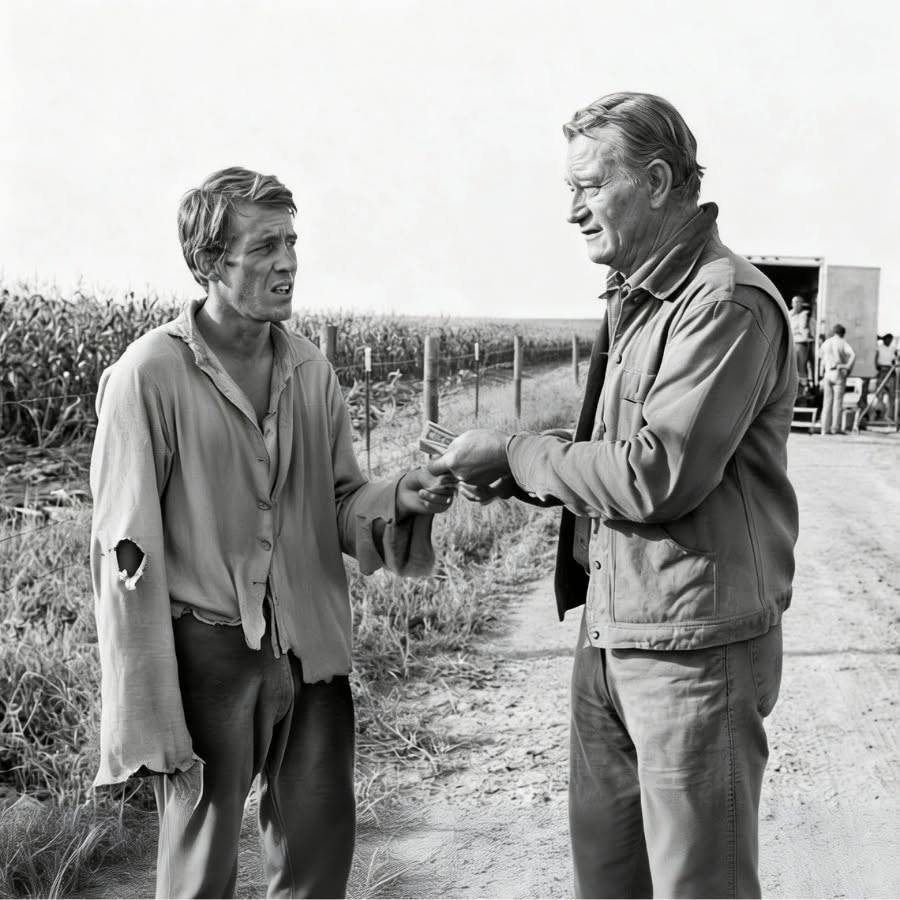
The story says Wayne approached Garrett personally.
That detail matters because it changed the entire tone of the situation.
A representative could have delivered an apology.
A manager could have written a check.
But Wayne chose to acknowledge the farmer himself.
He listened to Garrett explain what the destroyed field meant. He understood that the issue was not only financial. It was about respect.
For someone like Garrett, whose attempts to receive help had been ignored, being heard by one of the most famous men in America meant something.
Wayne reportedly made sure the farmer received compensation for the damage and that the production accepted responsibility.
The exact details of the arrangement have become part of Hollywood folklore, but the message behind the story has remained consistent.
John Wayne did not allow a powerful production to overwhelm an ordinary person.
He used his influence to correct something that was wrong.
And that was the moment many people remember.
Not because a movie star paid for damaged corn.
Because a movie star stopped long enough to care.
More Than Money: The Importance of Respect
There is a difference between solving a problem and making someone feel valued.
A check can replace money.
It cannot always replace dignity.
For Garrett, the destroyed field represented months of effort. It represented early mornings, long days, and the responsibility of providing for his family.
When someone loses a crop, they are not simply losing plants.
They are losing time they cannot recover.
That is why Wayne’s reaction became meaningful. He did not dismiss Garrett as a small farmer whose concerns were insignificant compared with a major Hollywood production.
He recognized that every person deserves to be treated fairly.
This lesson extends beyond Hollywood.
Throughout history, ordinary people have often found themselves standing against much larger forces. Sometimes the difference between feeling powerless and feeling respected is simply having someone important choose to listen.
The story of the Colorado cornfield became memorable because it showed a different side of fame.
Celebrity is often associated with attention, wealth, and influence.
But influence only matters when it is used responsibly.
John Wayne had the ability to ignore the situation.
Instead, according to this enduring story, he chose involvement.
He chose accountability.
He chose fairness.
The Legacy of John Wayne Beyond the Movies
John Wayne’s career created one of the strongest images in American entertainment history. For decades, audiences watched him portray characters who valued courage, loyalty, and personal responsibility.
His films created a larger-than-life image.
But stories like the Colorado cornfield incident reveal why many people admired him beyond his performances.
They believed the qualities he represented were also part of the man himself.
Whether every detail of the story has been preserved perfectly or whether some elements have grown through years of retelling, the meaning behind it remains powerful.
It is a story about a community meeting Hollywood.
It is a story about a farmer protecting his family’s future.
It is a story about a famous actor remembering that ordinary people matter.
The most important moments in a person’s life are not always the ones recorded by cameras.
Sometimes they happen quietly.
A conversation.
A decision.
A moment when someone chooses not to look away.
Reflection: The Hero Behind the Legend
Movies often teach audiences that heroes are defined by dramatic moments. They save someone from danger, defeat an enemy, or stand against impossible odds.
But real life rarely works that way.
Real heroes are often revealed through smaller choices.
They appear when someone with power decides to help someone without it.
They appear when responsibility matters more than convenience.
They appear when a person could easily walk away but chooses to stay.
The story of John Wayne and the Colorado farmer has lasted because it represents something people continue to value: the belief that character matters.
A Hollywood production may eventually be forgotten. A movie set may disappear. The cameras may stop rolling.
But the way someone treats another person can become the story people remember.
John Wayne became famous for playing men who stood tall when challenges arrived.
And according to this unforgettable tale from a Colorado cornfield, when a young farmer found himself standing alone against a much larger world, the man behind the cowboy image chose to do what audiences always hoped his heroes would do.
He stepped forward.