On April 4, 1975, a giant military aircraft lifted into the sky above Saigon carrying something far more precious than any cargo it had ever transported. Inside the enormous C-5A Galaxy were not tanks, weapons, or supplies, but hundreds of tiny children whose entire futures depended on the success of one desperate mission. They were babies who had already lost so much before they were old enough to understand what loss meant. Many had no parents waiting for them, no homes to return to, and no idea that the country beneath them was collapsing into the final days of a devastating war. Some were only weeks old. Some were sick and dangerously undernourished. Some had spent their earliest days surrounded by uncertainty, hunger, and the sounds of conflict. Yet on that day, they were given a chance at something every child deserves — the chance to live.
The aircraft was part of Operation Babylift, a humanitarian mission launched during the final days of the Vietnam War to evacuate thousands of Vietnamese orphans and bring them to safety in the United States and other countries. It was an operation born from heartbreak and urgency, a race against time as North Vietnamese forces moved closer to Saigon and the city prepared for its inevitable fall. Behind the headlines of armies, governments, and politics was another story — a quieter story about hundreds of children who had become innocent victims of a war they never chose. While adults fought battles over land and ideology, these children were simply waiting for someone to protect them.
The decision to evacuate the orphans was surrounded by emotion and controversy. Some questioned whether removing children from Vietnam during such a chaotic moment was the right choice. Others believed that leaving them behind in a collapsing country would put their lives at even greater risk. But for the nurses, volunteers, and military personnel who stepped forward, the answer was simple: these children needed help, and there was no time left to wait.
President Gerald Ford approved the mission after receiving reports about the vulnerable children trapped in the final days of the conflict. The goal was ambitious — to rescue approximately 3,300 Vietnamese orphans and transport them to new lives overseas. It was a mission filled with hope, but also one surrounded by unimaginable danger. The war was ending violently. Airports were becoming increasingly unsafe. Every flight leaving Saigon carried risks that could not be predicted.
The first aircraft chosen for the mission was the largest airplane in the world at the time — the Lockheed C-5A Galaxy. Designed as a massive military transport aircraft capable of carrying enormous equipment across continents, it was never built to carry hundreds of fragile infants. But history had created a situation where ordinary rules no longer applied.
Inside that aircraft on that April morning were 314 people. Among them were 243 babies and children. Many were younger than one year old. Some were too small to even hold their own heads up. Some cried softly while others slept, unaware of the terrifying journey happening around them. They were surrounded by nurses and volunteers who moved carefully through the massive cargo area, checking on each child, feeding them, comforting them, and doing everything possible to make them feel safe.
But there were not enough proper supplies.
There were not enough infant seats.
There were not enough cribs.
There was only urgency.
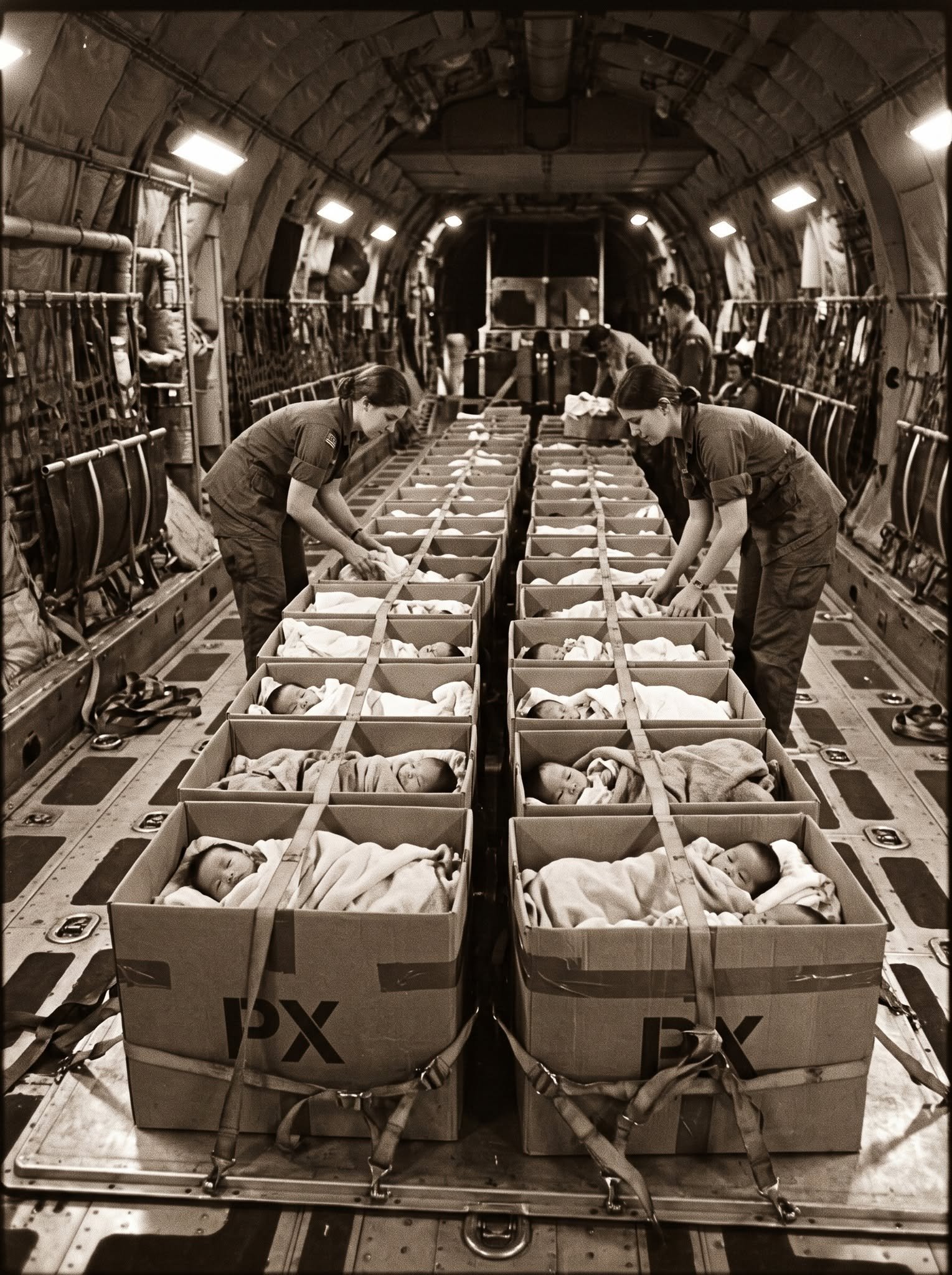
So the volunteers created makeshift beds from whatever they could find. Cardboard boxes from the military base became temporary cradles. Blankets were placed inside. Babies were carefully positioned in the boxes and secured with cargo nets to keep them safe during the flight. Some boxes held two or even three infants together.
To someone looking at photographs from that day, the image is almost impossible to comprehend. Rows of cardboard boxes filling the inside of a military aircraft. Tiny babies lying inside them. Nurses bending down, checking each child with gentle hands. A war zone outside the aircraft and a fragile hope inside.
Those boxes were never meant to carry human lives.
But on that day, they carried the hopes of hundreds of families who would eventually welcome those children.
They carried the dreams of nurses who believed every child deserved a future.
And for many of those babies, those simple cardboard boxes became the first step toward survival.
The nurses who boarded that aircraft understood the danger they were facing. They knew Saigon was falling. They knew the war had reached its final, most unpredictable stage. They knew that flying into and out of a battlefield was never guaranteed to end safely. But they also knew something else — those babies had no one else.
So they went.
They walked into the cargo hold of a military plane, surrounded by strangers, carrying children who could not even say their own names. They held them, comforted them, and prepared them for a journey that would change their lives forever.
For a few moments after takeoff, everything seemed to be going according to plan.
The massive aircraft climbed above the chaos of Saigon. The city below was disappearing into the distance. The babies were finally moving away from the danger. The volunteers could breathe for a moment.
But only twelve minutes after leaving the runway, everything changed.
At approximately 23,000 feet above Vietnam, the rear cargo door of the C-5A Galaxy suddenly failed. The aircraft suffered catastrophic damage, and the peaceful mission instantly became a fight for survival. The force of the decompression was overwhelming. The inside of the aircraft filled with fog as the pressure changed violently. Communication became difficult. Panic spread through the cabin.
The plane that had carried so much hope was suddenly falling apart in the sky.
In the rear section of the aircraft were dozens of children and crew members who had no chance to escape. Two flight attendants and 78 babies and children were lost in those terrible moments.
For the people onboard, there was no time to grieve.
There was only survival.
Captain Bud Traynor, the pilot of the aircraft, suddenly faced one of the most difficult challenges any pilot could imagine. He was controlling a damaged aircraft carrying hundreds of lives. The plane was badly crippled. Returning to Saigon was impossible. The aircraft could not land normally. Every second brought them closer to disaster.
Yet Captain Traynor refused to give up.
With incredible skill and determination, he fought to keep the aircraft in the air. He searched for somewhere — anywhere — where he could bring the plane down. Beneath him was a country still at war, but inside the aircraft were children who had already survived one tragedy and now depended on him for another miracle.
Eventually, he made the only choice available.
He attempted an emergency landing in a rice field.
The enormous aircraft came down violently.
The impact shattered the plane.
The C-5A Galaxy broke into four pieces.
And when the dust finally settled, the world was left with one of the most heartbreaking aviation disasters of the Vietnam War.
One hundred and thirty-eight people had died.
But among the wreckage, something extraordinary was discovered.
Somehow, impossibly, many of the babies had survived.
Still strapped inside their cardboard boxes.
Still protected by the very makeshift cradles that had seemed so fragile.
They were alive.
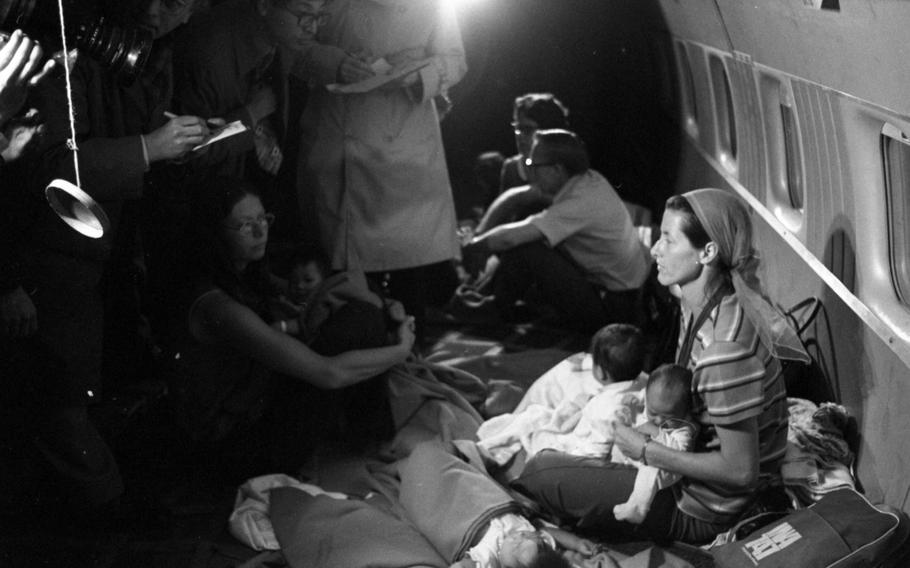
The sight that greeted rescuers after the crash was something that many of them would never forget for the rest of their lives. The massive C-5A Galaxy, once a symbol of American military power, now lay broken across the rice fields outside Saigon. Its enormous body had been torn apart, scattered across the ground like pieces of a giant machine that had finally surrendered to gravity. Smoke rose from the wreckage. The silence that followed the crash was almost impossible to describe. Moments earlier, the aircraft had been filled with the cries of babies, the voices of nurses, and the sounds of people fighting desperately to survive. Now there was only destruction.
But then, among the twisted metal and shattered remains of the aircraft, rescuers heard something unexpected.
A baby crying.
Then another.
Then another.
Inside the wreckage were children who had survived.
Many of them were still inside the same cardboard boxes that had carried them into the sky.
The boxes that seemed so fragile had somehow protected them when the aircraft broke apart. The blankets, the cargo nets, and the careful placement by the nurses had become the difference between life and death. In a moment when everything else had failed, those simple cardboard containers had become unexpected shields.
Of the 314 people aboard the aircraft, 176 survived. Among them were 149 babies and children who were pulled from the wreckage alive.
For the rescuers, it was a moment filled with both heartbreak and amazement. They had arrived expecting to find only tragedy. Instead, they discovered something that seemed almost impossible — tiny children who had survived one of the worst moments of their young lives before they were even old enough to remember it.
But there was no time to celebrate.
The war around them was still moving forward.
Saigon was still falling.
And thousands of other children were still waiting.
The crash of the first Babylift flight could have ended the mission forever. Many people would have understood if the operation had been stopped. The danger had become painfully clear. A plane full of babies had fallen from the sky. Families, officials, and volunteers had every reason to question whether another flight should ever leave the ground.
But something remarkable happened.
The people who had dedicated themselves to saving those children refused to walk away.
The nurses came back.
The volunteers came back.
The aircraft returned.
They knew what had happened. They knew the risks. They knew that another disaster was possible.
But they also knew that behind every number was a child.
A child with a heartbeat.
A child with a future.
A child who deserved a chance.
The very next day, another Babylift flight prepared to leave Vietnam.
The photograph that would later become one of the most recognizable images of Operation Babylift came from this second successful mission. It showed exactly what the first flight had looked like before tragedy struck — rows of cardboard boxes filling the cargo hold of a military aircraft, each one carrying a baby who had no idea that history was unfolding around them.
The image is difficult to look at without feeling something.
At first glance, some people see only boxes.
But those boxes contained names.
They contained dreams.
They contained entire futures waiting to begin.
Behind every small face was a story that had started with loss but would continue with hope.
The nurses in that photograph were not simply transporting children.
They were carrying humanity through one of the darkest moments of the war.
Many of them had watched the news of the crash. Some knew people who had died. Some had seen the wreckage. They understood exactly what they were volunteering for.
And still, they stepped onto the aircraft.
They walked through the same cargo area where other children had lost their lives only one day earlier.
They checked the boxes.
They held the babies.
They prepared for takeoff.
Because courage is not the absence of fear.
Courage is knowing the danger is real and choosing to do what is right anyway.
For many of those children, the flight marked the beginning of a completely different life.
They arrived in America as strangers in a foreign land. They had no memories of Vietnam. They had no understanding of the war that had shaped their earliest days. They were welcomed by families who adopted them, raised them, and gave them opportunities they might never have had.
But for decades, many of them did not know the full story of how they arrived.
They grew up hearing that they had been rescued from Vietnam.
They knew they were part of Operation Babylift.
But many did not know just how close they had come to death.
They did not know that the plane carrying them had fallen from the sky.
They did not know that some of the children who began that journey beside them never reached America.
They did not know that their lives were connected to one of the most tragic and miraculous chapters of the Vietnam War.
For some survivors, the truth came much later.
Decades after the crash, they learned that they had not simply been evacuated from a war zone.
They had survived a disaster.
They had been carried through the sky inside a broken aircraft.
They had been protected by strangers who refused to give up.
One of those survivors was Aryn Lockhart.
She was only two months old when she was placed inside one of those boxes aboard the first Babylift flight.
She was too young to remember the sound of the engines.
Too young to remember the fear.
Too young to know that the aircraft carrying her would soon become one of the most tragic flights in American military history.
But her life was changed forever in those few minutes above Vietnam.
Today, Aryn is a mother living in Ohio.
She grew up thousands of miles away from the country where her life began. She built a family, created memories, and experienced all the ordinary moments that make a life meaningful.
But behind that ordinary life was an extraordinary beginning.
A beginning that started inside a cardboard box.
A beginning that survived a plane crash.
A beginning made possible by people who chose compassion during a time of war.
The story of Operation Babylift is not only about an airplane.
It is not only about a crash.
It is not only about the final days of Saigon.
It is about the power of human kindness when everything around us is falling apart.
It is about nurses who entered danger because helpless children needed them.
It is about pilots who fought against impossible odds.
It is about strangers who became family.
And it is about children who began their lives surrounded by uncertainty but grew up to prove that even the smallest lives can carry incredible strength.
The photograph of those babies in cardboard boxes remains powerful because it captures a moment when the world seemed completely broken.
A war was ending.
A city was disappearing.
A plane had fallen from the sky.
Yet inside those boxes were tiny reminders that hope can survive even in the darkest moments.
Those babies were not just passengers.
They were survivors.
They were witnesses to history.
And decades later, their lives became the answer to one unforgettable question:
What happens when humanity chooses to save someone, even when the world around them is falling apart?
The answer is written in every life that continued.
Every family that was created.
Every child who grew into an adult.
Every survivor who looked back and realized that before they ever learned to walk, they had already overcome the impossible.
Because on one terrifying flight out of Saigon, inside simple cardboard boxes, hundreds of fragile lives were carried toward a future they were never supposed to see.
And somehow, against all odds, they made it.