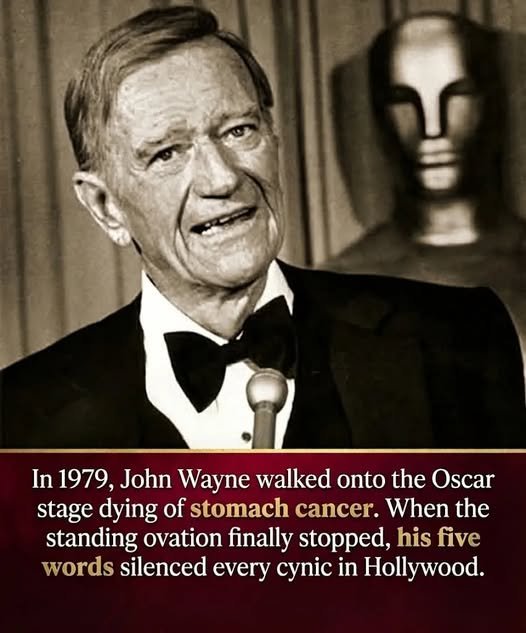
Hollywood held its breath in April 1979 as John Wayne, the embodiment of American fortitude, made his way to the Oscar stage. The applause was not merely polite; it was a sustained, emotional roar that seemed to lift him up. The man they celebrated was visibly diminished, having recently undergone a severe surgery in his fight against cancer. This was a poignant sight: the mythic cowboy confronting his own mortality in front of the entire world, yet doing so on his own two feet.
His appearance was a deliberate act of courage. After surviving lung cancer years before, this new illness threatened to confine him. Wayne would have none of it. He arrived at the ceremony thinner and weaker, but with a resolve that filled the room. The standing ovation he received was Hollywood’s unconditional tribute, a rare moment of pure unity for a figure who had been both revered and contested throughout his long career.
As the clapping slowly faded, Wayne leaned toward the microphone. With the eyes of the world upon him, he distilled the entire emotional experience into a single, perfect sentence: “That’s about all the medicine a fella’d ever really need.” The words were gentle, yet they landed with the force of a hammer. In that instant, the applause was reframed. It wasn’t just noise; it was recognition, respect, and a collective offering of strength to a man who had given so much of his own.
He then seamlessly transitioned into his role as presenter, charming the audience with a joke about their shared history in the industry. The moment was layered with meaning—the laughter acknowledged the joke, but the silence between the laughs acknowledged the truth. Everyone present knew they were witnessing a final, powerful statement from a living legend who was staring down the end with characteristic fearlessness.
John Wayne’s death a short time later turned that Oscar clip into a sacred piece of cultural memory. His final public act was not one of triumph over disease, but of profound human dignity in its face. The John Wayne Cancer Institute ensures his fight continues for others. That night in 1979 endures as a lesson: legacy is not about avoiding the fall, but about how you choose to stand before it. True courage is standing before your peers, diminished but unbroken, and accepting their salute.