The quiet of the Ardennes was shattered before dawn on December 16, 1944. Allied troops thought they were in a calm sector, but the calm vanished in an instant when the German artillery opened fire. Shells exploded along an eighty-mile front, shaking the ground and shredding trees. Snow flew into the air like smoke. Men of the 106th Infantry scrambled for cover, stunned by the ferocity of the assault. The Germans were launching a massive counteroffensive, one that would catch the Allies off guard and ignite the Battle of the Bulge.
Private Andy Harper pressed himself into a foxhole near St. Vith. The bombardment was so intense he could barely lift his head. His sergeant shouted orders, but the noise drowned everything out. Andy felt the vibrations of every explosion in his chest. He knew, even without seeing the enemy, that this attack was unlike anything they had faced before. Hitler was gambling everything on one bold strike through the snowy forest.
A few days later, Eisenhower studied a huge map showing the German advance. Red arrows pushed deep into the Allied line, and the air in the room was heavy with tension. Officers whispered about the possibility of losing Antwerp, which would sever the Allied front and disrupt everything they had gained since Normandy. Eisenhower asked for solutions, but none seemed realistic—until he turned to Patton.
When Eisenhower asked how quickly Patton could redirect his army north, the room fell silent. Patton answered quickly: two days. Officers exchanged incredulous looks, convinced he was exaggerating. Patton calmly explained that he had ordered contingency plans long before this meeting. Eisenhower weighed the risk and ultimately trusted him. Patton saluted and marched out, already preparing for the impossible.
At Third Army Headquarters, Patton’s presence filled the room like a gust of wind. He told his staff that they were moving immediately, and resistance flared among the officers. They argued that the men were exhausted, the weather worsening, and the roads nearly impassable. Patton cut them off and insisted that speed was their greatest weapon. The 101st Airborne was trapped in Bastogne, and he was determined to reach them. His voice left no room for debate.
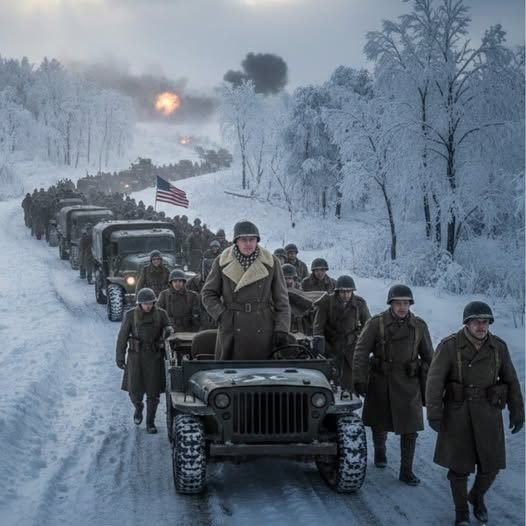
Within hours, units across Third Army scrambled into action. Truck engines growled to life as convoys formed. Tanks rolled out of their positions and lined up along icy highways. Infantry bundled themselves against the cold and marched through deepening snow. The scale of the movement was staggering—an entire army turning north in the middle of winter.
Patton refused to be out of sight during the march. He rode in an open jeep, greeting soldiers as snow stung his cheeks. His determination spread through the ranks. Even exhausted men felt a surge of energy when they saw him standing tall in the freezing wind. He believed that momentum itself could break the enemy’s spirit, and he drove his army like a man racing a clock.
Storms grounded Allied air support, and Patton stormed into the chaplain’s tent to demand a prayer for good weather. Father O’Neill hesitated, unsure how to word such a request, but Patton insisted it needed to be direct. Copies of the prayer were printed by the thousands. Soldiers recited it under their breath as they marched. When the sky cleared the next morning and the sun broke through, pilots took to the air, turning the tide against the Germans.
In Bastogne, the 101st Airborne endured constant shelling. Supplies dwindled. Men fought through freezing nights, huddled in foxholes carved from frozen earth. When German officers demanded their surrender, General McAuliffe sent back the single word that became legendary—“NUTS.” It gave the men a spark of confidence, even as the ring of German forces tightened.
Patton’s army pushed north with everything they had. Fighting intensified as German units tried desperately to stop the relief effort. Patton promised his officers that they would break the siege by Christmas. They did not argue, though many wondered how they would achieve such a feat. Yet on December 26, tanks from the 4th Armored Division smashed through and reached the defenders. Paratroopers rushed forward to meet them, tears freezing on their cheeks.
For the men in Bastogne, the arrival of Patton’s troops felt like a miracle. For Patton, it was simply the result of speed, discipline, and refusal to accept defeat. He praised the paratroopers for their courage but reminded his own men that the battle was far from over. The Germans had spent their strength, and now the Allies were ready to push back.
Clear skies returned in January, allowing bombers to pound retreating German forces. Patton laughed that he would keep the chaplain close, given how well the last prayer had worked. But in private moments, he walked quietly among the graves outside Bastogne, reflecting on the cost of victory.
The German offensive collapsed completely. Hitler’s last major gamble had failed, and Allied forces moved steadily eastward. Patton continued to lead from the front, urging his men through bitter cold and relentless fighting. He knew the war was entering its final stages.
Though the Ardennes remained scarred by the battle, the outcome marked a turning point. The courage of the trapped paratroopers and the speed of Patton’s advance became symbols of Allied resilience. When asked later how he had accomplished it, Patton simply said that when a task must be done, hesitation is the enemy. The winter of 1944 proved the truth of that belief in every frozen mile.