Because I was kidnapped as a child, my dad had a tracker embedded in my bracelet. That day, when I couldn’t find it, my dad called immediately: “Take nothing. Come downstairs immediately. Your brother is waiting in the car…”

The steam in the bathroom hadn’t fully cleared yet. A layer of condensation still clouded the mirror. I stepped out, wrapped in a towel, and instinctively reached for the second drawer on the right side of the vanity to grab my bracelet. My hand grasped empty air.
I looked down. The drawer held only a box of Q-tips and a half-empty tube of hand cream. The bracelet was gone.

My heart skipped a beat in that exact moment. I never took that bracelet off. Ever since I was kidnapped at the age of seven, my dad had a micro-locator chip the size of a grain of rice embedded inside the silver band. It synced in real time with our family’s proprietary cloud security servers.
For 22 years, it had felt like an extra bone grown into my wrist. I’d take it off right before stepping into the shower and put it back on the second I stepped out. There were no exceptions.

I ransacked the drawer again, then crouched down to check the grout lines between the floor tiles.
Nothing. “Ethan,” I called out toward the bedroom.
Ethan’s voice drifted in from the living room, carrying a touch of lazy nasal resonance. “What’s wrong?”
“Did you see my bracelet? I left it right here in the vanity drawer.” Footsteps approached unhurried. He appeared in the bathroom doorway wearing a gray heathered Henley shirt, his hair slightly tousled, wearing that gentle smile that had made me feel safe for the past 3 years.

“Your bracelet?” He walked over, pulled the drawer open to take a look, and then bent down to scan the floor. “I don’t see it. Did you leave it somewhere else?”
“Impossible. I put it here every single time.”
“Could it have fallen down the drain? You took it off and left it on the counter, and the water washed it down.”

“No,” I cut him off. “I put it inside the drawer before I showered.”
I remember it perfectly. He straightened up, placed both hands on my shoulders, and used his thumbs to gently knead the tight muscle near my collarbone.
“Don’t panic. Let’s just look for it slowly. If we really can’t find it, I’ll take you to get a new one tomorrow.”
His hands were warm. The pressure applied with exact precision.

Throughout our three-year marriage, every subtle gesture of his seemed calculated to perfection. When to massage my shoulders, when to hand me a cup of hot chamomile tea, when to say, “You’ve worked so hard.”
I used to call that thoughtfulness.
“I can’t just get a new one,” I said. “It has a tracking chip inside. It’s tied to my dad’s servers.”
His thumbs paused for about 0.3 seconds. Then they resumed massaging.

“Well, then we really need to find it,” he said, patting my back. “Get dressed first. Don’t catch a cold. I’ll go check the bedroom for you.”
He turned and walked out of the bathroom.
I stood rooted to the spot, staring at the empty drawer. My fingers mindlessly traced my left wrist. There was a faint permanent indentation left by years of wearing the metal band. Exposed to the air, it looked like an unhealed wound.
I walked into the bedroom, threw on my clothes, and unlocked my phone.
I didn’t make a call. Instead, I logged into the back end of Aurora Cybernetics Cloud Management System. I had helped develop this platform. The chip in the bracelet pinged the satellite every 12 seconds.

Even if the bracelet were locked in a lead box, as long as the micro-battery had juice, it could pierce through most conventional shielding. I entered my passcode and opened the tracking interface.
Signal status offline.
Last valid signal tonight, 7:47 p.m.
Current time: 8:23 p.m., which meant the signal had dropped during the 36 minutes I was in the shower.
It wasn’t a dead battery. The chip had an 8-year lifespan and was just replaced last year. The only explanation was physical shielding. Someone had wrapped it in professional-grade signal blocking material, a Faraday bag.

My fingertips started to turn icy.
Not the chill of a dropping temperature, but a deep seeping frost radiating from my bones.
Just then, my phone vibrated.
Caller ID, Dad.
I picked up.
“Chloe.”
My dad’s voice was incredibly heavy. So much so that I almost thought the connection was bad.
“Can you talk right now?”
“I can. What’s wrong, Dad?”
“Your bracelet signal dropped 15 minutes ago. My system automatically triggered an anomaly alert, but that’s not why I’m calling.”
He paused.
“Chloe, listen to me. The moment the chip disconnected, it triggered a fallback protocol. You don’t know about this because I added it later. The second the chip is shielded, it activates an ambient audio collection module. It records all sound within a 5-meter radius and syncs it to the cloud immediately.”
I gripped my phone tight.
“The recording just finished syncing.”
Dad’s pace quickened, each word clipped and urgent.
“Chloe, don’t grab anything. Come downstairs right now. You have a Rolls-Royce waiting by the fire lane.”
“Dad, tell me what’s on the recording.”
“Listen to it in the car. Leave now.”
“I need to know.”
“Chloe.”
Dad’s voice suddenly spiked in volume, then dropped, carrying a tremor I had only heard twice in my life. The last time being the day I was kidnapped at seven.
“Please just get out of there.”
I hung up.
Ethan walked out of the walk-in closet holding one of my cardigans, wearing his standard look of concerned affection.
“Found it?” he asked.
“No.” I took the cardigan and draped it over my shoulders. “I’m going to run down to the convenience store to grab something. Take a walk. Clear my head.”
“I’ll go with you.”
“No need. Go to bed early.”
I flashed him a smile. That smile lasted exactly 3 seconds. And it was the most strenuous feat of facial muscle management I had ever performed in my life.
Because as I smiled, my molars were clamped together so hard my jaw ached.
At the entryway, I didn’t take my purse.
I didn’t take my keys.
I didn’t even change into proper shoes. I just pushed the front door open in my cotton slippers.
Riding the elevator down, my hands wouldn’t stop shaking.
It wasn’t fear.
It was something deeper than fear.
It was my entire body refusing to accept the information my brain had already flawlessly deduced.
Sure enough, a black Rolls-Royce Phantom sat parked downstairs, headlights off, tucked discreetly beside the fire lane on the left side of the building’s main entrance.
It was a blind spot from our apartment’s windows.
I opened the rear door and slid in. My older brother, Julian, was sitting in the back wearing a dark trench coat. He looked grim.
Julian wasn’t the type to panic easily. He took over the family’s North American operations at 26 and had faced every kind of corporate shark imaginable.
But right now, the look in his eyes held something unfamiliar. It looked like heartbreak mingled with a violent rage forcibly suppressed beneath a calm facade.
“Drive,” he told the chauffeur.
The car glided silently into the night traffic.
“Julian, let me hear the recording first.”
He pulled a wireless earbud from his pocket and handed it to me.
“Dad pulled it from the cloud. It’s 4 minutes and 17 seconds.”
I took the earbud, placed it in my left ear. He tapped his phone screen.
The recording began.
The first thing I heard was a muffled background noise, the humming resonance of the water pipes, the unique acoustic frequency of our bathroom while the shower was running.
Then footsteps, someone walking very close to where the bracelet was.
Then came Ethan’s voice.
“I got it.”
His tone was completely different from the man I knew. No warmth, no gentleness.
It was an extremely cold clinical cadence, like he was delivering a corporate status report.
Another man’s voice chimed in, gravelly and rough, laced with an oppressive impatience.
“The bracelet? Just this piece of junk?”
“Don’t underestimate it. It connects directly to his father’s servers. The GPS accuracy is within 3 meters. I’ve wrapped it in the Faraday bag. When she gets out of the shower and can’t find it, I’ll just tell her it probably fell down the drain.”
“And then what? This plan you pitched me? When does it actually happen? Ethan, listen to me. My money can’t wait anymore.”
“What’s the rush?” Ethan’s voice lowered. “If we stick to my timeline, 2 months max.”
“2 months? You owe me $3 million, you son of a—”
“That’s exactly why we need to do this step by step.”
Ethan’s speaking pace quickened, yet maintained a terrifyingly methodical rhythm.
“Step one was neutralizing this bracelet, cutting off her real-time link to her family. Step two starts next week. I’ll slowly start slipping trace amounts of alprazolam into her diet. Just half a pill’s worth. She won’t notice. But after 3 to 4 weeks of continuous exposure, she’ll start showing symptoms of memory loss, emotional instability, and chronic lethargy.”
“And then?”
“Then I take her to see a psychiatrist, a guy I’ve already paid off. He’ll diagnose her with moderate generalized anxiety disorder and cognitive decline. With that medical report, I can legally step in as her proxy for certain legal affairs, including signing the waiver to surrender her rights as the beneficiary of the Sterling Family Trust.”
“You sure her old man won’t catch on?”
“That’s why I had to deal with the bracelet first. Her dad is paranoid. This tracking system is his eyes and ears. As long as I sever this line, he’s blind to what’s happening under his nose.”
“What happens after she signs? Won’t she just snap out of it and turn on you?”
“No. Because after she signs, under the guise of long-term recovery, I’m committing her to a private psychiatric residential treatment center I’ve already scoped out. It’s out in the suburbs, a fully locked-down facility. Once she’s in there, she only gets out if I authorize it.”
“You’re going to lock her up.”
“Not lock her up,” Ethan said. A faint trace of a smile was audible in his voice. “I’m going to make her invisible. Legally, socially, and financially erased. You’ll have your $3 million cleared within 3 months.”
The recording ended there.
The earbud was left with nothing but the static hiss of electrical current writhing in my ear canal like a dying snake.
I took the earbud out.
Outside the window, the street lights blurred past, casting alternating flashes of orange light over the back of my hand.
Bright, dark, bright, dark.
I looked down at my hands.
They weren’t shaking.
Not because I wasn’t afraid, but because every single muscle in my body had simultaneously locked up. From my shoulder blades to my fingertips, from my lower back to my ankles, every fiber was stretched to its absolute breaking point.
It felt as if I had been fully submerged in liquid nitrogen.
Julian had been watching me the whole time.
“Chloe,” he finally spoke.
“I’m fine.”
“You don’t have to say you’re fine.”
“I really am fine.”
I handed the earbud back to him. My movements were impossibly light and steady.
“Julian, is there water in the car?”
He grabbed a bottle of mineral water from the front console and handed it to me. I twisted the cap off and took two swallows.
The cold water slid down my throat, slightly dissolving the dense, suffocating mass lodged in my chest.
“What did Dad say?” I asked.
“Dad said you’re staying at the estate tonight. We handle the rest tomorrow.”
“No.” I shook my head. “We handle it tonight.”
“Chloe—”
“Julian, you heard that recording. This isn’t an affair. This isn’t emotional abuse. He’s plotting to turn me into a psychiatric patient. Lock me in an asylum and swallow everything I own.”
I turned to look at my brother.
“Do you honestly think a man like that will give me a tomorrow?”
Julian was silent for a few seconds. Then he unzipped his leather briefcase and pulled out a laptop.
“Dad figured you’d say that. He told me to bring this.”
I took the laptop and flipped the screen open. On the desktop was a single folder named Aegis Protocol Code Red.
It was the emergency response framework I had designed during my tenure as a systems architect at Aurora Cybernetics. At the time, it was just a corporate contingency project. I never imagined that one day I’d be executing it to save my own life.
The car cruised smoothly through the night, the city lights outside growing sparser.
I opened the code red folder. The file structure was immaculate. Dad always operated like a veteran general. Every move had a countermeasure.
Document one: Chloe Sterling premarital asset inventory and trust beneficiary details.
Document two: corporate registration data for Ethan’s company Caldwell Solutions and the source tracing of all its licensed proprietary technology.
Document three: a pre-drafted legal framework for an emergency preliminary injunction and asset freeze.
I opened them one by one, skimming the data. The occupational habits of a systems architect allowed me to automatically filter out emotion when processing data.
The numbers and clauses in front of me were no longer memories of my marriage to Ethan. They were simply variables in an equation that needed clearing.
“Julian, the core security protocol framework Caldwell Solutions currently uses. I wrote the base code for it when I was at Aurora. My signature is on the licensing agreement. I know if I revoke the license, his entire system collapses within 48 hours. Without the underlying security protocol, his clients’ data will be completely exposed. Enterprise clients won’t tolerate that risk. They’ll terminate their contracts immediately.”
“It’s pulling the rug out from under him,” Julian said.
“It’s not pulling the rug,” I corrected him. “It’s taking back what’s mine. That code is my intellectual property. I just gave him a free license to use it when he was starting up.”
Julian glanced at me, but didn’t speak.
I kept scrolling through the files.
When I hit the fourth document, I stopped.
It was a comprehensive credit and background report on Ethan Caldwell.
Total liabilities: $4,700,000, of which $3 million was a high-interest private loan, $230,000 in overdue credit cards, $800,000 in personal consumer loans, and another $670,000 listed simply as other with untraceable origins.
Three years of marriage and I had never known he was in this much debt. In front of me, he was always the hard-working, optimistic young founder.
Occasionally, when cash flow was tight, he’d frown and say, “Things are a little constrained this quarter. I would always offer to help out financially.”
He would always refuse.
“No, no, Chloe, you just take care of yourself. I’ll carry the company on my own.”
His tone always carried a touch of stubborn pride, like a good husband who refused to live off his wife’s money.
Now, I realized he didn’t refuse my money out of pride. He refused it because piecemeal handouts were too slow. He wanted the whole pot, the trust fund, the family assets, everything.
“$4,700,000.”
I read the number aloud, my voice flat.
“How does a guy running a boutique cybersecurity startup rack up $4,700,000 in debt?”
“I had my people dig into it,” Julian said. “Most of it is a penalty from a VC clawback agreement. Two years ago, he signed a deal with an institutional investor, promising to hit $15 million in revenue within three years. If he failed, he had to buy them out at a 3x multiple. Last year, his revenue was barely $3 million. He failed the milestone. The payout demand was $3 million.”
“So, the guy in the recording was the VC rep.”
“No, that was a middleman who floated him the cash through a shadow lender to pay off the VC. We’re still tracking the upstream creditor.”
I closed the laptop, leaned back against the leather seat, and closed my eyes.
The cabin was utterly silent, save for the hum of the tires on the asphalt. In the 3 seconds my eyes were closed, a rush of images flashed through my mind.
Ethan taking me out to dinner for the first time to a cheap diner where he ordered Texas chili, telling me it was his favorite comfort food from back home.
Ethan proposing to me on the steps of the Seattle Art Museum. The ring modest, but his eyes shining so bright.
Ethan reading his vows at our wedding, his voice trembling as he promised, “I will spend the rest of my life protecting you.”
Ethan bringing me a bowl of hot chicken noodle soup when I was working late, saying, “Eat first. The world can wait.”
Every image felt so warm, so intensely real. But now I knew the soup he brought me wasn’t meant to be seasoned with salt.
It was meant to be seasoned with alprazolam.
3 seconds passed.
I opened my eyes.
“Julian, call Attorney Gray. It’s almost 11 p.m. right now. I want to initiate the IP revocation process tonight, and I want the asset freeze injunction drafted immediately.”
“Chloe, are you sure you don’t want to just take a breath? Given your current state—”
“My state is perfect.”
I looked at him.
“Better than any day in the past 3 years, because for the past 3 years, I’ve had my eyes closed. Today, they are finally open.”
Julian stared at me for two seconds, then pulled out his phone and dialed Harrison.
“Sorry to call so late. It’s about Chloe. Yes, we need to move tonight. Can you make it out to the Medina estate? Great. See you in 20.”
Hanging up, he tapped the partition.
“Back to the estate.”
The Rolls-Royce executed a U-turn at the next intersection.
I looked out the rear window. The luxury high-rise apartment building where Ethan and I lived had already shrunk into a tiny speck of light in the distance, blending into the dense urban grid of Seattle, indistinguishable from the rest.
3 years, 1095 days.
I had played the role of the devoted wife in that building for 1095 days. Cooking for him, listening to his startup woes, offering my sympathy when he said things were a little constrained.
And during those 1095 days, he had racked up $4,700,000 in debt, sourced a drug to poison me, picked out the asylum to lock me in, and meticulously calculated the steps to siphon my trust fund.
The only thing he hadn’t calculated was the fallback protocol in the bracelet on my wrist.
And my dad, a father who had never dared to let his guard down for a single second since the day his seven-year-old daughter was kidnapped.
The car turned into the private driveway of the Sterling estate. Rows of towering evergreens caught the beam of the headlights, their shadows sweeping rapidly across the windows like hands reaching out and pulling back.
I pushed the door open and stepped onto the crushed gravel. The night wind swept off Lake Washington, carrying the distinct biting chill of late autumn.
I was still wearing the thin cardigan I had grabbed on my way out, my feet clad in cotton house slippers, my hair still slightly damp, but I didn’t feel cold at all.
Every drop of blood in my body was surging in the same direction. Toward absolute clarity, toward the brutal real world that Ethan Caldwell had spent 3 years trying to hide from me.
The massive oak doors opened.
The foyer was fully lit. Dad was waiting for me in the entryway. Behind him, the massive dining table was covered in documents and two open laptops.
The moment he saw me, his lips parted as if to speak, but he ultimately just reached out, pulled me into a fierce embrace, and patted my back hard.
“You’re home,” he said.
I buried my face in his shoulder.
I didn’t cry.
It wasn’t that I was holding it back.
It was that I had already decided from tonight onward Ethan Caldwell wasn’t worth a single tear. All he was worth was a reckoning.
The library was on the east wing of the second floor. Three of the walls were floor-to-ceiling bookshelves. In the center sat a massive mahogany table large enough to spread out dozens of documents simultaneously.
By the time I walked in, attorney Harrison Gray was already seated at the table.
Harrison was 53, Dad’s personal legal counsel for 20 years. He had silver hair, wore gold-rimmed glasses, and spoke with an unhurried measured cadence. But every word he spoke was as precise as a scalpel.
“Chloe.”
He pushed a cup of hot black tea toward me.
“Your father has briefed me on the basics. I need to confirm a few critical facts.”
“Go ahead.”
“First, in your prenuptial agreement, how exactly is the intellectual property licensing clause phrased?”
“Section 14, clause 3,” I recited without needing to look at the paperwork.
All technological assets and intellectual property registered under my name during the duration of the marriage may be licensed to the spouse and affiliated entities for use royalty-free. However, the licensor retains the right to revoke this authorization at any time. The revocation takes effect 48 hours after formal notice is issued.
Harrison nodded, jotting down a note.
“Second, what is the current structure of your family trust?”
“The trust was established when I turned 18. I am the sole beneficiary. According to article 7 of the trust charter, any transfer or forfeiture of beneficiary rights requires three conditions. My physical signature on the declaration, two independent witnesses present, and the written consent of the trust executive, which is my dad.”
“Meaning,” Harrison adjusted his glasses, “even if Ethan successfully manipulated you into signing a waiver while you were in a state of cognitive decline, as long as your father doesn’t cosign, that document is entirely worthless.”
“Yes, but he obviously didn’t know that.”
“Whether he knew it or not is irrelevant.”
Harrison took off his glasses and wiped them with a microfiber cloth.
“What matters is that his actions already constitute criminal premeditation. From acquiring controlled psychiatric substances to physically jamming your security device to conspiring with a creditor to embezzle your assets. Every link in this chain is a felony.”
“Harrison, what do I need to do right now?”
“Three things.”
He held up three fingers.
“First, IP revocation. Draft the notice right now. I will provide the legal backing tonight. We send it via Aurora Cybernetics corporate email to Caldwell Solutions legal department and to every enterprise client using that licensed technology. In 48 hours, his baseline protocols die.”
“And the second?”
“We petition the court for an emergency preliminary injunction to freeze all bank accounts associated with Ethan Caldwell. This prevents him from liquidating or moving assets once he realizes you’ve fled. The grounds for the petition: imminent and malicious threat to the petitioner’s physical safety and financial assets by the spouse. The audio recording is more than enough to establish probable cause.”
“And the third?”
“Third, an emergency restraining order. This yields the fastest results. A judge has to rule on it within 24 hours. Once it’s issued, he cannot approach you, contact you, or enter your residence.”
I ran the three steps through my head. The logic was sound, airtight.
One more thing, I said.
“I want the source of his drugs investigated.”
“What do you mean?”
“In the recording, he mentioned alprazolam, Xanax. That’s a schedule 4 controlled substance. You can’t just buy it over the counter. He either has a dirty doctor writing him prescriptions or he bought it through the black market. Either way, it’s an additional criminal charge to stack against him.”
Harrison looked at me. The corner of his mouth twitched as if suppressing an inappropriate smile.
“What is it?” I asked.
“Nothing.” He put his glasses back on. “Just thinking that Ethan Caldwell picked the absolute worst person in the world to mess with.”
I didn’t respond.
I pulled the laptop toward me and began drafting the revocation notice. I spent seven years as a security architecture engineer. Drafting technical legal documentation was muscle memory.
My fingers flew across the keyboard. Every clause cited, every timestamp, every legal precedent was flawlessly precise.
At 1:07 a.m., the revocation letter was finalized.
Harrison reviewed it, attached his formal legal counsel opinion, and applied his firm’s digital seal.
“Send it,” he said.
I hit send.
The email hit the inbox of Caldwell Solutions legal department, the contract management inboxes of 37 enterprise clients, and the compliance database of the industry regulatory commission.
In 48 hours, the core technology Ethan relied on to survive would no longer be his. His company would become an empty shell, and he didn’t even know I had left the apartment yet.
At 2:00 a.m., I lay down in the guest bedroom on the second floor of the estate. The bed was soft. The sheets smelled of the familiar lavender detergent my family always used. Growing up, whenever I came home from college on weekends, this was my room. This bed, this scent.
I turned on my side and stared at my empty left wrist resting on the nightstand. Without the bracelet, it felt as though a layer of skin had been peeled off. The raw exposure made me instinctively uneasy, but I didn’t suffer from insomnia.
On the contrary, the moment I closed my eyes, my brain felt remarkably pristine, like a server that had just been hard reformatted. All corrupted junk data had been purged, leaving only the core processor running at maximum capacity.
Ethan Caldwell.
$4,700,000.
Alprazolam.
The asylum.
The trust fund.
These key words arranged and rearranged themselves in my mind, forming a flawless, logical chain. I could see every step he had planned. Now it was my turn to move the pieces.
The next morning, at 9:00 a.m., my phone started buzzing violently.
It wasn’t Ethan calling. I had blocked his number the moment I got to the estate last night. The vibrations were from group texts, DMs, and endless social media notifications.
I opened Facebook and Instagram. The top post on my feed was an update shared hundreds of times.
Posted by Ethan Caldwell.
Image: our wedding photo.
He was looking sharp in his tux, holding me and laughing. I was leaning against his shoulder, my eyes crinkling into crescents of pure joy.
Caption: Last night. My wife Chloe left home unexpectedly without any warning. She was recently diagnosed with moderate generalized anxiety disorder and cognitive decline and has been on medication. As her husband, I am terrified for her safety. If anyone has seen her or knows where she is, please contact me immediately.
Chloe, whatever happened, please just come home. I’m waiting for you.
Below it, a tsunami of comments.
“OMG. Praying for you, man.”
“You’re such an amazing husband. Mental breakdowns are so scary. I hope she’s safe.”
“Stay strong, Ethan. We will help find her.”
I handed the phone across the breakfast table to Julian. He stared at it for 3 seconds, then slammed his fork onto the mahogany table.
“Son of a—”
“Don’t panic.”
I took the phone back and scrolled further down. A few dissenting voices popped up in the comments.
“Does this missing person post feel a bit performative to anyone else?”
“Could she be running away from domestic abuse? We only have his word for it.”
But those logical questions were quickly drowned out by the flood of husband of the year and poor Ethan sentiments.
Ethan had played a brilliant, vicious card.
He didn’t file a police report because involving the cops meant subjecting himself to an investigation and his story had too many holes. Instead, he chose the court of public opinion.
He built the narrative of a loving husband searching for his mentally ill runaway wife. It killed three birds with one stone.
First, it cemented his public image as a devoted partner.
Second, it successfully established the premise to the public that I was clinically insane. That way, even if I produced the audio recording later, he could claim it was a paranoid delusion. He had thought of everything.
Third, it was designed to flush me out.
The moment I stepped out to publicly deny his claims, I would expose my location.
I had to admit the man knew how to weaponize public relations, but he forgot one crucial detail.
People who build cybersecurity systems for a living are masters at finding vulnerabilities in an information war.
“Julian, look into something for me.”
“Name it.”
“In Ethan’s post, he claims I was officially diagnosed with GAD and cognitive decline and was on medication, but I have never seen a psychiatrist in my life, nor have I ever taken psychiatric meds.”
“You think he has a forged medical file?”
“If there’s a file, there’s a doctor who signed it. If there’s a doctor, there’s a clinic. Find that person. We find him, we find the co-conspirator in his little asylum scheme.”
Julian put down his coffee and dialed his fixer.
“Hey, check the records for every private psychiatric clinic and therapist in the greater Seattle area over the last 3 months. Look for a diagnosis issued under the name Chloe Sterling. Correct. She never went. If it exists, it’s forged.”
He hung up and looked at me.
“How are you going to counter his PR stunt?”
“I don’t.”
I took a sip of my oatmeal.
“Now is not the time to counter. He wants me to get into a screaming match with him online. If I speak up now, I transition from victim to disputed party. The public will say it’s a he said, she said, and the focus shifts from his felony crimes to a messy marital dispute.”
“So, you’re just going to let him perform?”
“Yes, let him perform. The deeper he plays the devoted husband, the harder he’ll crash when the time comes.”
“What are you doing right now?”
I put my spoon down and wiped my mouth with a napkin.
“Gathering evidence. Every move we make must revolve around evidence. Public opinion is like water. Evidence is a blade. Water just muddies things up. A blade draws blood.”
I stood up and walked toward the library.
Passing the living room, the massive flat screen TV was playing the local morning news.
Ethan’s missing person plea had already been picked up by a local Seattle affiliate. On screen, he stood outside our apartment building, eyes red-rimmed, looking directly into the camera.
“Chloe, if you’re watching this, please come home. The lights are always on for you.”
His acting was truly phenomenal. Had I not heard that audio recording with my own ears, I would have been moved to tears.
Unfortunately for him, I had.
At 3:00 p.m., Julian’s fixer called back with the results.
“Got him.”
Julian handed me his tablet.
On the screen was a scanned document.
Dr. Arthur Pennington, Oasis Psychiatry in Bellevue.
Three weeks ago, he issued a medical certificate under your name diagnosing you with moderate generalized anxiety disorder with cognitive decline. The logs show you visited twice, September 12th and September 26th.
September 12th, I was at the Aurora headquarters leading an all-day Q3 security audit.
I pulled up my digital calendar and showed it to him.
September 26th, I was at SeaTac airport picking up Dad with you.
Ironclad alibis for both dates.
“So, this diagnosis was bought and paid for.”
“And it’s not just the diagnosis. Look at the symptom details.”
I pinched the screen to zoom in on a specific paragraph.
It lists: “Patient complains of severe memory lapses, extreme mood swings, and frequent night terrors.”
These are the exact side effects of prolonged alprazolam exposure he described in the recording. He laid the ancillary groundwork for my breakdown before he even started drugging me.
First, the fake medical file, then the artificially induced symptoms, then using the file to lock me away.
It’s a closed loop.
I let out a cold laugh.
“If not for the fallback protocol in my bracelet, I would have been institutionalized without ever knowing what hit me.”
Julian’s fists clenched on the table.
“Can we nail this Pennington guy?”
“Medical forgery is a felony. Harrison is already drafting the paperwork to add him to the pile.”
After handling the fake diagnosis, I turned back to the monitors on the library desk.
I opened a specific software application.
Two years ago, I wrote a custom remote management module for our apartment smart home system. Ethan traveled a lot and I was often home alone, so I built it to remotely control the lights, the HVAC, the robot vacuum, the automated blinds, and the smart speaker sitting in the corner of our living room, the one with a built-in wide-angle camera.
It was a standard off-the-shelf smart home hub. The marketing touted it as a way to check on your pets while at work. We didn’t have pets, but Ethan had bought it because he liked the sleek design and put it on the TV console as a tech accent piece.
He had probably forgotten it even had a camera, or rather, he never paid attention to the technological details of our home.
To him, tech was my domain.
It was his biggest blind spot.
I executed the remote login sequence. The video feed buffered, then snapped into crystal clear 1080p.
A woman was sitting on my living room sofa.
It wasn’t me.
It was a woman around 30, long hair cascading over her shoulders, wearing a beige cashmere cardigan. She had her legs crossed, holding a cup of coffee. She was drinking out of my mug, the specific mug with keep calm and code on printed on the side.
Ethan walked out of the master bedroom wearing the exact same gray Henley shirt from the night before. He walked over to the sofa, sat down, and draped an arm over her shoulder.
“Did she run?” the woman asked.
Her tone was flat, casual, as if asking about the weather in Seattle.
“Must have. Her phone goes straight to voicemail. She’s not reading my texts. She probably ran back to her family’s estate.”
“Did you post that update?”
“Yeah, the media reached out, too.”
“How’s the traction?”
“Pretty good. The comments are basically all taking my side.”
Ethan rubbed his temples with his free hand.
“But if she just stays quiet and doesn’t come out to deny it, the heat will die down.”
“Then you need to pour some gasoline on it.”
The woman set my coffee mug down on the glass table and leaned into him.
“Find some of her old co-workers. Pay them to say she’s always been mentally unstable. Or film a video of yourself crying in her closet holding her clothes.”
“That’s a bit too theatrical, isn’t it?”
“The stunt you pulled downstairs for the cameras this morning was theatrical, and people ate it up.”
Ethan went quiet for a moment, then let out a bitter laugh.
“Jessica, if this thing blows up in our faces, we are completely ruined.”
Jessica.
Jessica Reynolds, his executive assistant.
I stared at the screen, watching the two of them lean against each other. I felt absolutely no emotional ripples.
It wasn’t numbness.
It was the total detachment that comes after reaching the absolute zero of grief. It’s like when you submerge your hand in ice water for long enough, eventually your pain receptors shut off and you feel nothing.
But it’s not that the damage isn’t there. It’s your body protecting you, allowing you to remain rational in extreme hostile environments.
I hit the record button on the server interface.
On the screen, Jessica rested her head on Ethan’s shoulder. They began brainstorming how to manipulate the algorithm, how to forge more evidence of my insanity, how to finalize the hostile takeover of my trust fund before I completely broke down.
They spoke with a relaxed, breezy tone, occasionally joking with each other like they were discussing a fun new startup pivot.
Except the startup was dismantling my entire existence.
I synced the recording directly to a triple-encrypted AWS backup server, then closed the feed.
It wasn’t that I couldn’t stomach watching it anymore.
It was simply that I had acquired the necessary data. Watching for another second was a waste of bandwidth.
I stood up and walked to the window.
The library overlooked the estate’s sprawling gardens. Golden autumn leaves carpeted the lawn. The afternoon sun shone through the glass, casting a warm patch of light on the back of my hand.
I looked down at my bare left wrist.
Ethan thought that by taking my security bracelet, he was stripping me of my armor, turning me blind.
What he didn’t realize was that every project I had engineered at Aurora Cybernetics, every line of code I had written, every security protocol I had ever designed was practice for this exact moment.
The only difference was that before I was building walls to protect enterprise clients.
From now on, I was protecting myself.
At hour 36, after the revocation notice was sent, the shock waves hit.
Julian walked into the library looking at his phone. The expression on his face hovered somewhere between sheer amusement and ruthless satisfaction.
“Three of Caldwell Solutions’ flagship enterprise clients just served formal breach of contract notices. They are demanding a full system migration before the 48-hour grace period expires or they trigger the penalty clauses.”
“Which three?”
“Seattle General Hospital’s patient data infrastructure, Pacific Bank’s network firewall division, and Vanguard Pay’s transaction security module.”
“What percentage of his annual recurring revenue do those three represent?”
“67%.”
I nodded and said nothing.
67% of his revenue was about to evaporate.
The remaining 33% of smaller clients would panic and jump ship the moment word got out.
A software platform running without its foundational security architecture is like a skyscraper missing its load-bearing steel.
Collapse is imminent.
Ethan Caldwell was undoubtedly panicking right now.
But panic wasn’t enough.
Panic would only make him scramble to borrow more money to keep the lights on. It wouldn’t force him to make the fatal, irrevocable mistake I needed him to make.
I didn’t just want him to panic.
I wanted him desperate.
Desperate enough to lose all rational judgment.
“Julian, Dad mentioned a while ago that I have a collection of art stored in a private vault downtown.”
“Right.” Julian blinked, caught off guard. “Yeah. The pieces Mom left you. 17 items in total. Mostly post-impressionist paintings and some rare 19th-century bronze sculptures. The whole lot was appraised at around $5 million. Why does Ethan know about them? Probably not. The vault registry is only known to you and Dad.”
“Good,” I said. “I need him to know.”
Julian’s brow furrowed into a deep V.
“What are you planning?”
“I’m going fishing.”
I opened my laptop and logged into my private lockdown Instagram account. I only had about 200 followers, close friends, and tech colleagues. I rarely posted anything besides coding memes or book recommendations.
I drafted a new post, setting the privacy to close friends only.
I uploaded a stock-like photo of the exterior of a high-end secure storage facility.
The caption read: “Going through some of the things Mom left me. Just realized some of these beautiful pieces have been gathering dust for way too long. Thinking about getting a professional appraisal soon. Maybe it’s time to let them see the light of day again.”
Ethan was on that close friends list. He would see it.
I hit post, then tossed my phone onto the desk.
Julian stared at me, his expression complex.
“You’re trying to lure him into stealing them.”
“Not just stealing. Fencing them,” I said. “He’s currently $4,700,000 in the hole. His company’s oxygen gets cut off tomorrow. The loan sharks are breathing down his neck. In his mind, I am a mentally unstable runaway wife. He views assets in my name as existing in a legal gray area that he can liquidate under the guise of marital property.”
When he suddenly sees $5 million of unclaimed treasure sitting in a vault, what do you think he’s going to do?
“He’s going to try and beat you to it and liquidate them.”
“Exactly. He’ll think it’s a lifeline falling right out of the sky. But what he doesn’t know is that every single piece in Mom’s collection has a microscopic military-grade nano tracking chip embedded in it. I installed them myself when I was at Aurora.”
The nanochips were part of a proprietary artifact tracking system we developed for the Smithsonian. Every chip was tied to a unique serialized blockchain identifier syncing directly with the global art theft database.
The second an artifact enters an unauthorized off-book transaction environment, the system automatically triggers an alert, locking onto the GPS coordinates and flagging the identities involved to federal authorities.
Julian leaned back in his chair, speechless for a long moment.
“So the minute he tries to sell them, he is literally handing the FBI the rope to hang him with.”
“More than that,” I said. “Under Washington state law, the theft and unauthorized liquidation of separate property valued over $5,000 is first-degree theft. And because he’ll likely use interstate wire communications to arrange the sale, we can add wire fraud. He isn’t just taking marital property. He is committing grand larceny.”
“Are you sure he’ll take the bait?”
“A man drowning in $4,700,000 of debt, his company imploding, backed into a corner by loan sharks. A $5 million lifeline suddenly appears right in front of him. He’ll take it.”
I took a sip of my tea.
It had gone cold, but the bitterness was perfect.
“Besides, he has Jessica in his ear, and she’s greedier than he is.”
My assessment was flawless.
The fish smelled the blood in the water less than 6 hours later.
Through the remote feed of the smart speaker, I watched the scene play out in my living room.
Ethan held up his phone to Jessica.
“Look at this. She posted a story. She’s talking about an art collection.”
Jessica leaned over to look. Her eyes lit up.
“$5 million? Are you serious?”
“Probably. Her mother was big in the high-end collector scene. She died and left Chloe a bunch of stuff. I vaguely remember her mentioning it once, but I never knew where it was kept. Now I do.”
Jessica pointed at the screen.
“It says it’s in a private vault. Can you find the address? Look through her home office. See if there are any statements or keys. Ethan, if this stuff is really worth $5 million, your entire debt is wiped out.”
“I know.”
“Then what are you waiting for? She’s having a mental breakdown and hiding at her dad’s house. Who knows if she wakes up tomorrow and decides to donate it all to a museum. You need to get to it before she does.”
Ethan hesitated.
“But these are her premarital assets. If I touch them—”
“You’re already planning to commit her to an asylum and you’re worried about property law?”
Jessica’s tone sharpened with impatience.
“Besides, you’re her husband. You’re just taking a few pieces out to manage the family finances. Once this all blows over and the company IPOs, you can just buy them back.”
Ethan nodded slowly.
Watching from the other side of the screen, I tapped my index finger against the mahogany desk.
The bait was taken.
Now we just had to wait for him to reel himself in.
The wait was shorter than anticipated.
The following afternoon, Julian received a call from Mr. Henderson, the manager of the private vault downtown.
“Julian,” Mr. Henderson’s voice was hushed. “We have a situation. A man came into the facility this morning claiming to be Miss Sterling’s husband, requesting to view the inventory ledger for her unit. I followed your instructions. I didn’t grant him physical access, but I showed him the scheduled-for-renewal public manifest. The fake list you gave me.”
“How did he react?” Julian asked.
“Looked it over, took a few photos with his phone, and left.”
Julian hung up and looked at me.
“He took the bait.”
That fake manifest was something I had Mr. Henderson prepare days ago. It listed the real names, serial numbers, and estimated values of the 17 items, but the actual vault locker numbers were fabricated.
The genuine artifacts had already been quietly relocated to the subterranean, climate-controlled bunker beneath the Sterling estate.
Sitting in the downtown vault were high-quality replicas, but every single replica had a genuine nano tracking chip embedded in its base.
The only difference was that I had rewritten the firmware on these chips. If they entered a non-authorized transaction protocol, they wouldn’t just alert the global database. They would automatically ping the FBI art crime team and the Seattle Police Department’s financial crimes unit with an automated distress signal.
In other words, the moment Ethan tried to sell a single painting, the cops would know before the buyer even handed over the cash.
Over the next three days, using the smart speaker camera and the vault’s external surveillance feeds, I tracked Ethan’s every move.
Day one, he and Jessica visited a shady underground art dealership in Pioneer Square. They met with a man known in the circuit as Marcus Thorne.
Marcus was a notorious fence specializing in turning problematic high-value art into liquid cash for a steep commission.
Day two.
Using the photos of the fake manifest, Ethan brought in an appraiser to estimate the street value of five specific pieces. The appraiser valued them at roughly $3,800,000 on the black market. Close enough to my $5 million retail estimate.
Day three.
Today, at 7:40 a.m., vault surveillance showed Ethan arriving at the facility’s secure rear entrance carrying a large canvas duffel bag.
He accessed the door using my thumbprint. That made me freeze for a second. I quickly searched my memory.
Then it clicked.
3 months ago, he offered to apply a new tempered glass screen protector to my phone. He asked me to press my thumb onto a gel pad to recalibrate the biometric scanner.
I didn’t think twice about it. Now I knew he had captured a mold of my fingerprint 3 months ago. This entire plot had been in motion for at least 90 days.
On the monitors, Ethan used a silicone thumbprint overlay to bypass the biometric scanners. He moved quickly, clearly having memorized the locker numbers from the manifest. He bypassed the main alarms, popped the locks on three display cases, and carefully extracted five items, two bronze sculptures, and three rolled canvases.
He wrapped them in microfiber cloths and shoved them into the duffel bag. The entire extraction took under 12 minutes.
He slung the bag over his shoulder, exited through the rear fire door, and climbed into a waiting black SUV.
Julian’s private security detail immediately logged the plates.
At 11:00 a.m., Ethan walked into the underground dealership in Pioneer Square.
Marcus Thorne was waiting.
I was watching the entire transaction live through the dealership’s lobby security cameras, a system that ironically Aurora Cybernetics had installed years ago. I still had backdoor admin privileges.
Ethan unzipped the bag and laid the five items out on a long velvet table.
Marcus put on white cotton gloves and used a jeweler’s loupe to inspect the signatures and the patina of the bronze.
“Good stuff,” Marcus nodded. “$2.5 million, cash wire transfer. You take it or leave it.”
“$3 million,” Ethan countered.
“$2.5. Not a penny more. You know the cost of washing items with this kind of heat on them.”
Marcus took off his gloves.
“If you don’t like it, find another buyer.”
Ethan’s jaw tightened.
“Deal.”
They reached across the table and shook hands, and in the exact microsecond their palms connected, the nanochips embedded in the base of all five items simultaneously broadcasted a tier-one alert to the global tracking network.
Transaction location: 87 Pioneer Square, lower level, Seattle, WA.
Target subject: Ethan Caldwell.
Biometric ID match confirmed via surveillance.
Artifact serials: AUR20900003 through 00007.
Registered owner: Chloe Sterling.
Violation code: unauthorized transfer of tier-one protected asset.
Simultaneously, an automated digital warrant request flared across the dispatcher screens at the Seattle Police Department’s financial crimes unit.
Sitting in the library of the Sterling estate, I watched my laptop screen.
Five green GPS dots jumped from the vault location to Pioneer Square, then instantly flared into pulsing Crimson Warning icons.
A system log popped up in the corner of my screen.
Alert successfully routed to FBI art crime team and SPD financial crimes unit.
Case ID: S AFC 20261107.
I closed the laptop and leaned back. The midday sun streamed through the window, casting a bright, warm rectangle across the desk.
Right now, Ethan Caldwell was probably staring at a screen, watching millions of dollars route into an offshore account.
He had no idea that he wasn’t counting money.
He was counting the years of his prison sentence.
The news of Ethan’s arrest came at 4:00 p.m. that afternoon.
Julian took the call. He hung up and walked into the library, his face tight with suppressed vindication.
“SPD raided the gallery, caught them dead to rights. They recovered all five items and froze the $2,500,000 wire transfer in escrow. Ethan and the fence Marcus are in custody.”
“What about Jessica?”
“She wasn’t at the gallery, but the detectives dumped Ethan’s phone and found their entire encrypted chat history. She’s confirmed as a co-conspirator in the grand larceny. They’re dispatching a unit to her place to serve an arrest warrant tonight.”
I nodded.
“There’s something else.”
Julian sat down opposite me and slid a manila folder across the table.
“Harrison just got this from the judge.”
“The asset freeze?”
“Yes. All of Ethan’s bank accounts, Caldwell Solutions corporate accounts, and the deed to a property jointly registered under Ethan and Jessica’s names are officially frozen.”
I stopped.
“Wait, they have a property jointly registered in their names?”
“A luxury penthouse in Bellevue Towers. 4,000 square feet. Title transferred to both of them in March of this year. Purchase price: $1,200,000. Paid entirely in cash.”
“$1.2 million,” I repeated slowly. “His company’s cash flow broke three months ago. He owed $4,700,000. Where did he get $1,200,000 in liquid cash to buy a penthouse?”
“That’s exactly why I had the forensic accountants trace the funds.”
Julian’s expression darkened.
“Chloe, you probably didn’t notice this. Between October of last year and June of this year, Caldwell Solutions corporate accounts initiated 12 anomalous wire transfers, each ranging from $50,000 to $150,000, totaling exactly $1,500,000.”
“Where did the money go?”
“To an LLC called JR Consulting. The sole registered proprietor of JR Consulting is Jessica Reynolds.”
I closed my eyes.
$1,500,000, the operational capital of Caldwell Solutions generated entirely from the enterprise clients paying for the security architecture I had engineered.
He took the money generated by my intellectual property, used it to buy a penthouse for his mistress, and funneled it through a shell company.
And while he was doing all of this, he came home every night, smiled at me, and said, “You worked so hard today, Chloe.”
He brought me hot soup while I was coding late at night.
Soup he eventually planned to lace with Xanax.
Behind his gentle smiles was a $1,500,000 embezzlement scheme and a golden cage built for another woman.
“What charges does this add?”
I looked at attorney Gray, who was standing by the bookshelf holding his own notes.
Harrison pushed his glasses up his nose.
“Three layers. First, corporate embezzlement and wire fraud. He abused his position as CEO to siphon $1,500,000 to a personal affiliate. That carries heavy federal penalties. Second, money laundering, funneling the cash through an LLC to purchase real estate. Third, grand larceny for the art theft today.”
Harrison closed his legal pad, his tone clinically absolute.
“Add in the conspiracy to commit medical fraud, illegal possession of schedule 4 narcotics, and reckless endangerment. Chloe, Ethan Caldwell is no longer looking at a slap on the wrist. This is a RICO-level chain of felonies. He is looking at 12 to 15 years in federal prison. Minimum 12 to 15 years.”
The number hung in the quiet air of the library.
Outside, the wind rustled the golden leaves of the oak trees, sounding like distant applause.
Dad had been sitting on the leather sofa in the corner the entire time, remaining completely silent.
He finally stood up, walked over, and placed a heavy, warm hand on my shoulder.
“Chloe,” he said softly.
“Yeah, Dad?”
“You did perfectly.”
Just those three words.
He didn’t say, “I always knew he was a snake.”
He didn’t say, “I told you not to marry him.”
No hindsight moralizing.
Just, “You did perfectly.”
I looked down at my empty left wrist. I hadn’t gotten the bracelet back yet. But in that moment, I realized I didn’t need it as desperately as I thought I did on day one.
For 22 years, that bracelet was my armor.
It was an invisible tether. My father tied to me a promise that if the worst happened, the cavalry would come.
But this time, the cavalry didn’t save me.
I saved myself.
The code I wrote, the chips I engineered, the protocols I built. All those late nights grinding over keyboards, writing syntax that quietly slept in servers, embedded in the bases of bronze statues, hidden in the lenses of smart speakers.
They woke up when I needed them most and executed a flawless silent counterstrike.
“Harrison,” I looked up. “Are the evidentiary packets ready?”
“Ready for submission to the district attorney.”
“Then submit them.”
I stood up and walked to the window.
The sun was dipping below the horizon, painting the sky a bruised, violent purple. The shadows of the trees stretched long across the manicured lawns. It looked like a painting, but I would never let beauty distract me from danger ever again.
Five days after Ethan was denied bail and remanded to the King County Correctional Facility, his defense attorney contacted Harrison Gray with a request.
Ethan wanted to see me.
Harrison put the phone on speaker in the library. The defense attorney’s voice sounded young, stressed, and barely holding on to his professional courtesy.
“My client insists that there has been a massive misunderstanding between him and Chloe. He wants to speak to her face to face. If she is willing, we can arrange it in a private consultation room at the jail.”
“There is no misunderstanding,” I spoke up, leaning over the desk.
The line went dead silent for 2 seconds.
“Counselor,” I continued, “tell your client that if he wants to see me, fine, but not in a private room. It will be in an official visitation room with both legal teams present and his immediate family, and my condition is that the entire meeting is video and audio recorded.”
“I… I will have to confirm that with my client.”
“Let him confirm it.”
I signaled Harrison to cut the line.
Julian looked at me from the sofa, his brow furrowed.
“Why are you agreeing to see him? He’s already locked up. What’s the point?”
“Because he has one last card to play,” I said, walking over to the bookshelf and pulling out a textbook on criminal psychology.
“What card?”
“The emotion card.”
I flipped through the pages.
His behavioral pattern has been consistent from day one. He uses emotional manipulation to achieve his operational goals.
When he chased me, he used gentleness.
When he betrayed me, he used thoughtfulness.
Now that he’s trapped, he’ll use repentance.
He’s going to cry.
He’s going to beg.
He’s going to say, “I only did it because the pressure broke me.”
He’ll try to convince me that the man I loved is still in there, hoping I’ll be emotionally compromised enough to ask the DA for leniency.
Julian scoffed.
“You think he can pull that off?”
“No,” I shoved the book back onto the shelf, “but I need him to perform his little circus act in front of everyone, and then I am going to personally rip off his final shred of dignity.”
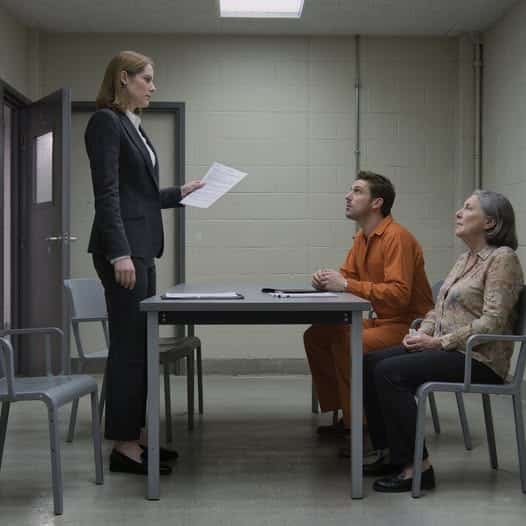
Two days later, the meeting took place in an official conference room at the King County Correctional Facility.
It was a bleak room with cinder block walls, a long metal table, and bolted down chairs.
I brought Julian and attorney Gray.
Ethan’s side included his defense attorney and, to my surprise, his mother.
Mrs. Caldwell was a woman in her late 50s from a small rural town in Texas. She wore a faded floral blouse, her eyes swollen red from days of crying.
The moment she walked in and saw me, she practically lunged forward, her knees buckling as she tried to drop to the floor in front of me.
“Chloe.”
She grabbed the fabric of my trousers, her voice wrecked and raspy.
“Please, please spare Ethan. He just made a stupid mistake. He’s not a bad boy. He was just corrupted by that awful woman.”
“Mrs. Caldwell. Please get up.”
I bent down and gripped her arms, stopping her from kneeling.
“I won’t get up,” she sobbed louder. “Tell them to let him go. He’ll never do anything like this again. I’ll scrub your floors for the rest of my life. Just please.”
“Mrs. Caldwell.”
I crouched down so I was eye level with her tear-streaked face. My voice was calm, slow, and completely immovable.
“I know you love your son, but some things cannot be fixed by begging on the floor. Please sit down. Wait until Ethan comes in. Let’s hear what he has to say first.”
Julian stepped forward and gently helped the sobbing woman into a plastic chair. She sat there hyperventilating, clutching a soaked tissue.
The heavy metal door buzzed and opened. Two corrections officers escorted Ethan into the room.
He was wearing a standard-issue orange jumpsuit. His wrists weren’t cuffed, standard protocol for attorney-present conferences. He had lost weight. Dark stubble shadowed his jaw and his eyes were sunken.
But there was a feverish brightness to his gaze. Not the brightness of hope, but the highly concentrated, terrifying focus of a desperate gambler pushing his last chips onto the table.
He sat down across from me.
“Chloe,” he whispered.
I didn’t say a word. I just looked at him.
“I know you hate me. You have every right to. But I need you to know. It’s not what you think.”
“What is it then?” I asked.
“I made horrible mistakes. The company was drowning in debt. I panicked. My brain wasn’t working. Those plans, the asylum, the drugs. I was backed into a corner. And Jessica kept whispering in my ear. She pushed me to do it. If she hadn’t manipulated me—”
“You’re blaming Jessica.”
“I’m not deflecting blame. I just want you to know that what we had, my feelings for you, they were real.”
His voice trembled, tears pooling in his eyes.
“Chloe, I admit I got greedy. I admit I screwed up. But I never actually wanted to hurt you. The alprazolam, I hadn’t even started using it yet.”
He stopped talking.
“Are you saying you hadn’t put the drugs in my food yet?” I asked.
“Yes, I swear to God I didn’t. I was hesitating. I couldn’t bring myself to do it because I—”
“Ethan.”
I cut him off.
I unzipped my leather portfolio, pulled out a single sheet of paper, and slid it across the metal table.
It was a toxicology report issued by Seattle General Hospital.
Patient: Chloe Sterling.
Date of test: the morning after I returned to the estate.
I had highlighted line item seven on page three with a yellow marker.
Serum alprazolam and metabolite concentration: 0.023 ng/mL.
Clinical note: sustained low-dose exposure to benzodiazepines.
Ethan’s eyes locked onto those numbers. The expression on his face looked like it was being erased by a digital scrubber.
First, the desperate plea vanished.
Then, the calculated sorrow.
Finally, nothing was left but a blank hollow mask of terror.
“You said you didn’t do it.”
My voice was as flat as a heart monitor flatlining.
“My blood has alprazolam metabolites in it. This isn’t the result of a single dose. It indicates continuous exposure, which means without my knowledge, you had been dosing me for at least 2 to 3 weeks.”
“This… This is impossible.”
“Did you put it in the hot soup or the milk?”
His lips began to quiver.
“Or was it in that cup of warm chamomile tea you brought me every single morning?”
I continued, the pitch of my voice never shifting.
“You made me a cup of tea every morning by the bed. You said it was good for my stomach. You even made one the morning my dad came over.”
He lowered his head.
“Ethan, you didn’t hesitate. You had already started. For 3 weeks, every time I felt dizzy or lethargic or couldn’t remember where I put my keys, I thought I was just burned out from work. Tell me, was that your trial run?”
He had nothing left to say.
His mother, sitting next to him, stopped crying. The silence emanating from her was absolute. She covered her mouth with both hands, her entire body shrinking into the plastic chair.
His defense attorney went completely pale, quickly reading over the tox screen, realizing his client had lied to him, too.
“You said your feelings were real.”
I stood up slowly, gathering my papers back into the portfolio.
“Real feelings don’t induce memory loss. Real feelings don’t make you chronically fatigued. Real feelings don’t leave benzodiazepines in your bloodstream.”
I zipped the portfolio shut and looked down at him.
“Ethan, your biggest miscalculation wasn’t that the audio recorded. It wasn’t that the nanochips triggered an FBI raid. It wasn’t that your company died. Your biggest miscalculation was mistaking my kindness for a lack of intelligence.”
The air in the visitation room felt heavy enough to crush bone.
Ethan stared at his knees, his knuckles white as he gripped the fabric of his jumpsuit. His lawyer whispered something to him, but he didn’t react.
I turned to Harrison.
“Are the prosecution files fully assembled?”
“The DA has completed the grand jury review. Arraignment is Monday.”
“Good.”
I walked toward the door.
Just before I left, I looked at Mrs. Caldwell.
She wasn’t looking at me. She had slowly stood up, walked over to her son, and stared at the top of his head. I thought she might slap him.
She didn’t.
She just placed her trembling, calloused hand on his hair, exactly like a mother comforting a toddler.
“Ethan,” her voice sounded like torn sandpaper. “Tell me the truth. Did you really do this to your wife?”
He didn’t look up.
“Tell me.”
“I owed a lot of money, Mom,” he mumbled into his chest.
“I didn’t ask about the money,” she screamed, her voice cracking violently. “I asked if you were really going to poison the girl you married. Were you really going to lock her in a mad house?”
He finally looked up. His eyes were red, but the tears in them held no repentance. They held only the agonizing frustration of a rat caught in a trap.
He wasn’t crying because of what he had done.
He was crying because he had lost.
“Yes,” he whispered.
His mother’s hand recoiled from his head like she had touched a hot stove. She stumbled backward, collapsing into the chair, refusing to look at him again.
“Let’s go,” I told Julian.
We walked out.
The trial took place on a rainy Monday in November at the King County Courthouse.
Because the case involved a tech CEO drugging his heiress wife to steal a multi-million dollar trust fund, it had become a media circus.
Every local news affiliate was parked outside. The public gallery was packed. I wore a dark charcoal suit, my hair tied back in a neat low ponytail, flat black loafers, no makeup, no jewelry, not even the silver tracking bracelet.
The SPD had recovered the bracelet from the glove box of Ethan’s SUV wrapped in the Faraday bag. The chip was fully functional, but I chose not to wear it yet.
I wanted to get used to the feeling of walking into a room armed with nothing but my own spine.
The trial moved blindingly fast.
The DA read out the six felony charges: aggravated assault poisoning, forgery, possession of a schedule four narcotic, corporate wire fraud, grand larceny, and money laundering.
Ethan’s defense attorney tried a desperate diminished capacity due to extreme financial duress angle.
The DA slaughtered it on cross-examination.
The defendant’s actions required highly coordinated logistical planning over a span of 90 days, bypassing biometric security, forging medical documents, establishing a shell corporation.
This was not a panic response.
This was a calculated sustained siege.
The star witness was Jessica Reynolds.
She had taken a plea deal.
Wearing a county jail uniform, she admitted to helping him secure the alprazolam on the dark web.
When the DA asked why she did it, Jessica looked at the floor and delivered the line that killed the courtroom.
“He promised me that once she was locked away, all her trust fund money would be ours. He said we’d buy a yacht and move to Miami.”
A collective murmur ripped through the gallery. The judge slammed his gavel.
I sat at the prosecution’s table, my hands folded perfectly still in my lap.
The words didn’t hurt. They had lost the power to wound me weeks ago. In that moment, the final mask was ripped off.
The devoted husband, the stressed founder, the man corrupted by another woman. All of it fell away, leaving only the pathetic reality of a man drowning in $4,700,000 of debt, who teamed up with his mistress to turn his wife into a sedated ATM.
The verdict and sentencing came down simultaneously.
Ethan Caldwell was found guilty on all counts.
The judge sentenced him to 14 years in a federal penitentiary plus $3,200,000 in restitution.
Jessica Reynolds received six years.
Dr. Pennington was stripped of his medical license and sentenced to two years.
The Bellevue penthouse was seized under federal asset forfeiture laws.
Caldwell Solutions was forced into Chapter 7 bankruptcy liquidation.
When the judge read the sentence, I watched Ethan. He didn’t look at the judge and he didn’t look at me. He looked back at his mother.
Sitting in the very last row, she was staring at her lap, her shoulders shaking silently.
He closed his eyes. The bailiff clamped the handcuffs over his wrists. The metallic clack clack echoed sharply in the high-ceiling room.
As they led him away, he passed within 3 feet of me. He didn’t stop, but for a fraction of a second, his pace stuttered, a microscopic hesitation, as if he wanted to turn his head.
But he didn’t.
He kept walking until the heavy oak doors swallowed him.
I stood up, gathered my files, and walked toward the exit.
At the threshold, I stopped.
I wasn’t hesitating.
I was mentally saying goodbye to something.
Not Ethan.
That goodbye happened the night I hit the revoke IP button.
I was saying goodbye to the girl on the art museum steps three years ago. The girl who believed that a bowl of soup equated to love and that a promise of protection equated to safety.
She was gone.
The woman walking out of the courthouse was someone else entirely.
Twelve days after the sentencing, I went to the SPD evidence lockup to retrieve my bracelet.
The officer handed it to me in a clear plastic evidence bag sealed with red tape. I signed the release form, broke the tape, and tipped the silver band into my palm.
There were a few tiny scratches on the metal from when Ethan pried it out of the drawer. The internal chip blinked a faint green.
It had already re-synced with the Aurora Cloud servers.
I stood in the hallway of the precinct holding the metal band.
“Miss Sterling.”
I turned.
A female desk sergeant approached me.
“The corrections transport detail dropped something off for you this morning. Ethan Caldwell wrote you a letter before he was transferred to federal lockup. He asked us to give it to you. Do you want it?”
I looked at the plain manila envelope in her hand.
“I’ll take it.”
I sat down on a wooden bench in the lobby and opened it.
Two pages of lined yellow legal paper. The handwriting was messy, written in cheap blue ballpoint. He always had this habit of hooking the end of his horizontal strokes. I used to think it was charming. Now it just looked like fish hooks.
Chloe,
It’s 3:00 a.m. The lights in the holding block never fully turn off, and I can’t sleep. I know you don’t want to read this, but I have to say it. Not to beg for forgiveness. I know that’s gone.
You once asked me if I knew about your family’s money when I first asked you out. I swear to God I didn’t. I only knew that you looked beautiful reading in the library and that you bit your lip when you wrote code.
I don’t know when I changed.
Maybe it was our first year of marriage when your dad casually mentioned the size of his investment fund over dinner. I couldn’t sleep that night.
It wasn’t jealousy.
It was the realization of how microscopic I was compared to your world. I felt like a joke standing next to you.
Then the company started failing. The debt piled up. I was terrified of telling you, terrified you’d look down on me. I know you aren’t like that, but my ego couldn’t take it.
Jessica was just someone who made me feel like I was in control. It’s pathetic, isn’t it? A man who can’t even keep his own company afloat, playing God with his wife’s life just to feel powerful.
Chloe, I don’t deserve to say I’m sorry, but I want you to know one thing.
For the last 3 weeks, every time I made you that chamomile tea, I took a sip from the mug before I brought it to you.
I knew what I was doing to you, but I still wanted to share the same cup.
That’s probably the sickest part of it all.
Ethan.
I folded the letter neatly.
I stood up, walked over to the lobby trash can, and dropped it in.
I didn’t hesitate.
I threw it away as effortlessly as a used napkin because I finally understood how he operated.
Even at 3:00 a.m. in a holding cell, writing with a cheap pen, every word was designed to manipulate. He was trying to pivot his narrative from sociopathic criminal to tragically insecure man broken by pride.
He was still trying to hack my empathy.
I snapped the silver bracelet back onto my left wrist. The cold metal shocked my skin for a second before warming to my body temperature.
I walked out into the crisp Seattle air.
Julian’s SUV was idling at the curb. I climbed into the passenger seat and buckled up.
“Get it?” he asked, eyeing the silver band.
“Got it.”
“Did he leave a message?”
“Nothing that matters.”
I cracked the window, letting the cold breeze hit my face.
“Julian, we need to talk about my next move, which is: I’m going back to Aurora Cybernetics.”
Returning to Aurora as a full-time senior tech partner was seamless. I still held the patents that drove 42% of the company’s enterprise products. No one could stop me.
On my first day back, I presented a new project proposal to the board of directors.
Project name: Aegis, Electronic Guard and Intervention System.
Core concept: a low-cost, high-reliability personal safety and emergency broadcasting network designed for vulnerable demographics, specifically women.
Architecture: an evolution of the proprietary tracking protocol my father built for me.
My pitch was simple.
The original system was a multi-million-dollar bespoke setup for a heiress. I wanted to scale it down into a consumer-grade product.
It had three components.
Micro-hardware disguised as everyday jewelry, necklaces, rings, standard bracelets, equipped with GPS and ambient audio triggers.
An integrated cloud protocol. If the device detects violent kinetic impact, signal jamming, or a manual panic trigger, it bypasses the user’s phone directly, notifying emergency contacts and local 911 dispatch with a live audio feed and GPS ping.
Legal evidence vault. All triggered data is instantly encrypted and uploaded to a blockchain-secured server, maintaining strict chain of custody so it can be used immediately as admissible evidence in court.
The board approved the funding in 20 minutes.
After the meeting, Dad’s oldest friend and Aurora’s co-founder pulled me aside.
“Chloe, if you pull this off, you’re going to save a lot of lives. That’s why we’re backing you.”
For the next 3 months, I practically lived at the office. We built a team of 23 engineers and two legal compliance officers.
The hardest part wasn’t the tech.
It was simplifying it so that a user with zero technical knowledge could set it up in 30 seconds.
I knew exactly who my target demographic was.
It wasn’t women like me who had billionaire fathers monitoring their vitals and brothers waiting with fleets of lawyers.
It was ordinary women.
Women trapped in abusive relationships, being stalked, being controlled.
Women who didn’t have the luxury of calling a fixer.
They needed a silent, invisible guardian.
Aegis was that guardian.
We launched quietly on March 8th, International Women’s Day. No massive marketing campaign, just a targeted rollout through domestic violence nonprofits and women’s advocacy networks.
I wrote the press copy myself.
Aegis, named after the mythical shield.
It cannot make the decision to leave for you, but when you need it most, it will scream for you. It will remember everything for you. You are not alone.
Day 1: 370 registered users.
One month later: 7,200 users.
Three months later: 43,000 users.
Six months post-launch, Aegis was nominated for a National Tech Innovation Award.
The ceremony was held in Washington, DC.
I stood on the brightly lit stage wearing a sleek black tuxedo suit holding a crystal trophy. The lights were so bright they almost blinded me.
The host asked me, “Miss Sterling, what was your personal inspiration for engineering the Aegis system?”
I leaned into the microphone.
“Because I was once someone who desperately needed to be saved. I was lucky. I had a father who implanted a tracker on my wrist, a brother ready to deploy an army, and limitless resources. Most women don’t have that. I built Aegis because safety shouldn’t be a luxury afforded only to the wealthy. It is a fundamental human right.”
The applause was deafening.
As I walked off stage, Dad was waiting in the wings. He didn’t clap. He just looked at me with a faint, impossibly proud smile.
“Your mother would have loved to see this,” he said.
I felt a sting behind my eyes, but swallowed it down.
“Let’s go home, Dad. Julian said he’s cooking tonight.”
Dad’s expression instantly soured.
“The last time your brother tried to cook a steak, I had to chew on it for 3 days. Let’s order in.”
3 months later, June hit Seattle with an uncharacteristic heatwave.
I was sitting in my 37th-floor office overlooking Puget Sound, reviewing the schematics for Aegis Gen 2, when my phone rang.
“Hello, Miss Sterling. This is Emily, a social worker at the Pine Ridge Family Center.”
“Hi, Emily. How can I help?”
“We have a resident here who really wants to meet you. She’s an Aegis user. Last month, the system automatically dispatched police during a severe domestic violence incident. She asked if there was any way she could thank you in person.”
“Tell her I’ll be there at 3 p.m. today.”
Pine Ridge was an older, low-income apartment complex in the suburbs. The paint was chipping off the siding, and the rhododendrons in the courtyard were wilting in the heat.
Emily led me into a small cramped office on the ground floor.
A woman in her mid-30s with short hair was sitting at the table. On her left wrist, she wore a simple slender silver band.
The baseline Aegis model.
She stood up nervously when I walked in.
“Miss Sterling.”
“Just Chloe,” I said, sitting across from her.
“What’s your name?”
“Rachel.”
Her eyes were red-rimmed. She twisted her fingers in her lap.
“Chloe, I don’t know how to thank you. Last month, my husband came home drunk. He got violent. I used to just take it because of the kids and because I didn’t have my own money. I had nowhere to go.”
She choked on a sob, wiping her eyes.
“But that night when he grabbed me by the throat, this thing on my wrist vibrated. The system detected the kinetic impact and my elevated heart rate, and it triggered the silent alarm. The police kicked the door in before he even let go of my neck.”
I pulled a tissue from the box on the desk and handed it to her.
“What happened next, Rachel?”
“I filed charges. The audio the bracelet recorded got me an immediate permanent restraining order. Emily helped me get legal aid, and I’m filing for full custody. I got a job scanning groceries at a supermarket. It’s not much, but it feeds me and my kids.”
She looked down at the silver band.
“I always thought nobody cared what happened to people like me. I thought if I called the cops, he’d just beat me worse when they left.”
She looked up at me, and in her eyes, I saw something so familiar.
It was the exact same light I felt inside myself the moment I walked out of the King County courthouse.
The absolute clarity of survival.
“But this thing,” she held up her wrist, letting the silver catch the fluorescent light. “This thing tells me someone is watching. Someone is recording. Someone cares.”
I looked at the silver band on her wrist.
I remembered the day I got mine. 7 years old, sitting in a police station, wrapped in a blanket, while my dad clasped the heavy metal around my tiny wrist, promising me he would always know where I was.
22 years later, that bracelet saved my life, and I had manufactured 43,000 more of them.
Leaving the community center, I had my driver drop me off at Gas Works Park. The evening wind blowing off Lake Union finally carried a hint of cool relief. Joggers passed by, dogs chased Frisbees, and an older couple sat on a bench sharing a box of takeout.
I found an empty bench facing the water and sat down.
I pulled out my phone and tapped the screen. My lock screen wallpaper was still the default blue gradient.
On the night of the verdict, I had deleted the wedding photo of Ethan and me. I never put a new picture up.
I realized I didn’t need one.
I didn’t need a photo of a person, a relationship, or a promise to remind me that I was loved or that I belonged to someone.
I belonged to myself.
It sounds like a cheap motivational quote, but only someone who has clawed their way out of a psychological slaughterhouse disguised as true love knows exactly how much weight those words carry.
A ferry blared its horn as it cut across the water.
The setting sun ignited the Seattle skyline, turning the clouds into brilliant streaks of violent orange and gold shattering into a million shimmering reflections on the lake.
I looked down at the silver bracelet on my left wrist. The tiny scratches Ethan had left were still there.
I never had them buffed out.
They weren’t a memorial.
They were a reminder.
Safety is never a gift bestowed upon you by someone else.
It is the cards you hold in your own hand.
It is the code you write, the money you save, the evidence you archive.
It is that microscopic sliver of ruthless clarity you refuse to surrender even in your darkest, most desperate moments.
Inside the silver casing, the chip’s LED indicator blinked every 12 seconds.
Blink, blink, blink.
Like a heartbeat, like a breath, like a silent, unbreakable promise that would never be turned off.
I stood up, brushed off my suit pants, and turned toward the city.
Behind me, the sun sank into the water.
Ahead of me, the city lights began to burn bright against the coming night.
I walked between the two edges of the light, my pace steady, not too fast, not too slow, just exactly my own rhythm.