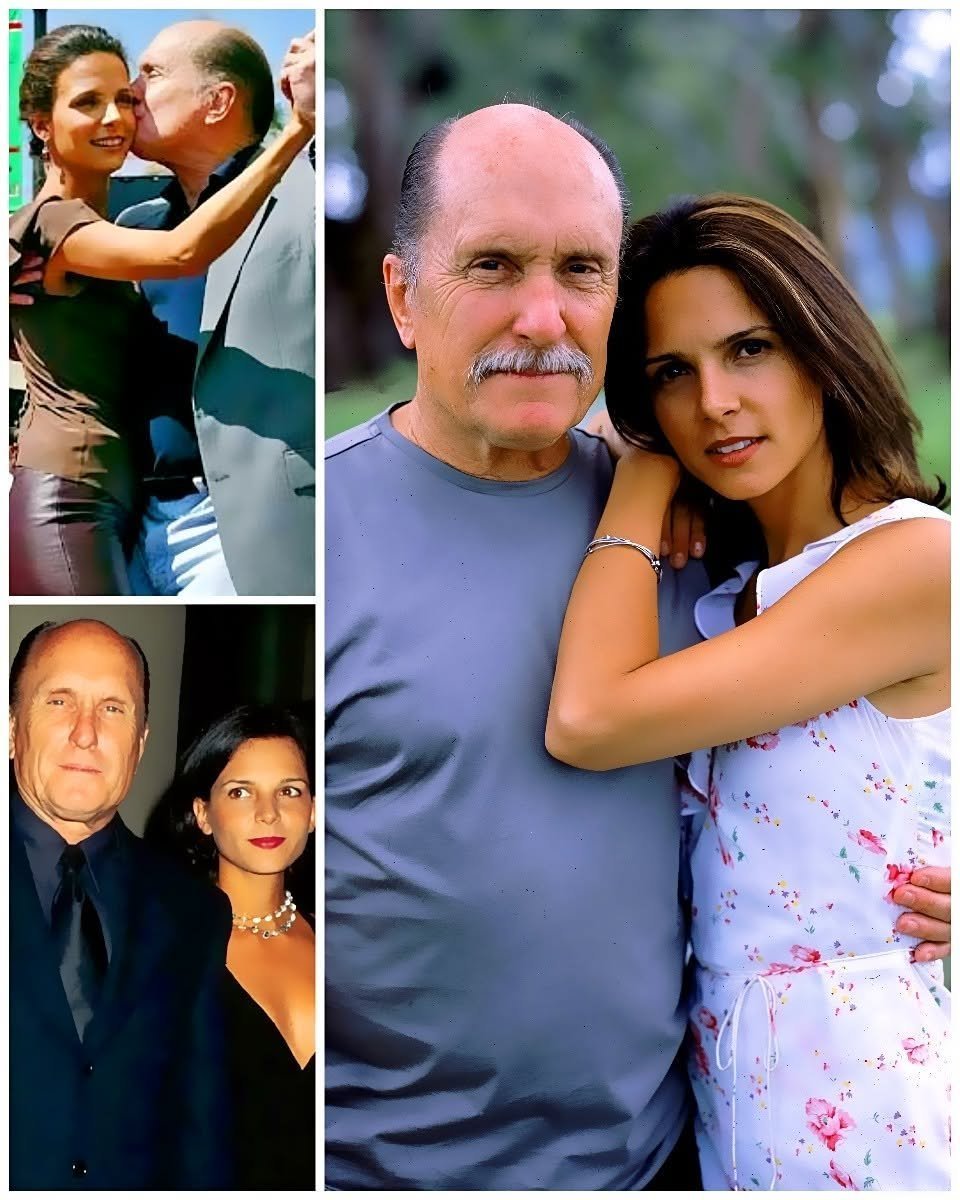
In the quiet rhythm of late-life Hollywood stories, few love stories feel as unexpectedly gentle — or as enduring — as the one between Robert Duvall and Luciana Pedraza. It is not a tale built on red carpets or publicity cycles. It does not rely on scandal or spectacle. Instead, it begins, almost improbably, on a street in Buenos Aires, where a closed flower shop and a spontaneous detour into a bakery set the stage for a connection that would quietly reshape two lives across continents, careers, and decades.
Robert Duvall was already a towering figure in American cinema by the time he met Luciana. With a career spanning from The Godfather to Apocalypse Now, he was the kind of actor whose presence alone could change the temperature of a scene. Yet when he arrived in Buenos Aires in 1996, he wasn’t there as an icon. He was simply a man moving through a city he loved, drawn to its culture, its music, and especially its tango — a dance he admired not just as performance, but as emotional language.
Luciana Pedraza, on the other hand, was not thinking about Hollywood at all. She was living her life in Buenos Aires, surrounded by friends who saw opportunity in coincidence. When they learned that Duvall was in town — and that he had a deep appreciation for tango — they insisted she invite him to a gathering they were planning. She hesitated. Not out of arrogance, but out of disbelief. Why would she approach someone like him? A man whose name carried weight far beyond their city streets.
But sometimes, life insists on small decisions that later feel like destiny.
So she walked.
Not to a studio. Not to a gala. Not to a carefully arranged meeting with cameras waiting. Just around a block in Buenos Aires, where she found him in a moment of everyday stillness. And in that ordinary space, something unplanned happened — conversation.
No scripts. No introductions framed by fame. Just two people talking.
Later, Luciana would recall the simplicity of it all. She handed him a card. She told him about the party. She did not expect anything in return. No promise. No certainty. Just an invitation left in the air like a note.
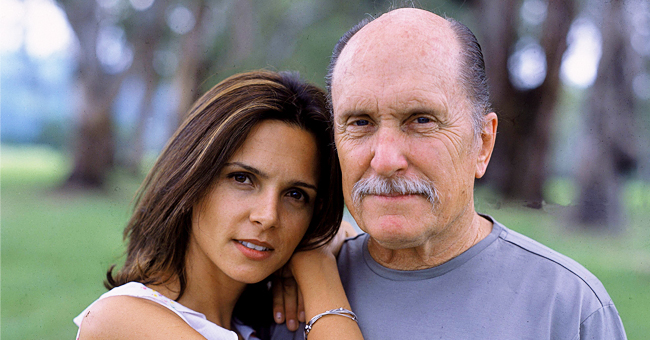
And then something surprising happened.
He came.
That small act — showing up — would become the first quiet thread in a much larger story.
At the party, Robert Duvall was not “Robert Duvall.” Not in the way the world knew him. He was not the commanding figure of courtroom dramas or war epics. He was present, observant, and, in Luciana’s memory, unexpectedly approachable. The barrier between celebrity and stranger dissolved not through drama, but through familiarity.
And perhaps that was the beginning of everything.
Luciana would later describe a truth that defined their entire relationship. She did not meet “Robert Duvall, the actor.” She met a man named Bobby.
That distinction mattered more than it might seem. Because love, in its most enduring form, rarely begins with status. It begins with recognition — the sense that you are seeing a person, not a symbol.
As their connection developed, tango became the language between them. Not metaphorically at first, but literally. In Buenos Aires, tango is not simply dance; it is structure and improvisation, control and surrender, silence and intensity. It demands presence. Two bodies moving with awareness of each other, never separate even in motion.
Duvall understood that instinctively. He had long been drawn to stories of emotional precision — characters who lived in tension, restraint, and quiet force. Tango mirrored that world. It did not require performance in the theatrical sense. It required honesty.
At some point after their first meeting, he invited Luciana into that world more directly. He taught her, guided her, and learned with her. And when their relationship deepened, it did not do so in public view or under the expectations of Hollywood romance. Instead, it rooted itself in something far more private.
At his Virginia farm, they transformed a barn into a dance space. Not as a statement. Not as a project. But as a living environment where music, movement, and community could exist freely. Tango teachers were invited. Friends gathered. Floors filled with footsteps tracing the invisible architecture of rhythm and trust.
Luciana once described how that world felt. There was no performance pressure. No audience expectation. Just learning, repetition, and shared discovery.
“I didn’t have to put a rose in my mouth,” she said of her early tango experiences. “I learned my tango with Bobby.”
That phrase — simple, almost casual — carries the emotional center of their story. Because it suggests something deeper than romance. It suggests transformation. Not of identity, but of perception.
To the world, he remained Robert Duvall. But in her life, he was Bobby. And in his life, she was not a companion shaped by fame or age or narrative convenience. She was simply Luciana — a partner in rhythm, in conversation, in ordinary days that built something extraordinary over time.
Their age difference — 41 years — was always visible in public interpretation of their relationship. At 65, Duvall had already lived through decades of film history. At 24, Luciana was only beginning to define her adult life. It was a contrast that invited commentary from outside their world. People questioned it, analyzed it, tried to place it within familiar categories of late fame relationships or Hollywood patterns.

But the internal reality of their connection did not conform to those assumptions.
Even Duvall himself acknowledged the gap with a kind of understated honesty. He joked about meeting Luciana’s father, who reportedly struggled with the generational span between them. “I don’t know whether to call you father or son,” the father said, half in humor, half in disbelief.
Duvall laughed about it too. But beneath the humor was awareness. He knew the difference in age was real. He never denied it. Instead, he moved through it — not by ignoring it, but by refusing to let it define the emotional structure of the relationship.
Because what defined them was not symmetry of age, but symmetry of presence.
Their home life reflected that balance. In Virginia, they built a shared space that was deeply personal. Luciana shaped the environment with care, insisting that it feel lived-in rather than designed. She resisted the idea of outside decorators because she believed a home should carry the imprint of its inhabitants — not an external vision of perfection.
Duvall, in his own way, appreciated that instinct. He once remarked that people often speak of “my house” or “my room,” but he preferred to say “our house” and “our bedroom.” It was a small correction, but it revealed something essential about how he viewed partnership — not as ownership, but as shared space.
Their life together was not built around the machinery of Hollywood. There were no constant premieres or public reinventions. Instead, there was travel between places they cared about, time spent with friends, and a rhythm shaped by work, rest, and shared interests.
Argentina remained central to Luciana’s identity, and through her, it became part of Duvall’s emotional geography as well. The tango was not left behind; it expanded. It moved from Buenos Aires streets into Virginia barns, from social gatherings into private practice, from cultural tradition into personal ritual.
Over time, their relationship matured not by becoming more dramatic, but by becoming more ordinary in the best sense of the word. Meals together. Conversations that did not need external validation. Days that did not require explanation.

They did not have children together, a fact that Duvall addressed without regret or performance. Life, for them, had taken a different shape. One defined not by continuation through lineage, but by continuity through companionship.
As the years passed, Duvall continued to work, though less frequently. Luciana remained beside him, not as a figure in the background of his career, but as a constant presence in his personal life — someone who understood both the public image and the private individual, and chose to remain with the latter.
In later years, when asked about happiness, Duvall did not point to awards, recognition, or industry milestones. He pointed instead to daily life.
“Day to day with my wonderful wife,” he said. “She takes care of me.”
It was not a grand declaration. It was something quieter. Something more revealing.
Because in the end, their story was never about the magnitude of difference between them — age, fame, background, or expectation. It was about the small space they built inside that difference. A space where identity softened into familiarity. Where admiration became companionship. Where a man known to the world as Robert Duvall could simply be Bobby to someone who saw him not as an icon, but as a person.
And in that space, they lived not loudly, but fully.
When love stories are told from a distance, they often appear dramatic, defined by the most visible contrasts. But when lived from within, they are usually quieter. Less about arrival, more about continuation.
For Robert Duvall and Luciana Pedraza, the story was never about how unlikely they seemed from the outside.
It was about how natural they felt from the inside.