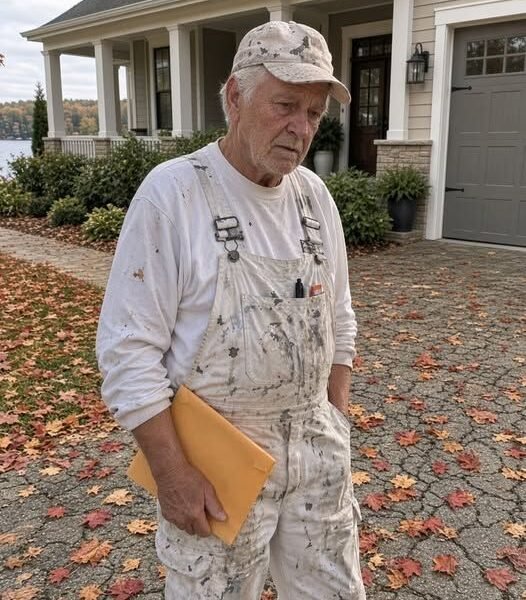
My father turned the car into the cracked entrance of the apartment complex the way he did everything—steady, deliberate, without rushing even when there was reason to. I watched the buildings come into view through the windshield, their faded yellow walls catching the late afternoon light in a way that might have looked warm from a distance but never felt that way up close. The metal covers above the parking spaces cast uneven shadows across the asphalt, and a row of neglected plants near the stairs leaned lifelessly in their pots, their soil long since dried and forgotten. It all looked exactly the same as it always had. Nothing about it suggested that this was the place where everything in my life had quietly come apart.
And yet, I felt it before I even saw it.
Patricia’s white SUV sat near the entrance, perfectly aligned as always. Derek’s truck was a few spaces over. And then there it was—parked slightly closer to the building than I usually managed to get—a blue sedan I knew from every angle.
My car.
Except it wasn’t. Not really.
I had made every payment for nearly two years. Every second Friday, without fail, part of my paycheck disappeared into something I had convinced myself was temporary. Derek had always talked about sorting it out “soon.” Patricia had always reminded me how much she had helped by handling the paperwork. The title remained in her name. The car remained in that spot.
And I remained… somewhere in between.
Dad turned off the engine and looked at me. He didn’t speak right away. He didn’t need to. He had already seen enough earlier that day when I showed up at his house with Evan on my hip and a grocery bag cutting into my hand, trying to pretend I wasn’t in pain.
“Can you walk?” he asked finally, glancing at my ankle.
“Yes,” I said.
He studied me for a second longer.
“Can you walk enough to go inside and get your things?”
The question landed differently than anything else he’d said.
Your things.
Not talk. Not fix. Not figure it out.
Get your things.
I turned to look at him. “My things?”
“You and Evan aren’t staying here tonight.”
Something shifted inside me then. Not suddenly, not dramatically—just enough to make everything feel real in a way it hadn’t before. I had imagined leaving countless times, usually late at night when Evan was asleep and the apartment felt too quiet and too small at the same time. But imagining didn’t require decisions. It didn’t require action.
This did.
I opened the door and stepped out onto the asphalt. Pain shot through my ankle immediately, but I ignored it. Dad came around the car, lifted Evan from the back seat, and nodded toward the stairs.
We climbed slowly. The railing wobbled under my hand just like it always had. I had offered to fix it once. Patricia told me it wasn’t my place.
The door was unlocked.
That told me everything.
Patricia only left it that way when she felt completely in control.
Dad knocked once anyway, firm and clear. When she opened the door, irritation was already written across her face—until she saw him. Then it shifted into something colder, more measured.
“Can I help you?” she asked.
“We’re here for her things,” Dad said.
Her eyes flicked toward me, then down to my ankle.
“That seems a little dramatic,” she replied. “We were just discussing things earlier. She can’t run away every time something feels uncomfortable.”
The familiar heat rose in my chest. The instinct to explain, to soften, to apologize for being difficult.
But Dad stepped forward before I could say anything.
“She’s not running,” he said. “She’s leaving.”
The word settled into the space between them, heavy and undeniable.
Patricia let out a short laugh. “Leaving? With what, exactly? Everything she has is here.”
Dad looked at me. “Go pack.”
And just like that, I moved.
The hallway felt narrower than I remembered, though I knew that wasn’t real. It was just the result of two years spent making myself smaller, quieter, easier to accommodate.
The bedroom door was open. The mattress sat on the floor. Evan’s blanket was crumpled where I had left it that morning. My purse hung on the back of the same chair where I always kept it—because I had learned not to spread out, not to claim space that wasn’t explicitly offered.
I pulled the duffel bag from under the bed.
Everything I owned fit into it.
Clothes. Diapers. Evan’s things. The small routines of a life that had never fully belonged to me.
And then I reached for the folder.
It was hidden at the bottom of the bag, tucked beneath everything else. Pay stubs. Bank statements. Records of every payment I had made for that car. Proof.
I hadn’t created it with a plan in mind. I hadn’t even fully admitted to myself why I was keeping it. But somewhere along the way, I had learned that if I didn’t document the truth, it would be rewritten.
I zipped the bag and filled a laundry basket with the rest.
In the living room, voices had risen.
“She agreed to contribute,” Patricia was saying. “That’s called responsibility.”
“Contributing isn’t the same as control,” Dad replied evenly.
“We helped her. We gave her stability.”
“You put your name on the car and kept taking her money.”
Silence.
Derek spoke then, quiet and uncertain. “We were going to sort it out.”
“When?” Dad asked.
No answer.
I stepped into the room.
Derek looked at me, his expression unreadable. Patricia stepped forward again, reclaiming control of the conversation.
“You don’t understand the full picture,” she said to my father. “There’s context here.”
“I understand what I saw,” he replied.
And then he said it.
“I saw my daughter walk into my house carrying groceries and a baby, limping, trying not to show it. I saw someone who pauses before she speaks, like she’s asking permission.”
Something in the room shifted.
Derek moved slightly, like he might say something.
For a moment, I believed he would.
He opened his mouth.
Closed it.
And looked at his mother.
That was it.
That was the moment everything ended.
Not with a fight. Not with anger.
Just… silence.
I had spent two years explaining that silence. Calling it stress. Calling it pressure. Calling it something temporary.
But it wasn’t.
It was a choice.
“I’m not coming back,” I said.
My voice didn’t shake.
Patricia laughed again, dismissive. “We’ll see.”
I shook my head. “No. You won’t.”
I looked at Derek one last time.
“The car,” I said. “I paid for it.”
“Legally, it’s not yours,” Patricia snapped.
“Legally,” Dad said calmly, “we’ll deal with that.”
That was enough.
He nodded toward the door.
“Let’s go.”
And I did.
I didn’t look back at the apartment. Not at the couch, not at the kitchen, not at the place where I had spent so much time trying to belong.
Outside, the air felt different.
Lighter.
We walked down the stairs slowly. Dad carried Evan. I carried what was left of my life.
At the car, he loaded everything into the trunk and buckled Evan into his seat with quiet care.
Then he turned to me.
“We’ll get the car back,” he said.
I nodded.
But something inside me already understood that it wasn’t the most important thing anymore.
I got into the passenger seat.
As we drove away, I saw them in the doorway—Patricia rigid, Derek half-hidden behind her.
Waiting.
Like nothing had really changed.
But everything had.
The blue sedan stayed behind in that parking lot.
And for a moment, I felt the weight of it. Not the car itself—but what it represented. The time. The hope. The version of the future I had believed in.
That loss was real.
But it didn’t stop me.
Because as the car turned out of the lot and the city opened up ahead of us, something else became clear.
I hadn’t just left that apartment.
I had taken myself with me.
And for the first time in two years, that felt like enough.