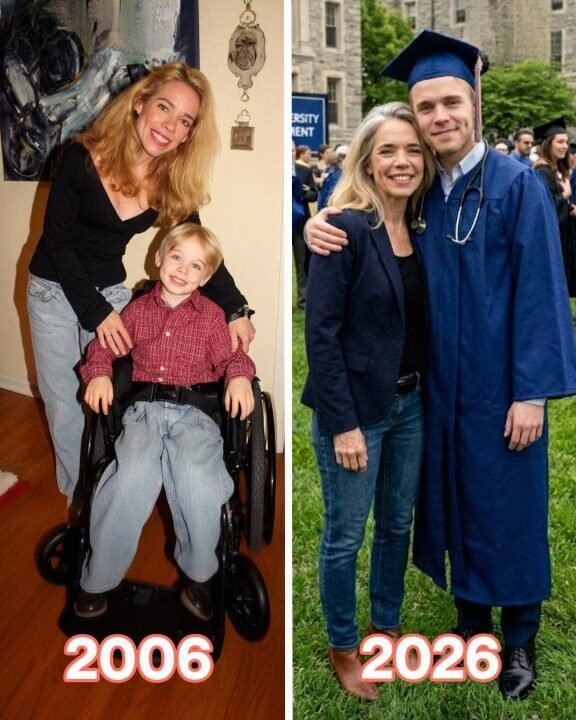
I gave birth believing my marriage had survived anything. I was wrong. My husband walked out the day our son was born, and I raised that boy alone through every hard year that followed. Twenty-five years later, one public moment made the man who left us wish he had stayed gone.
The day my husband left me, he didn’t slam the door.
I think that would have been easier. My mother used to say that a slammed door is anger, and anger is alive.
“You can fight anger, Bella. You can understand the reason for it.”
What Warren gave me instead was a glance at our newborn son, one look at the neurologist, and a silence so clean it felt sharpened.
“You can fight anger, Bella.”

Henry was less than three hours old. I still had an IV in my arm. My body felt split open, and my son was tucked against my chest, with one tiny fist twisted in my hospital gown.
The neurologist spoke gently, which I later learned is the first sign that your life is about to split into before and after.
“There is motor impairment,” she said. “We won’t know the full picture today, and Henry will need therapy, support, and close follow-up in the next few months.”
I nodded like she was giving me directions to a pharmacy.
Henry was less than three hours old.
“It’s not your fault, Mom,” she said. “Pregnancy is unpredictable. What matters is that this isn’t life-threatening. With support, your son can still have a full life.”
She squeezed my hand. “I’m just a call away.”
“Thank you,” I whispered.
Then Warren reached for his keys.
At first, I assumed my husband just needed some air. He was like that, usually needing a walk to digest important information.
“Babe,” I said. “Can you hand me that glass of water?”
“Pregnancy is unpredictable.”
He didn’t move.
Instead, he looked at Henry the way some men look at a ruined wall. Not grief, not fear… appraisal.
“I’m not doing this,” he said.
I stared at him. “What?”
My husband’s jaw tightened. “I didn’t sign up for a life like this, Bella. I wanted a son I could throw a ball with, a kid I could surf with. Henry won’t be able to do any of that.”
“I’m not doing this.”

I waited for him to take it back. I waited for him to cry, to panic, to say anything a decent man would say after hearing hard news about his son.
He picked up his jacket and walked out of the delivery room like he was leaving a meeting that had run long.
The nurse touched my shoulder. The neurologist said something I didn’t hear.
I looked down at my son, so innocent and trusting.
“Well, sweet boy,” I whispered. “I guess it’s just you and me now.”
He blinked at me like he had expected nothing else.
“I guess it’s just you and me now.”
Two days later, I signed discharge papers alone, listened to therapy instructions alone, and watched women leave the maternity ward with flowers, balloons, and husbands carrying bags.
I left with a sleeping baby, a folder thick enough to choke a printer, and a nurse named Carla walking beside me.
“You got somebody meeting you?” she asked.
I smiled so tightly it hurt. “Eventually.”
That was the lie I told strangers for about a year.
I signed discharge papers alone.
My apartment smelled like formula, baby powder, and lemon cleaner. I cleaned when I was scared, which meant I was always cleaning.
The hard years weren’t noble. They were expensive and exhausting.
I learned how to stretch Henry’s legs while he cried and my own hands shook from lack of sleep. I learned which insurance reps responded to charm and which ones needed pressure.
At church, people spoke to me in the soft voice reserved for funerals.

One Sunday, when Henry was six months old, I was in the nursery hallway fixing his braces when a woman from the choir came over.
The hard years weren’t noble.
“He is just precious,” she said. Then her voice dropped. “And Warren? Is he… coping?”
I smoothed Henry’s sock and said, “No. He left long before my stitches melted.”
Her mouth opened and closed.
Henry sneezed.
I kissed his forehead. “If you see the sign-in sheet, can you hand it over? My hands are full.”
By the time Henry started school, he had already developed a stare too direct for adults who liked children better when they were easy.
The first time I had to fight for him in a school office, he was seven, sitting beside me while the assistant principal smiled over folded hands.
“He left long before my stitches melted.”
“We just want to be realistic,” she said. “We don’t want Henry feeling frustrated in a classroom that may move faster than he can manage.”
Henry looked at the worksheets on her desk. Then at her.
“Do you mean physically,” he asked, “or because you think I’m stupid?”
The woman blinked. “That’s not what I said.”
“No,” my son said. “But it’s what you meant, isn’t it?”

I pressed my lips together so I wouldn’t laugh.
“That’s not what I said.”
In the car afterward, I failed anyway.
He leaned forward from the back seat. “What?”
“You can’t say things like that to school administrators.”
“Why not, Mom? She was wrong.”
I looked at him in the mirror, sharp eyes, stubborn chin, my boy in every sense.

“That,” I said, “is unfortunately a very strong argument.”
Physical therapy became the place where his anger grew muscles.