“In this house, the wife hands over her paycheck, serves dinner, and learns to keep her mouth shut. If she won’t learn the easy way, she’ll learn the hard way.”
Marvin spoke those words exactly seventy-two hours after our civil wedding. He stood at the head of the dining table, his face flushed with a dark, unfamiliar heat. The man who had spent the last two years asking permission to hold my hand, who had memorized my coffee order and learned the names of my childhood pets, vanished. In his place stood a stranger wearing my husband’s skin.
Before I could process the shift in his voice, his heavy boot connected with the solid oak table.
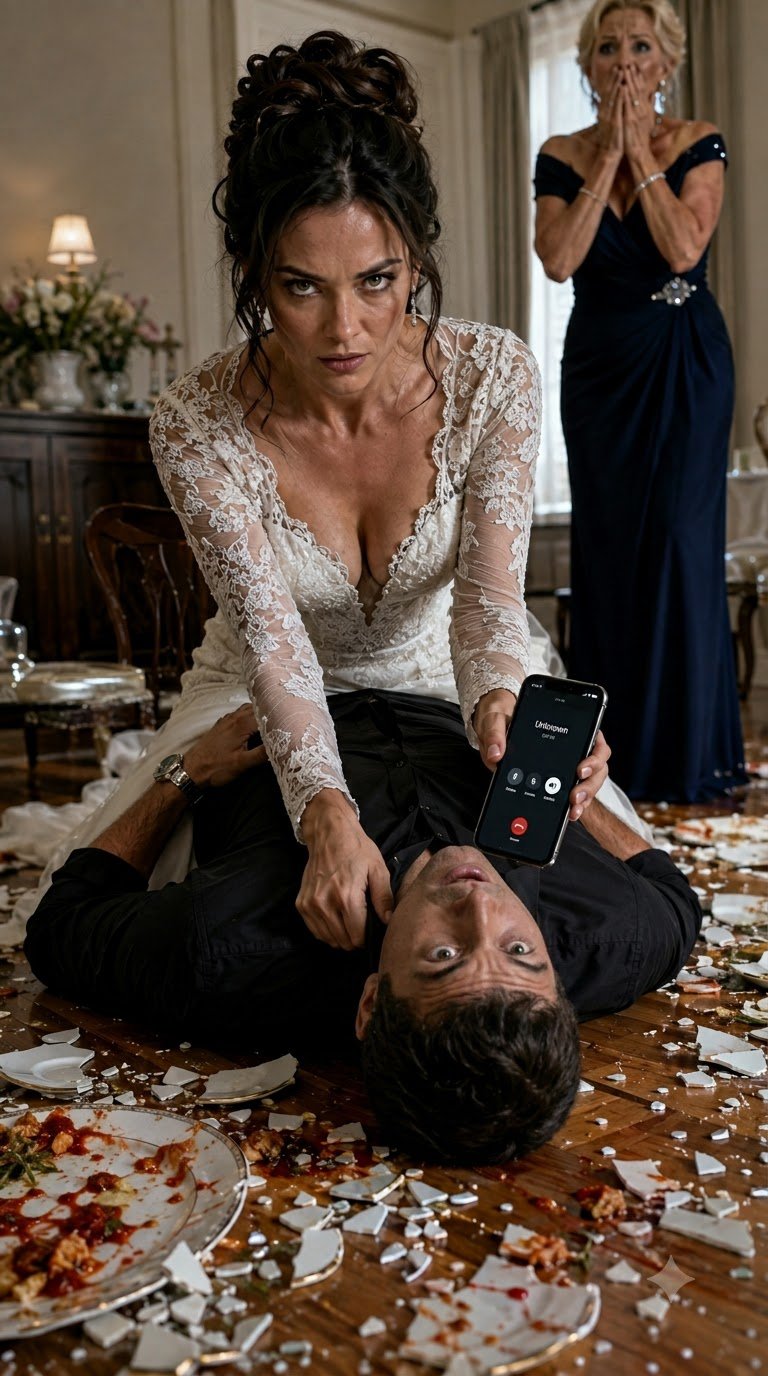
Plates launched into the air. The porcelain my mother had given me as a moving-out gift shattered against the far wall. Roasted chicken, garlic, and hot oil sprayed across the imported rug. A jagged shard of ceramic skipped across the hardwood and grazed my ankle, drawing a thin line of heat.
I didn’t scream. My fork hovered halfway to my mouth. I simply stared at the wreckage, my mind struggling to align the charming architect I had married with the volatile force now looming over me.
“My mother warned me,” he continued, his chest heaving, his voice dropping into a terrifyingly calm register. “A woman needs to know her place. Your paycheck goes into the account she controls. You’ll pay for this house, wake up at six every morning to make me breakfast, and when I get home, I expect a hot meal. When I speak, you stay quiet.”
I carefully set my fork down on the only plate that had survived.
“And if I don’t?”
Marvin smiled, but it didn’t reach his eyes. “Then I’ll make you.”
He reached into his pocket and pulled out his phone, tapping the screen. A second later, the router lights in the hallway blinked and died. The hum of the refrigerator was suddenly the only sound in the house.
“I shut down the Wi-Fi,” he said, stepping toward the front door and twisting the deadbolt, slipping the key into his pocket. “And I know your phone is charging in the bedroom. We are going to have a long conversation, Lena. Just you and me.”
He thought he had me trapped. He thought I was the naive, accommodating woman I had played during our courtship, willing to endure his mother’s passive-aggressive barbs for the sake of peace.
He didn’t know about the burner phone tucked into the waistband of my slacks at the small of my back—a parting gift from my older cousin, Diana, a ruthless divorce attorney who trusted no man, let alone a man whose mother picked out his ties. “Hope for romance, but prepare for reality,” she had told me, pressing the cheap plastic device into my palm.
I reached behind me, my thumb finding the physical record button by pure muscle memory. I clicked it.
I stood up. Slowly.
“What are you doing?” he snapped.
“I’m trying to figure out,” I said, my voice eerily steady, “who taught you that treating your wife like a prisoner is normal.”
“My mother taught me how the world works!” Marvin lunged across the spilled food, his hands reaching for my shoulders.
I had taught women’s self-defense at the municipal center for four years. But this wasn’t a padded mat, and Marvin was seventy pounds heavier than me. As his hands clamped down on my collarbone, I didn’t try to overpower him. I used my environment.
I twisted my torso, dropping my weight, and swept my foot directly into the largest pile of greasy, shattered porcelain. His heavy boots lost traction on the oiled floor. He slipped, his grip tearing my blouse, and crashed hard into the vintage bookshelf behind me.
Wood splintered. Books cascaded to the floor in a flurry of dusty pages.
Marvin groaned, clutching his shoulder. But as he pulled himself up, the bottom panel of the antique bookshelf—a piece of furniture he had inherited from his late father—gave way.
A heavy, rusted metal lockbox tumbled out, hitting the floor with a hollow clang. The latch, brittle with age, snapped off entirely.
The contents spilled across the hardwood.
It wasn’t money. It wasn’t jewelry.
I backed away, keeping my distance from Marvin, my eyes dropping to the scattered papers. My breath caught in my throat. At the top of the pile was a faded, yellowed document bearing the seal of the county coroner.
Arthur Whitaker. Cause of death: Blunt force trauma to the cranium. Not a natural heart attack.
Beside it lay a Polaroid of a heavy iron fireplace poker, its tip stained a dark, rusty brown.
Marvin froze, his anger momentarily eclipsed by utter confusion. He stared at the papers, then at me. “What… what is that?”
I stooped down, my fingers trembling slightly as I snatched the coroner’s report. I scanned the text, the pieces of a twenty-five-year-old lie clicking into place. Camryn had always told everyone her husband died of a tragic heart condition. She had built her entire charity empire on the narrative of the grieving, resilient widow.
“This,” I whispered, the burner phone still recording every word, “is the real foundation of your family.”
Marvin scrambled to his feet, panic replacing his rage. “Give that to me.”
“No.” I backed into the kitchen, grabbing the heaviest cast-iron skillet from the stove. “Stay exactly where you are, Marvin. You want to sleep in the master bedroom tonight? Fine. I’ll take the guest room. But if you touch that doorknob, I will scream loud enough to wake the entire street.”
He stared at the skillet, then at the scattered papers on the floor, the fight completely drained out of him by the shock of his father’s ghost.
I locked myself in the guest room, the burner phone and the coroner’s report pressed against my chest. As I sat in the dark, listening to Marvin pacing in the hallway, I sent a single text to Diana from the burner.
It happened. Initiate the protocol. And bring a team.
My marriage was over. But the war had just begun.
I didn’t just have evidence of Marvin’s abuse. I held the rope that would hang his mother’s empire. And tomorrow morning, she was walking right into my trap.
I didn’t sleep. I spent the hours before dawn meticulously arranging the battlefield.
By 6:00 AM, the dining room was clean enough to walk through but damaged enough to tell a story. I left the shattered porcelain piled neatly in the corner. I left the grease stain on the rug. And I left the broken bookshelf exactly as it was, though the lockbox and its secrets were safely hidden beneath the floorboards of the guest room.
I brewed coffee. I fried eggs. I set the table, placing Marvin’s plate right over a deep scratch he had kicked into the wood.
When Marvin emerged from the master bedroom, he looked hollowed out. His eyes were bloodshot, darting nervously around the room, searching for the papers from the night before.
“Where are they?” he rasped.
“Sit down,” I commanded.
He flinched, but he sat. He looked at the breakfast. A pathetic glimmer of hope crossed his face. He thought my cooking meant surrender.
At exactly 7:00 AM, the doorbell didn’t ring. Instead, the deadbolt clicked.
Camryn used the spare key Marvin had secretly given her.
She swept into the entryway, carrying the scent of expensive jasmine perfume and unearned authority. She wore a tailored cream suit, her silver hair perfectly coiffed. When she saw the broken dishes in the corner, a distinct flash of triumph lit up her eyes. She thought Marvin had broken me.
“Well,” Camryn said, placing her designer handbag on the counter. “I expected the house to look worse. Good morning, Lena. I see you’re learning how to correct your mistakes before the neighbors notice.”
I poured myself a cup of coffee. “Good morning, Camryn. Please, have a seat.”
She frowned at my calm demeanor but took the chair opposite Marvin. “I told Marvin this would happen,” she declared, folding her manicured hands. “Modern women think marriage is a partnership. It is a hierarchy. A man leads. A woman obeys. If she earns money, it belongs to the household. If she argues, she must be corrected.”
“And you taught him how to correct me?” I asked softly.
“I taught him to be a man.” Camryn smiled, a thin, predatory line. “Which brings me to why I am here.”
She reached into her handbag and pulled out a sleek leather folder. She slid a stack of banking documents across the table. I didn’t need to read the fine print to know what they were. Joint account authorizations. Wealth transfer forms.
At the bottom of each page was my signature. A perfect, flawless forgery.
My phone—my primary smartphone, which Marvin had returned to the counter—suddenly buzzed. A notification flashed on the screen.
Alert: Wire transfer of $45,000 initiated from your personal savings to Whitaker Joint Holding.
My blood ran cold. She hadn’t brought the papers to force me to sign. She had brought them to gloat.
“My contact at the regional bank is very efficient,” Camryn said, taking a sip of the coffee I had poured. “The transfer is pending. It takes about fifteen minutes for their fraud department to clear a transaction of that size on a weekend. By 7:30, your little independence fund will be safely under Marvin’s control. You see, Lena, you can’t outsmart the architecture of this family.”
Marvin stared at his mother in horror. “Mom… you forged her signature?”
“I secured your future,” she snapped. “Quiet.”
I glanced at the clock on the stove. 7:18 AM. I had exactly twelve minutes before my life savings vanished into her offshore labyrinth.
I didn’t panic. I picked up my phone, dismissing the bank notification, and opened my audio files.
“You think you hold all the cards, Camryn,” I said, my voice deadly quiet. “But you made one fatal miscalculation.”
“And what is that?” she scoffed.
I pressed play.
Camryn’s own voice filled the kitchen, crisp and damning.
“Put her in her place today, Marvin. If she resists, hurt her. Show her who controls the house. I’ll come over first thing tomorrow to see if she’s learned her lesson.”
The recording stopped. The silence that followed was suffocating.
Camryn’s teacup rattled against her saucer. Marvin buried his face in his hands.
“You recorded a private conversation,” Camryn sneered, recovering her composure faster than I expected. “That’s inadmissible in court without two-party consent. You have nothing.”
“It’s enough for a restraining order,” I countered. “But you’re right. Maybe the police won’t care about a phone call. But I wonder what the city will care about.”
I reached into the pocket of my apron and pulled out the yellowed coroner’s report from the lockbox. I placed it gently on top of her forged bank documents.
Camryn’s eyes dropped to the paper. The color drained from her face so fast she looked like a corpse. Her jaw went slack. The elegant, untouchable matriarch vanished, leaving behind a terrified old woman.
“Where…” she choked out. “Where did you get that?”
“Ten minutes, Camryn,” I said, tapping the face of my watch. “You have ten minutes to call your friend at the bank and cancel the wire transfer. If that money leaves my account, this coroner’s report—detailing how your husband had his skull caved in with a fireplace poker, completely contradicting your beautiful, tragic widow narrative—goes straight to the press.”
Camryn stared at the paper as if it were a venomous snake. Her breath came in short, jagged gasps.
She was trapped. But as she reached a trembling hand toward her phone to make the call, my laptop on the kitchen island chimed.
The green camera light blinked on.
“What was that noise?” Camryn whispered, her eyes darting to the laptop.
“That,” I said, stepping aside so she had a clear view of the screen, “is my insurance.”
On the laptop screen, a video conference grid displayed twelve different faces. At the center was Mara, the director of the municipal sports center where I worked. But Mara wasn’t alone. Beside her sat the City Attorney. Below them was the Chief of Police. And occupying the top left square was the Mayor himself.
These were the exact people sitting on the City Charity Board—the very board Camryn chaired, the board currently reviewing a massive multi-million dollar grant application submitted by Camryn’s foundation.
Camryn stumbled backward, knocking her chair to the floor. “No. No, this is illegal! Turn that off!”
The Mayor’s voice crackled through the laptop speakers, somber and heavy. “Mrs. Whitaker, this call is not being recorded for legal proceedings. We agreed to Ms. Lena’s request to simply observe the dynamic of this household regarding the grant’s ‘Family Wellness’ criteria. But I must say, what we have witnessed over the last eight minutes is deeply disturbing.”
“You set me up!” Camryn shrieked, pointing a trembling finger at me.
“You set yourself up,” I corrected. “I just turned on the lights.”
I checked the stove clock. 7:24 AM.
“Six minutes, Camryn. Cancel the transfer.”
Marvin stood up, his face twisted in a bizarre mix of betrayal and awe. “Mom… the report. Did you kill him? Did you kill Dad?”
“Shut up, Marvin!” Camryn practically spat the words, her polished veneer entirely gone. She looked feral. She grabbed her phone, her fingers shaking so violently she dropped it twice before dialing.
We listened in dead silence as she barked orders at whoever was on the other end.
“Cancel the Whitaker Joint Holding transfer. Now. I don’t care about the protocol, Richard, pull it back! It was a clerical error!”
She ended the call and threw the phone onto the counter. She glared at me, her chest heaving. “It’s done. You have your money. Now turn off that camera and give me my husband’s file.”
“The camera stays on,” I said, picking up the coroner’s report and holding it out of her reach. “And I’m not giving you anything. Because you didn’t just forge a signature today, Camryn. You spent twenty-five years building a charity dedicated to ‘protecting vulnerable families’ while actively grooming your son to be an abuser.”
On the screen, the City Attorney unmuted his microphone. “Mrs. Whitaker, pending a formal investigation into financial fraud and forgery, your charity’s grant application is immediately suspended. We will also be requesting your resignation from the board by end of day.”
Camryn looked like a woman who had just watched her house burn to the ground. Her entire identity, her social standing, her wealth—all of it hinged on her pristine public image. And in less than ten minutes, I had systematically dismantled it.
She let out a sound that was half-laugh, half-sob. “You think you’re a hero, Lena? You think you’re saving my son? You know nothing about this family. You know nothing about the monsters I had to keep at bay!”
She pointed to the coroner’s report in my hand.
“Arthur was a monster! He broke my ribs. He locked me in the basement. He was going to kill Marvin that night. I did what I had to do to survive! I made myself untouchable so no man could ever hurt me again! And I taught my son to be strong so he wouldn’t end up weak!”
“You didn’t teach him to be strong,” I said quietly. “You taught him to be the monster you killed.”
Marvin let out a choked cry and sank to his knees amidst the broken porcelain. The realization of what he had become, of the poison he had been fed his entire life, finally broke him.
Camryn sneered, adjusting her ruined suit jacket, trying desperately to salvage a shred of dignity. “It doesn’t matter. None of you can prove anything about Arthur’s death. It’s been twenty-five years. The coroner is dead. The files are lost. That piece of paper is a photocopy. It’s worthless without a primary witness.”
She turned toward the front door, her chin held high. “I am leaving. And if any of you try to stop me, I will unleash hell.”
She grabbed the doorknob. But before she could turn it, the deadbolt clicked from the outside.
The door swung open, forcing Camryn to step back.
Standing on the porch was my cousin, Diana. And leaning heavily on Diana’s arm was an elderly woman holding a thick, manila medical file.
Camryn stopped breathing.
The woman standing on my porch was frail, her silver hair thin, her posture bowed by decades of invisible weight. But her eyes—sharp, clear, and devastatingly sad—were fixed entirely on Camryn.
“Hello, Camryn,” Elise said. Her voice was barely more than a whisper, but in the dead silence of the hallway, it sounded like a thunderclap.
Marvin looked up from the floor. “Grandma?”
Elise. The grandmother I had only met once at our brief civil ceremony. The woman Camryn claimed suffered from severe dementia and needed to be kept in a “specialized, secure facility” upstate. The woman who had secretly whispered to me on my wedding day: “Keep your own name, your own account, and your own door key.”
Now I understood why.
“What are you doing here?” Camryn hissed, the blood rushing back into her face in angry, mottled patches. She glared at my cousin. “You kidnapped my mother!”
Diana, dressed in a sharp power suit, smiled coldly. “It’s not kidnapping when the patient checks herself out, Camryn. Especially when the patient has been of perfectly sound mind for the last ten years, despite your desperate attempts to keep her heavily medicated and isolated.”
Diana guided Elise into the living room. Camryn tried to block their path, but I stepped between them.
“Let her pass,” I warned.
Elise moved to the dining table and slowly took a seat, laying the heavy manila folder on the wood. She didn’t look at the laptop screen still broadcasting the stunned faces of the City Board. She looked only at her daughter.
“I couldn’t let you do it again, Camryn,” Elise said softly. “I sat in that facility for a decade, letting you lock me away because I carried your guilt. I thought I was protecting you. But when Diana came to me last night… when she told me what Marvin tried to do to Lena…”
Elise’s eyes filled with tears as she looked down at Marvin, still kneeling in the ruins of the dining room.
“I realized I didn’t protect you,” Elise said. “I just helped you build a new cage.”
“Mother, stop talking,” Camryn commanded, her voice vibrating with panic. “You’re confused. You don’t know what you’re saying.”
“I know exactly what I am saying,” Elise replied, her hand resting on the medical file. “This is Arthur’s original, un-redacted autopsy report. The one the corrupt coroner gave me before you paid him to alter the official record.”
On the laptop screen, the Chief of Police leaned forward, his expression instantly shifting from a spectator to a law enforcement officer.
Camryn lunged for the folder.
I intercepted her, catching her wrist and twisting it just enough to freeze her in place. “Sit. Down.”
For the first time in her life, Camryn Whitaker had no leverage. She collapsed into a chair, burying her face in her hands.
Elise opened the folder. “Arthur didn’t die of a heart attack. He died because you struck him with the iron poker.”
“He was going to kill Marvin!” Camryn screamed, tears finally spilling down her cheeks. “He was drunk! He was looking for the boy!”
“Yes,” Elise agreed softly. “He was a violent, cruel man. And if that had been the whole truth, the law would have protected you. I would have protected you.”
Elise paused, taking a shuddering breath. The air in the room felt thick, heavy with the ghosts of a quarter-century.
“But you didn’t kill him to save Marvin,” Elise said. “You killed him because he found out about the money you stole from his business. And worse… you didn’t just hit him once.”
Marvin choked on his own breath.
“What are you saying?” I asked, my heart pounding against my ribs.
Elise looked at me, a profound sorrow in her gaze. “Arthur fell. He was bleeding, but he was alive. He begged for an ambulance. I arrived minutes later. I told Camryn to call 911.”
Elise closed her eyes, the memory playing out behind her eyelids.
“She wouldn’t do it. She stood over him and watched him bleed out for forty-five minutes. She told me if he lived, he would take the money and leave her with nothing. She let him die to secure her inheritance. And then… she blamed it on the boy.”
The silence that followed was absolute, shattered only by a horrifying realization that suddenly connected the past to the present.
Camryn slowly lifted her head, looking not at her mother, but at me. A twisted, hateful smile crept onto her face.
“You want the whole truth?” Camryn whispered to the room. “Let’s tell Lena the rest of the story. Let’s tell her about her own mother.”
I froze. “What does my mother have to do with this?”
Camryn let out a bitter, raspy laugh. The Mayor and the City Board on the laptop screen watched in grim silence, completely captivated by the unspooling tragedy.
“You always thought you were so righteous, Lena,” Camryn sneered. “With your self-defense classes and your strong independence. You think you’re the first woman who tried to fix this family?”
Elise shook her head pleadingly. “Camryn, don’t. It’s in the past.”
“No!” Camryn slammed her hand on the table. “She wants to drag skeletons out of the closet? Let’s drag them all out.”
She pointed a trembling finger at me. “Twenty-five years ago, a young, idealistic social worker was assigned to our family. Someone had reported Arthur’s abuse. That social worker tried to convince me to leave him. She offered me safe houses, legal aid, everything. But I refused. I was too afraid of losing my status.”
My mouth went dry. My mother had been a social worker in this county before she retired. She rarely spoke about her early cases, only ever mentioning that the failures haunted her.
“One night,” Camryn continued, her eyes alight with a manic energy, “Arthur got violent. But not with me. With my first son.”
Marvin’s head snapped up. “What? What first son?”
Camryn ignored him, keeping her eyes locked on me. “His name was Thomas. He was seven. He tried to stand between Arthur and me. Arthur pushed him. Thomas fell down the stairs.”
A cold dread coiled in my gut. I felt sick.
“Your mother, the brilliant social worker, arrived the next day,” Camryn said, her voice dripping with venom. “She saw the bruises. She begged me to testify. She told me if I didn’t, child services would take Thomas away to protect him. She had the paperwork ready.”
“And what did you do?” I asked, my voice barely audible.
“I lied,” Camryn stated, completely devoid of remorse. “I told the police your mother was unstable, that she was harassing us. I used Arthur’s money and lawyers to have her thrown off the case. I kept my son in that house to protect my own image.”
Elise let out a muffled sob.
“Two weeks later,” Camryn whispered, the venom fading into a hollow, dead tone. “Thomas ran away. He tried to walk to the police station in a snowstorm. He froze to death two miles from our house. It was ruled a tragic accident.”
The room spun. My mother had carried the guilt of a dead child for twenty-five years because of this woman’s cowardice.
“That’s why I hated you the moment Marvin brought you home,” Camryn hissed at me. “You have her eyes. You have her arrogant, self-righteous courage. You were a walking reminder of the boy I let die. And I promised myself I would break you, just like I broke her.”
I looked at Camryn. I didn’t see a powerful matriarch anymore. I just saw a pathetic, hollow shell of a human being who had destroyed everything she touched out of fear.
Marvin stood up. Slowly. He didn’t look at his mother. He looked at me.
The man who had thrown plates and threatened my life twelve hours ago looked as if his soul had been ripped out through his chest.
“I’m sorry,” Marvin whispered. It wasn’t an apology to win me back. It was the sound of a man realizing his entire existence was built on a graveyard.
He pulled his phone from his pocket. He didn’t dial a lawyer. He didn’t try to run.
He dialed 911.
“Yes, hello,” Marvin said into the receiver, his voice dead flat. “I need to report an attempted assault. My name is Marvin Whitaker. I attacked my wife last night. And… I need you to send detectives. We have evidence of a homicide from twenty-five years ago.”
Camryn shrieked and lunged at him, clawing at the phone. Marvin simply caught her wrists, holding her at arm’s length with the effortless strength of a man who finally recognized the monster in the room.
On the laptop, the Police Chief spoke. “Units are already en route, Mr. Whitaker. They’ll be there in two minutes.”
Sirens began to wail in the distance, cutting through the crisp morning air, growing louder with every heartbeat.
The police station smelled like damp wool, stale coffee, and ozone.
I gave my statement. I handed over the burner phone, the forged bank documents, and the coroner’s report. Diana sat beside me the entire time, sharp and protective as a drawn blade.
Marvin gave his statement, too. He didn’t soften his actions. He didn’t claim he was drunk, or stressed, or misunderstood. He told the police exactly what he had said, and what he had intended to do. He pled guilty to domestic assault and coercion.
Camryn was arrested for fraud, forgery, and elder abuse regarding Elise’s confinement. The homicide case for Arthur was reopened. The City Board permanently stripped her of her charity titles, freezing the foundation’s assets. Her empire crumbled into dust in a single afternoon.
I didn’t move back into the house with Marvin. We signed the divorce papers a month later. He didn’t fight me for a single dime. He moved into a small apartment across town and enrolled in a rigorous psychological accountability program. He sent me one letter, three months after the divorce was finalized.
“I am learning that love without safety is just a hostage situation. I will spend the rest of my life ensuring I never build a cage for anyone else. Thank you for not letting me become him.”
I didn’t reply. Some forgiveness is silent, and some distances must remain permanent.
A year later, I stood in the same dining room where the plates had shattered.
The room was full of light, and the air smelled of fresh paint and blooming rosemary. Outside, in the backyard, dozens of women and children were laughing, setting up folding chairs under the trees.
The house was mine now. But it wasn’t just a house anymore.
With the help of Mara, the Mayor, and the redirected grant funds from Camryn’s dissolved charity, we had transformed the property.
I walked out onto the back porch. Mara handed me a microphone. The chatter died down, and a sea of faces looked up at me. Women who had arrived broken and were learning to stand tall. Women who had found the courage to leave.
Sitting in the front row, holding a plate of peach cobbler, was Elise.
“A year ago,” I began, my voice carrying over the quiet yard, “someone tried to teach me that obedience was the price of survival. They tried to lock the door.”
I looked at the women, catching their eyes one by one.
“But I learned that fear travels through families only when nobody stops to name it. I learned that leaving is not a failure; it is a revolution.”
The crowd erupted into applause. When it faded, Elise stood up and walked toward me. She was carrying a small, beautifully carved wooden box.
“This was supposed to be your wedding gift,” Elise said, her voice stronger now, no longer shaking. “I was too afraid of Camryn to give it to you then.”
I took the box and opened the brass latch.
Inside lay a heavy, antique iron key. Attached to it was a small paper tag in Elise’s careful handwriting: For the woman who knows when to open a door, and when to lock it.
“It belongs to my cabin on the lake,” Elise smiled. “The deed is underneath. I want you to use it for the program. A safe house. A place to breathe.”
I stared at the key, tears finally blurring my vision. The very asset Camryn had tried to control to protect her image was now the cornerstone of our sanctuary.
We named the program “The Door Key Project.”
That evening, as the sun dipped below the horizon, painting the sky in strokes of violent orange and bruised purple, I stood alone in the kitchen. I looked at the spot where the lockbox had fallen. I looked at the new, sturdy dining table.
My marriage had ended after three days. But my life had not. I hadn’t just escaped a family’s curse; I had dismantled it, piece by piece, and built a fortress on its ruins.
I slipped the heavy iron key into my pocket, feeling the cold, solid weight of freedom against my skin. The house was quiet. But it was a good quiet. The quiet of a cage that had finally been broken open.
If you want more stories like this, or if you’d like to share your thoughts about what you would have done in my situation, I’d love to hear from you. Your perspective helps these stories reach more people, so don’t be shy about commenting or sharing.