Some photographs don’t need an explanation.
The moment you see them, they stop you in your tracks.
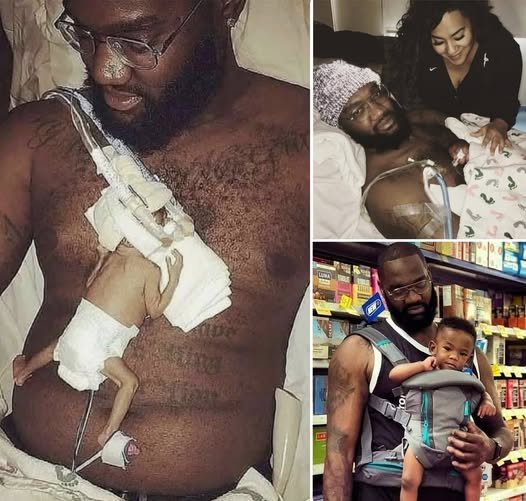
At first, all you notice is the contrast. A giant of a man lies quietly in a hospital bed, his broad chest covered with medical tubes and bandages. Resting against him is a baby so impossibly small that his entire body fits comfortably in the palm of his father’s hand. His skin is almost transparent. Tiny wires connect him to machines helping him survive. He weighs little more than a bottle of water, yet somehow, in that fragile little body, beats a heart determined to keep going.
It is difficult to believe that a life this small could carry so much strength.
Like every expectant parent, this father had imagined a very different first meeting with his son. He imagined holding a healthy newborn wrapped in a warm blanket, hearing that first powerful cry, introducing him to family, and taking him home within days. Instead, he found himself standing in a Neonatal Intensive Care Unit surrounded by ventilators, incubators, alarms, and doctors who spoke in careful, measured words. His son had arrived nearly four months too early—born at just 24 weeks of pregnancy, sixteen weeks before anyone expected. At that stage, many babies are still developing inside the safety of the womb. Their lungs are unfinished. Their immune systems remain fragile. Even maintaining body temperature becomes an enormous challenge.
For premature babies born this early, survival is never guaranteed.

Modern medicine has transformed what is possible, but even the most advanced technology cannot replace everything nature intended those final months of pregnancy to accomplish. Every hour becomes a milestone. Every breath becomes a victory. Parents quickly learn to celebrate things most people never even notice—a tiny increase in weight, slightly stronger lungs, one less machine providing support. Progress is measured not in weeks, but sometimes in grams.
Then came a moment no monitor, ventilator, or incubator could ever provide.
The nurses gently lifted the tiny infant from his hospital bed and placed him directly against his father’s bare chest.
Doctors call it kangaroo care.
The concept is beautifully simple. A premature baby is placed skin-to-skin against a parent, allowing body heat, breathing, and heartbeat to provide comfort and stability that even sophisticated medical equipment cannot fully replicate. Decades of research have shown that this simple act can regulate a baby’s heart rate, improve oxygen levels, stabilize body temperature, reduce stress, encourage weight gain, improve sleep, strengthen the immune system, and even increase survival rates.
To anyone watching, it may have looked like nothing extraordinary was happening.
A father was simply holding his son.
But inside that tiny body, remarkable things were taking place.
For the first time since entering the frightening world outside the womb, the baby heard a sound that had surrounded him every day of his short existence.
His father’s heartbeat.
Long before babies recognize faces, they recognize rhythm. Before they understand voices, they know the steady pulse of the people who love them. That familiar heartbeat becomes one of the earliest sounds every human being ever hears. Against his father’s chest, surrounded by warmth instead of plastic walls, the little boy found something no machine could manufacture.
He found safety.
Perhaps that is why this photograph has touched millions of people around the world.
It isn’t simply the image of a premature baby.
It is the image of a father becoming the safest place his child has ever known.
When people think about strength, they often picture muscles, size, or physical power. This father certainly appears strong. His shoulders are broad, his arms covered in tattoos, his hands large enough to cradle his entire son. But the greatest strength captured in this photograph isn’t found in his appearance.
It is found in his stillness.
For hours at a time, parents practicing kangaroo care remain almost perfectly motionless, afraid that even the smallest unnecessary movement might disturb their fragile baby. They learn patience unlike anything they have ever known. They whisper softly. They breathe carefully. They sit through fear while hoping their child can somehow feel only love.
Real strength isn’t always loud.
Sometimes it looks like staying perfectly still because someone much smaller needs you.
Days inside the NICU have a way of changing people. Parents stop measuring life by calendars and begin measuring it by tiny victories. A successful feeding becomes a celebration. A tube removed feels like winning a championship. One uninterrupted night of breathing without complications becomes a reason to cry tears of relief.
Hope becomes something much smaller—and somehow much stronger.
This father couldn’t breathe for his son.
He couldn’t make his lungs mature faster.
He couldn’t remove the uncertainty that filled every day.
But he could give his child the one thing no doctor could prescribe.
His presence.
And sometimes, presence is powerful enough to carry someone through the darkest moments of their life.
Weeks slowly turned into months. The baby who once seemed impossibly fragile continued doing what fighters do best. His lungs grew stronger. His body gained weight. The tubes gradually disappeared. Machines that once seemed essential became unnecessary one by one. Nurses smiled more often. Doctors spoke with growing confidence. Every new day brought another reason to believe.
Then, one day, the impossible became reality.
He went home.
The little boy who had once fit inside one hand eventually became a smiling baby sitting comfortably in a carrier strapped across his father’s chest. Looking at the later photographs, it’s almost impossible to believe they show the same child. His cheeks are full. His eyes sparkle with curiosity. His tiny fingers now wrap tightly around the man whose heartbeat carried him through the most fragile days of his life.
The contrast is extraordinary.
Yet perhaps the greatest miracle isn’t how much the baby changed.
It’s that his father never did.
From the very first terrifying moment until the day his son became strong enough to explore the world, he remained exactly where every child hopes to find a parent—close enough to feel their heartbeat.
Stories like this remind us that medicine and love are never separate forces. Doctors save lives with knowledge. Nurses save lives with skill. Technology saves lives with innovation. But parents save lives in quieter ways that science is still learning to understand. A gentle touch. A familiar voice. A steady heartbeat. A promise made without speaking a single word.
I’m here.
You’re safe.
Keep fighting.
As adults, we often underestimate the power of human connection. We forget that before we ever learned language, we learned comfort. Before we understood words, we understood warmth. Before we recognized faces, we recognized the rhythm of another person’s heart.
Perhaps that is why skin-to-skin care feels so extraordinary.
It speaks the very first language every human being has ever known.
Love.
Not spoken.
Simply felt.
Today, that once-fragile baby continues growing, discovering the world one milestone at a time. Few people who meet him would ever guess how uncertain his beginning truly was. They won’t see the endless nights in the NICU, the anxious prayers, or the countless moments his parents wondered what tomorrow might bring.
What they will see is a happy child.
What they may never realize is that one of the greatest gifts he ever received wasn’t a machine or a medicine.
It was a father’s heartbeat.
Looking back at this unforgettable photograph, it’s easy to focus on the size difference between the two.
A giant man.
A tiny baby.
But perhaps that’s not what the picture is really about.
It’s about a love so powerful that it became a lifeline.
It’s about a father who discovered that sometimes protecting your child doesn’t require extraordinary strength.
It only requires showing up, staying close, and refusing to let them fight alone.
Because in the end, the safest place in the world isn’t always inside four hospital walls.
Sometimes, the strongest incubator isn’t made of glass.
Sometimes, the greatest medicine isn’t found in a bottle.
Sometimes, healing begins with something every child recognizes long before they ever open their eyes…
The steady, reassuring heartbeat of a father who will never stop being home.