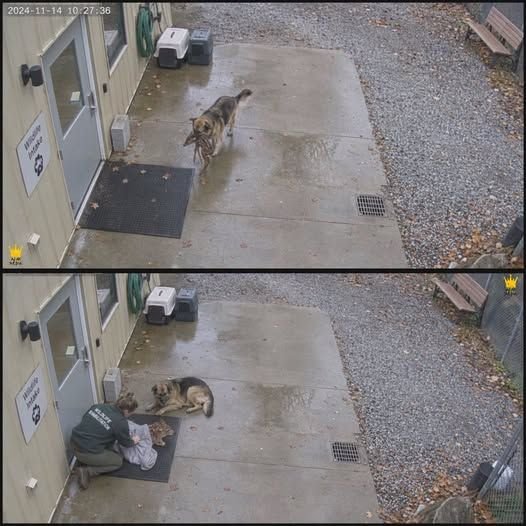
For nearly an hour, the staff at a wildlife clinic kept hearing a strange sound coming from outside the building. It was not loud, but it was persistent. A faint bark from somewhere near the back entrance, followed by moments of silence, then another bark again. At first, nobody thought too much about it. The clinic was used to unexpected visitors. Injured birds, abandoned animals, frightened wildlife, and creatures needing emergency help were all part of their daily routine. A stray dog wandering around the property was not unusual enough to immediately cause concern. But something about this dog was different. He was not simply passing by. He was staying. He kept returning to the same spot, almost as if he was trying to tell someone inside that something important was happening.
Eventually, one staff member decided she needed to find out what was causing the repeated barking. She walked outside toward the back of the building, expecting to find a lonely dog looking for food or shelter. Instead, she found a scene that she would never forget. Standing near the clinic door was a stray German shepherd, tired and covered in signs of a difficult life on the streets. But what caught her attention was not the dog himself. It was what was lying beside him.
A tiny deer fawn was resting on the ground.
The baby deer looked weak, exhausted, and vulnerable. It appeared dehydrated and had likely been without proper care for some time. But the most surprising part of the scene was the dog’s behavior. The German shepherd was not chasing the fawn. He was not treating it like prey. He was standing beside it, watching over it, almost as if he had taken responsibility for protecting a life that was not his own.
The staff member immediately understood that the fawn needed help. She carefully brought the baby deer inside, and the veterinary team began working quickly. They provided fluids, vitamins, and emergency care to stabilize the fragile animal. Everyone knew that young wildlife can be incredibly vulnerable, especially when separated from their mothers. A fawn that is weak and dehydrated may not survive without immediate attention.
But while the medical team focused on saving the deer, another remarkable thing was happening outside.
The dog waited.
He did not run away after delivering the fawn.
He did not disappear back into the woods.
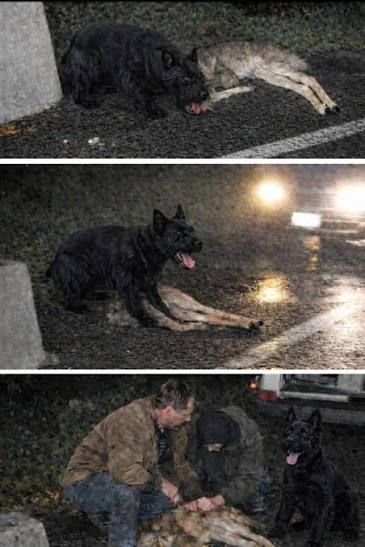
He remained near the clinic door, watching and waiting for the creature he had brought there.
Hours passed, but the German shepherd stayed exactly where he was. The staff members began to realize that this was not just a coincidence. Somehow, this stray dog had discovered a helpless baby deer, protected it, and brought it to the one place where humans could provide help.
The dog had no way of knowing what a wildlife clinic was. He did not understand medicine or emergency treatment. He did not know that people inside the building could save the fawn’s life. But he seemed to understand one simple thing: the small animal beside him needed someone.
And he refused to leave.
The more the staff observed the dog, the more they realized that he had his own story of survival. He was not a well-cared-for pet arriving with a family searching for him. There was no collar, no owner waiting nearby, and no comfortable home where he could return. He was a stray who had likely spent a long time trying to survive on his own.
He knew what it meant to be hungry.
He knew what it meant to be alone.
He knew what it meant to have nobody looking after him.
Perhaps that was why his actions were so powerful. Instead of ignoring another vulnerable creature, he recognized something familiar. He saw an animal that was scared and in need, and he stayed beside it.
Animals cannot explain their emotions the way humans do. They cannot tell us why they make certain choices. But sometimes their actions communicate more clearly than words ever could.
This dog’s message was simple.
Help this little one.
That was all that mattered.
As the hours passed, the clinic staff began caring for the dog as well. One employee brought him food and spent time sitting beside him. Slowly, the nervous stray began to relax. The dog who had arrived as an unknown animal outside the building started showing his true personality.
He was gentle.
He was calm.
He trusted the people who had helped the fawn.
And the staff soon realized something that touched everyone deeply.
The dog who had saved another life needed someone to save him too.
Behind his brave actions was an animal who had likely experienced hardship, uncertainty, and loneliness. He had spent his life looking for safety, but when given the chance to help another creature, he placed that creature’s needs before his own.
That kind of compassion made the decision almost impossible to avoid.
The dog would not return to the streets.
The same place where he delivered the fawn became the place where his own life changed forever.
He came there as a stray.
He left with a family.
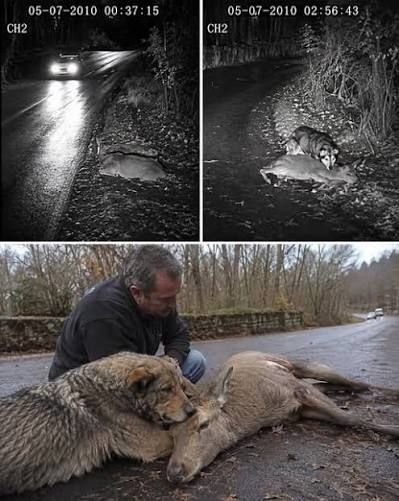
The story of this German shepherd became so powerful because it challenged the way people often think about animals. We usually describe animals by their roles. Dogs are loyal companions. Deer are gentle creatures. Wild animals are unpredictable. But sometimes animals show qualities that cannot be easily explained.
They show patience.
They show empathy.
They show a willingness to protect something smaller and weaker than themselves.
This dog was not trained as a rescue animal. Nobody taught him how to find injured wildlife. Nobody instructed him to bring the fawn to a place where humans could help.
He simply made a choice.
A choice to stay.
A choice to protect.
A choice to care.
And that choice saved a life.
The baby deer’s survival was a miracle of timing. Without the dog’s intervention, the fawn may never have reached the clinic. It may have remained alone and vulnerable, with no way to receive the treatment it needed.
But because one stray dog refused to walk away, the fawn had a chance.
And because the clinic staff recognized the heart behind the dog’s actions, he received something he had probably wanted for a long time.
A safe place.
A warm meal.
A family.
A home.
It was a rare kind of story where everyone involved received a second chance.
The deer was rescued from danger.
The dog was rescued from loneliness.
Stories like this remind people that kindness is not limited to humans. The natural world is full of moments that reveal unexpected connections. Animals may not communicate through words, but they communicate through actions.
A mother protecting her young.
A dog comforting someone who is sad.
A wild animal showing trust.
A stray dog standing beside a helpless fawn until help arrived.
These moments remind us that compassion is not always something that must be taught.
Sometimes it is simply part of who a creature is.
The German shepherd could have ignored the deer.
He could have continued searching for food.
He could have walked away and left the fawn behind.
Nobody would have blamed him.
He was a stray trying to survive his own challenges.
But instead, he stopped.
He noticed another life in danger.
And he decided that another creature mattered.
That decision changed everything.
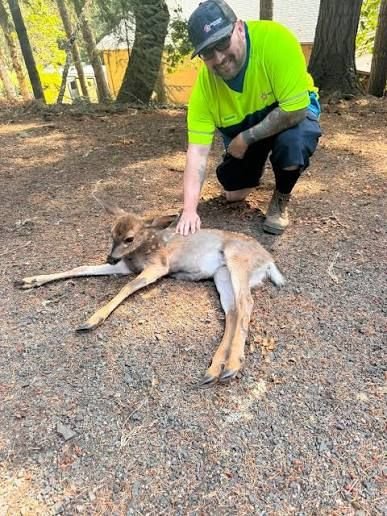
The dog who had no home became the hero of a story that touched people around the world. The little deer who might not have survived received the care it needed. And the humans who witnessed it were reminded that some of the greatest acts of kindness come from the most unexpected places.
In the end, the story was never only about a dog saving a deer.
It was about two vulnerable creatures finding hope at the exact moment they needed it most.
A fawn needed someone strong enough to protect it.
A stray dog needed someone kind enough to protect him.
And somehow, they found each other.
The dog arrived at the clinic carrying a life that needed saving.
But by the time the day ended, everyone understood the truth.
He was not just the rescuer.
He was also waiting to be rescued.
And that night, the dog who gave a second chance finally received one of his own.