Have you ever wondered why you instantly gravitate toward a certain answer in a simple visual puzzle? That split-second decision can be surprisingly telling. When you’re asked to find the “odd one out,” your brain quickly applies its favorite filters, ignoring some features and highlighting others based on your natural thinking habits. This process is automatic, making these puzzles a neat tool for self-reflection. They show us the quiet preferences of our own minds in a clear, immediate way.
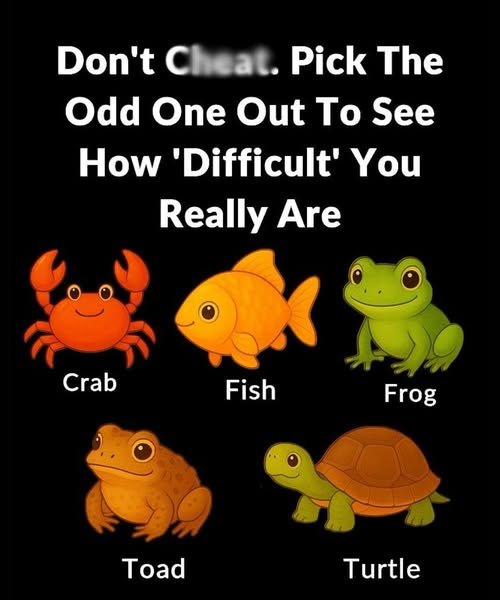
Let’s try it. Look at these five animals: a crab, a fish, a frog, a toad, and a turtle. Which one seems different? Trust your first instinct. There’s no single correct solution. In fact, each selection is defensible with solid reasoning. Your pick is a clue to your default cognitive approach—the way you tend to make sense of information when you’re not trying to impress anyone or follow a rulebook.
Did you pick the crab? Your mind likely prioritizes physical form and architectural difference. The crab’s rounded body with claws and legs stands in contrast to the smoother, more fluid shapes of the others. This suggests you have a strong sense of order and design. You probably approach challenges by looking for breaks in patterns and appreciate clear, structured solutions. In daily life, you might be the person who brings clarity and straightforward logic to confusing situations.
Maybe you chose the fish. This points to a thinking style centered on habitat and context. For you, the key difference is that the fish lives entirely in water, while the others operate in both land and water environments to varying degrees. You are likely a big-picture thinker. You instinctively consider the surroundings, the rules of the environment, and how things relate to each other within a system. This makes you adept at strategic planning and understanding complex cause-and-effect relationships.
If the frog stood out, you might be wired to notice processes of change. The frog’s dramatic metamorphosis from water-bound tadpole to land-capable adult is a powerful narrative of transformation. This choice suggests you think in terms of growth, stages, and potential. You are likely attentive to personal and emotional development, both in yourself and others. Your thinking style is dynamic and forward-looking, often focused on how things evolve rather than just how they are in a single moment.
Selecting the toad indicates a powerful strength in discerning fine details. You looked past the superficial similarity between the frog and the toad and identified subtle distinguishing traits. This means you have a meticulous, detail-oriented mind. You excel at comparative analysis and are rarely fooled by surface appearances. In work and conversation, you are the one who catches the nuances and deeper layers that others might miss, providing valuable depth and accuracy.
Perhaps the turtle was your answer. This suggests you think in well-defined categories and factual classifications. The turtle is biologically distinct as a reptile and carries a unique shell. Your mind naturally seeks clear definitions and organized systems of knowledge. You value precision, research, and understanding how things fit into a larger framework of information. You are likely a steady, reliable thinker who builds understanding step by step on a foundation of solid facts.
In the end, this exercise celebrates the variety of human thought. We all process the same information through different internal lenses. Your intuitive choice in a simple puzzle highlights a natural cognitive strength, a preferred way of navigating complexity. Recognizing this can help you play to your strengths and better understand the perspectives of those who chose differently. It’s a small reminder that there are many valid ways to see the world, and your unique way of thinking is something to be valued.